Technical Textiles Set to Drive Innovation Across Automotive, Healthcare and Infrastructure Industries
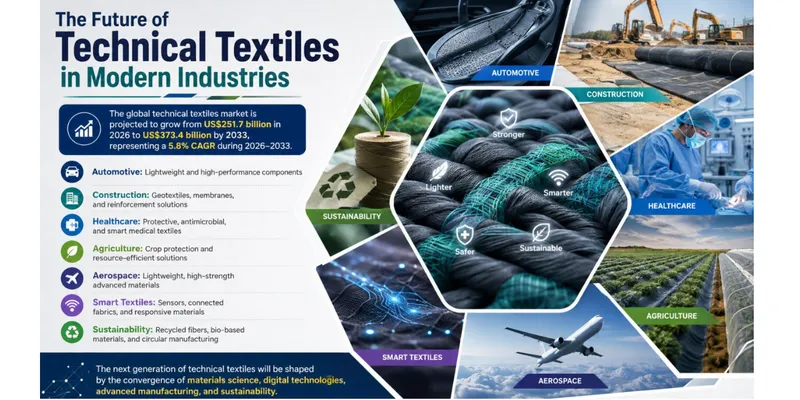
Global market projected to reach US$373.4 billion by 2033 as demand grows for high-performance, sustainable textile solutions
Technical textiles are playing an increasingly important role across modern industries by providing engineered materials designed for performance, durability, safety and efficiency. Unlike conventional textiles, these products are developed to deliver specific functional properties such as heat resistance, filtration, insulation, water repellency and protection.
According to a recent study by Persistence Market Research, the global technical textiles market is expected to be valued at US$251.7 billion in 2026 and grow to US$373.4 billion by 2033, registering a CAGR of 5.8% between 2026 and 2033.
Market growth driven by industrial demand
The increasing use of technical textiles is being supported by infrastructure development, technological advancements, demand for lightweight materials and growing focus on safety and environmental performance.
As industries continue to seek materials capable of performing in demanding environments, technical textiles are expanding their presence across automotive, construction, healthcare, agriculture, aerospace, energy and infrastructure applications.
Automotive sector expands use of technical textiles
The automotive industry is adopting technical textiles for components including:
- Airbags
- Seat belts
- Interior components
- Filtration systems
- Insulation materials
- Reinforcement structures
Lightweight textile-based materials help reduce vehicle weight while maintaining strength and safety standards.
The shift towards electric vehicles is also expected to create opportunities in battery protection, thermal management, acoustic insulation and lightweight interior solutions.
Construction and infrastructure applications increase
Technical textiles are becoming widely used in construction through products such as:
- Geotextiles
- Architectural fabrics
- Waterproof membranes
- Reinforcement materials
Geotextiles support soil stabilisation, erosion control, drainage and separation. Continued investment in roads, bridges, tunnels and urban infrastructure is expected to support demand for these materials.
Healthcare applications continue to expand
Healthcare remains an important application area for technical textiles.
Current uses include:
- Surgical gowns
- Face masks
- Wound-care products
- Medical filtration materials
- Implants
Future developments may include smart textiles incorporating sensors, responsive materials and embedded technologies to support connected and personalised healthcare applications.
Agricultural textiles improve resource efficiency
Technical textiles are helping improve agricultural productivity through products such as:
- Crop covers
- Shade nets
- Greenhouse fabrics
- Irrigation-related textiles
- Protective agricultural materials
These solutions assist in managing temperature, moisture, pests and environmental conditions while supporting more efficient use of resources.
Aerospace and defence require high-performance materials
The aerospace and defence industries continue to adopt advanced fibres and textile composites that combine low weight with high strength and resistance to demanding operating conditions.
Future developments are expected to focus on materials capable of withstanding heat, impact and pressure while supporting lightweight designs.
Sustainability remains a key focus
Environmental considerations are influencing the next generation of technical textiles.
Areas of development include:
- Recycled and bio-based fibres
- Lower-impact manufacturing processes
- Longer-lasting products
- Textile recycling and material recovery
- Reduced water and energy consumption
- Lightweight materials that improve resource efficiency
The environmental benefits of technical textiles also extend to applications that improve fuel efficiency in transportation or reduce energy consumption in buildings.
Smart textiles and digital technologies
The integration of textiles with electronics and sensors is expanding the capabilities of technical fabrics.
Potential applications include:
- Wearable health monitoring
- Protective clothing
- Sports equipment
- Industrial safety solutions
- Connected infrastructure
Advances in sensor technology are expected to make it increasingly practical to integrate monitoring functions such as temperature, pressure, movement and moisture into textile structures.
Manufacturing technologies support innovation
Advances in manufacturing are enabling increasingly sophisticated technical textile products.
Technologies supporting this development include:
- Automation
- Digital design
- Advanced weaving and knitting
- Nonwoven production
- Coating technologies
- Composite manufacturing
These manufacturing methods help improve product consistency, reduce material waste and enable customised production for specialised applications.
Industry faces ongoing challenges
Despite positive market prospects, several challenges remain.
The sector continues to face:
- High development and manufacturing costs
- Investment requirements for specialised production
- Complex recycling of multi-material textile products
- Standards and certification requirements
- Supply chain resilience
- Need for skilled professionals across engineering, materials science and manufacturing
Future outlook
The future of technical textiles is expected to be shaped by advances in materials science, engineering, digital technologies and sustainability.
Applications are expected to continue expanding across automotive, healthcare, infrastructure, agriculture and aerospace as industries seek lighter, safer, more durable and environmentally responsible materials.
With the global market projected to increase from US$251.7 billion in 2026 to US$373.4 billion by 2033, technical textiles are positioned for continued innovation and investment across multiple industrial sectors.