Tandhan Denim on sustainable manufacturing, innovation and the future of Indian denim
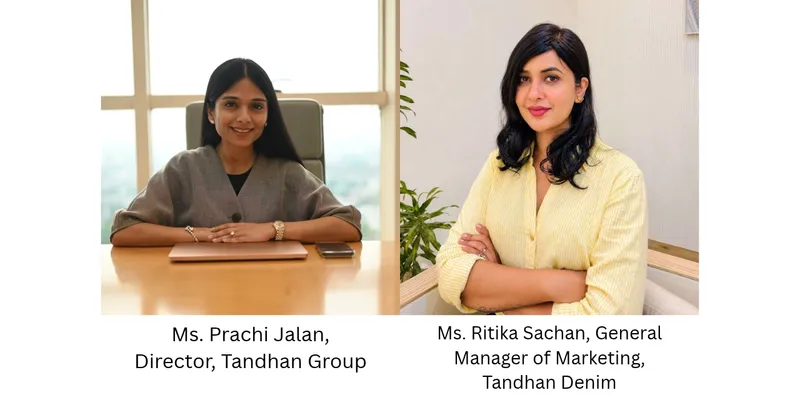
An Exclusive Conversation with , Ms. Prachi Jalan, Director, Tandhan Group; and Ms. Ritika Sachan, General Manager of Marketing, Tandhan Denim
1. You are both associated with different roles within the Tandhan Group. How would you describe the Group’s vision and leadership philosophy, and what has been your biggest learning while working in the textile and manufacturing industry?
Ms. Prachi Jalan:
At Tandhan Group, we believe in combining an entrepreneurial mindset with disciplined execution and a long-term vision. For us, growth is not just about scalability; it is equally about innovation, adaptability and consistency in everything we do.
The textile industry is particularly process-driven, where every stage requires precision to ensure that the final product meets the desired standards. My biggest learning has been that building trust is just as important as building capabilities and productivity. Ultimately, it is about consistently delivering on your commitments and creating long-term relationships.
Ms. Ritika Sachan:
I believe relevance is one of the most important factors for any business today. It is about understanding what customers need, recognising their challenges and developing products that address those requirements.
Price will always remain a consideration, but what truly differentiates a manufacturer is the ability to offer relevant solutions, maintain consistent quality and build sustainable customer relationships. At Tandhan, sustainability is also central to the way we approach business.
2. Denim is one of the most competitive segments of the global textile industry. What do you believe makes a denim manufacturer stand out today beyond price, production capacity and product quality?
Ms. Ritika Sachan:
I would say customer relevance, collaboration and consistency are the biggest differentiators today.
A manufacturer needs to understand the evolving requirements of its customers and develop products that are aligned with their business needs. It is not simply about manufacturing fabric; it is about understanding what the customer is looking for and finding ways to deliver the best possible solution.
Consistency is equally important. Customers expect the same level of quality and reliability with every order. When you combine that with innovation, sustainability and strong customer relationships, you create a business that stands out in a competitive market.
3. As a woman working in the manufacturing and industrial business ecosystem, what challenges have shaped your professional journey, and how do you see women’s leadership evolving in India’s textile sector?
Ms. Ritika Sachan:
It is interesting because women are present across the entire textile value chain, from fibre and fabric to the final consumer. In fact, women are among the largest consumers of fashion and textile products. However, when we look at leadership positions, particularly in textile and parallel manufacturing, the representation of women is still relatively limited.
In my 15 years of professional experience, I have sometimes found myself in rooms full of senior industry professionals where there were very few women. That has made me reflect on the importance of women stepping forward and recognising their own potential.
I believe the challenge is not always about the availability of opportunities; it is also about having the confidence to take those opportunities.
Ms. Prachi Jalan:
I completely agree. I believe women should recognise their own capabilities and not underestimate their decision-making abilities.
Whether as professionals, mothers, daughters or homemakers, women make important decisions every day. These are skills that are equally valuable in a manufacturing environment, where judgement, knowledge and the ability to take responsibility are essential.
With increasing mentorship opportunities, initiatives encouraging women to return to the workforce and greater industry participation, I believe we will see more women taking leadership positions in India's manufacturing and textile sectors.
4. The journey from fibre to finished denim involves several complex processes, including spinning, rope dyeing, weaving and finishing. Which stages have the greatest influence on the final fabric’s quality and performance?
Ms. Prachi Jalan:
I believe every stage is equally important because the final fabric is the result of several interconnected processes. However, rope dyeing is particularly significant because it has a considerable influence on the character and quality of denim.
When we started our denim manufacturing journey, one of our major decisions was to invest in rope dyeing technology rather than opt for a comparatively less expensive alternative. The investment was significantly higher, but we chose technology because we believed it would help us achieve better consistency and quality.
Ms. Ritika Sachan:
I would add that the process begins much earlier, with the selection of fibres and yarn development. The type of fibre, yarn thickness, slub characteristics and other specifications determine the eventual character of the fabric.
The dyeing process is particularly important in denim because indigo gives denim its distinctive identity. At Tandhan, we use liquid indigo and advanced machinery to achieve the desired results.
Weaving, finishing and the final washing process also influence the fabric's appearance, texture, hand feel and performance.
At our sampling and product development facilities, we undertake research, develop samples and visualise how the finished garment will look. This helps us understand how each manufacturing decision will influence the final product. Ultimately, quality has to be monitored at every stage.
5. Consumers today expect denim to be fashionable, durable, comfortable and versatile. How is the industry balancing these expectations while developing the next generation of denim fabrics?
Ms. Ritika Sachan:
Denim has undergone a significant transformation over the years. Historically, it began as a highly durable fabric, particularly for miners, where longevity and strength were its primary selling points.
However, consumer behaviour has changed considerably. With the influence of fast fashion and e-commerce, denim has evolved into a mainstream fashion product rather than remaining limited to occasional wear.
Today, people wear denim to offices, social gatherings and everyday occasions. Consumers have multiple options in terms of fits, washes, colours and silhouettes.
Therefore, the industry is no longer focusing only on durability. Fashion, versatility, comfort and adaptability have become equally important.
Manufacturers need to continuously understand changing preferences and develop fabrics that allow brands to cater to different consumer segments and fashion requirements.
6. Denim manufacturing has traditionally been associated with high water consumption and chemical usage. How can manufacturers move towards more responsible production without compromising fabric quality or commercial viability?
Ms. Prachi Jalan:
Responsible manufacturing needs to be considered an integral part of the business rather than an additional investment.
At Tandhan, we believe sustainability should be embedded into the manufacturing process from the beginning. Our approach is to invest in the right infrastructure and technology so that responsible production becomes a natural part of our operations.
Water management is particularly important in textile manufacturing. At our facility, we have invested in effluent treatment and water recycling infrastructure to minimise wastage and ensure that water is reused within our processes.
We believe that environmental responsibility and commercial growth should go hand in hand. Manufacturers need to take a long-term view rather than evaluate sustainability only in terms of its immediate financial implications.
7. Zero Liquid Discharge (ZLD) is increasingly discussed as an important step towards sustainable textile manufacturing. What does implementing ZLD mean in practical terms, and what challenges do manufacturers face in making it commercially sustainable?
Ms. Prachi Jalan:
For us, Zero Liquid Discharge represents a commitment to responsible manufacturing. It means treating wastewater generated during manufacturing, recovering and reusing water, and ensuring that untreated liquid waste is not released into the surrounding environment.
At Tandhan, we have invested in an effluent treatment and water recycling system that enables us to process and reuse water within our operations. We recycle approximately one million litres of water every day, and this infrastructure is an important part of our manufacturing ecosystem.
One of the challenges in establishing such infrastructure is the investment involved, particularly in regions where common effluent treatment facilities are not readily available.
When we established our manufacturing facility in Eastern India, the absence of an established common treatment ecosystem was one of the considerations. We decided to invest in the necessary infrastructure ourselves.
We do not look at this as an additional cost or a regulatory compulsion. It is a necessity for building a globally competitive manufacturing business and ensuring that industrial development remains environmentally responsible.
8. Global fashion brands are becoming increasingly conscious of their supply chains. How are sustainability standards, environmental compliance and buyer expectations influencing the way Indian denim manufacturers operate?
Ms. Ritika Sachan:
Sustainability is increasingly becoming an important part of the global textile supply chain. Manufacturers today need to look beyond the product itself and consider how responsibly it is being manufactured.
For us, sustainability is not a separate conversation or an additional activity. It is part of Tandhan's overall business vision.
Global competitiveness requires manufacturers to be conscious of their processes, maintain consistency and understand the changing expectations of customers.
We believe that investing in responsible manufacturing practices and building long-term relationships with buyers will be essential for Indian manufacturers looking to strengthen their position in the global market.
9. Global brands such as Levi’s and GAP have built strong identities around denim. In your opinion, what does it take for an Indian denim brand or manufacturer to build a distinctive identity and achieve similar global recognition?
Ms. Prachi Jalan:
I think there is an important distinction between a denim brand and a denim fabric manufacturer. Brands such as Levi's and GAP are recognised by consumers, but the fabric that goes into their products is manufactured by textile companies like ours.
We are part of the value chain that enables these brands to create their products. Our contribution is in the fabric, technology and manufacturing capabilities behind the finished garment.
Ms. Ritika Sachan:
India already has a strong textile manufacturing ecosystem and the capabilities to produce fabrics for some of the world's leading fashion brands.
I believe the opportunity for Indian brands lies in building stronger consumer acceptance and creating distinctive brand identities.
Interestingly, some of the world's largest apparel brands depend on manufacturing ecosystems across India, China, Bangladesh, Vietnam and other Asian markets.
India has a substantial domestic consumer base and a strong manufacturing foundation. The next step is to leverage these strengths to build greater international recognition for Indian brands.
10. From classic straight-fit jeans to skinny, bootcut, baggy and wide-leg silhouettes, denim trends keep evolving. How closely does a denim manufacturer need to follow fashion trends, and how does the marketing team translate changing consumer preferences into product and brand communication?
Ms. Ritika Sachan:
Denim is now a highly fashion-driven category, and manufacturers need to remain closely connected to changing consumer preferences.
We see different fits, washes, colours and silhouettes gaining popularity at different times. Consumer preferences are also influenced by e-commerce, social media and the changing fashion choices of younger generations.
For a manufacturer, understanding these trends is important because the fabric needs to support the garment styles that brands are developing.
At Tandhan, we focus on understanding what our customers require, identifying emerging trends and working closely with our product development teams to develop relevant fabrics.
Marketing, in this context, is not just about communicating an existing product. It is also about understanding the market today and anticipating what customers may need tomorrow.
11. In a crowded denim market, what marketing strategies are most effective for communicating a fabric’s quality, innovation and sustainability credentials to fashion brands, garment manufacturers and buyers?
Ms. Ritika Sachan:
The denim market is extremely competitive and dynamic. Raw material prices fluctuate, global developments influence business decisions, and customer expectations continue to evolve.
In such an environment, relationship-building becomes extremely important.
For us, marketing is closely connected with customer engagement. We regularly interact with our customers to understand their requirements, introduce new product developments and identify opportunities for collaboration.
Timely delivery, consistent quality and reliability are equally important. In the textile industry, timing matters significantly because the fashion and retail cycles move quickly.
We also work closely with our product development teams to understand emerging market requirements and develop fabrics that are relevant to future demand.
Ultimately, effective B2B marketing is about combining product innovation with strong relationships and the ability to deliver consistently.
12. How important are digital platforms, social media, trade fairs and direct industry engagement in building brand visibility and trust for a B2B denim business?
Ms. Prachi Jalan:
All these platforms are extremely relevant because a business needs to establish its presence wherever its target audience is engaging.
Digital platforms allow us to reach a much wider audience than traditional marketing channels alone. The more visible a brand is, the greater the opportunity for people to recognise, recall and engage with it.
At Tandhan, we are continuously working towards strengthening our digital footprint and establishing our presence across relevant platforms.
Ms. Ritika Sachan:
Digital visibility and physical industry engagement complement each other. While digital platforms help us reach a wider audience, exhibitions, trade fairs and direct customer interactions allow us to build stronger business relationships.
Our vision is to strengthen our presence across international markets, from South America to Japan.
For a B2B business, being visible, accessible and actively engaged with the industry is essential to building credibility and long-term trust.
13. If you could bring back one denim trend from the 1990s and make it popular among Gen Z today, which one would you choose—and why?
Ms. Prachi Jalan:
I would definitely bring back straight-fit denim.
I feel it is one of the most versatile silhouettes and works well across different body types. While fashion trends keep changing, straight-fit denim has a timeless appeal and can be styled for different occasions.
Today, we see a lot of interest in cargo styles, baggy fits and wide-leg silhouettes, but I believe a classic straight fit deserves to make a strong comeback.
Ms. Ritika Sachan:
I completely agree. Straight-fit denim is something I personally look for as well.
There is a certain timeless quality to the straight-fit silhouettes of the 1990s that we seem to be missing in today's market. I would love to see Gen Z rediscover that classic fit.
14. Kolkata and Eastern India have significant potential in the textile and manufacturing ecosystem. How do you see this region contributing to India’s ambition of becoming a stronger global textile sourcing destination?
Ms. Prachi Jalan:
Eastern India, particularly Bengal, has historically had a strong connection with the textile industry. The region has a significant manufacturing legacy, and I believe it has tremendous potential to emerge as an important textile manufacturing destination.
At Tandhan, we are proud to be contributing to this development. Our manufacturing facility produces approximately 21 million metres of fabric annually, and we are continuously looking at expanding our capabilities.
Eastern India's geographical proximity to the Northeast, Bangladesh and other South Asian markets provides a strategic advantage.
There is also growing investment in textile infrastructure, including textile parks and integrated manufacturing facilities. With further development of spinning and other supporting processes, the region can become a stronger textile manufacturing hub.
Ms. Ritika Sachan:
I would also highlight the availability of a skilled workforce. A significant number of workers in India's existing textile and apparel manufacturing ecosystems come from Eastern states such as West Bengal, Odisha and Bihar.
If manufacturing opportunities expand in Eastern India, it could encourage more people to work closer to their hometowns and families.
This would not only strengthen the regional economy but also contribute to a more integrated textile and apparel manufacturing ecosystem in the country.
15. With Bangladesh being an important apparel manufacturing hub, what opportunities exist for Indian denim manufacturers to strengthen their position in the regional and international supply chain?
Ms. Ritika Sachan:
I believe there is considerable potential for collaboration between Indian textile manufacturers and Bangladesh's apparel manufacturing industry.
At Tandhan, our geographical proximity to Bangladesh gives us an important business advantage. We already have a presence in Dhaka, with an office and showroom, and we manufacture and supply denim fabric to apparel manufacturers in the country.
Our customers in Bangladesh value our fabric quality and the relationships we have built with them. I believe the relationship between Indian textile manufacturers and Bangladeshi apparel manufacturers should go beyond a conventional demand-and-supply arrangement.
It should be built around collaboration, long-term partnerships and a better understanding of each other's requirements. Such partnerships can help strengthen the regional supply chain and create opportunities for both markets.
16. The textile industry is facing challenges such as fluctuating raw material prices, global competition, changing consumer demand and geopolitical uncertainties. Which of these concerns you most, and how should Indian manufacturers prepare?
Ms. Ritika Sachan:
The textile industry is extremely dynamic. We see fluctuations in prices, changes in global markets and new developments that can influence business decisions almost every day. I would say the biggest challenge is the constantly changing business environment and the need to remain relevant despite these uncertainties.
Manufacturers need to become more adaptable and maintain strong relationships with their customers. They must understand market requirements, respond quickly to changes and ensure that quality and delivery commitments are never compromised.
At Tandhan, we focus on understanding customer requirements, continuously developing new products and working closely with our product development teams to anticipate future demand. I believe the ability to adapt while maintaining consistency will be a major differentiator for Indian manufacturers.
17. Apart from business responsibilities, Ms. Prachi, you are also a Trustee at Tandhan Foundation. How can businesses create meaningful social impact while maintaining commercial growth, and what role should the manufacturing industry play in community development?
Ms. Prachi Jalan:
I believe social development should happen at every stage of life. At Tandhan Foundation, our approach is not to look at social responsibility merely as a CSR obligation. We undertake initiatives because we genuinely believe that contributing to society is an important responsibility.
We are particularly focused on developing the communities around our manufacturing facilities in Bengaluru and Habra.
One of our key priorities is working with the younger generation. We believe that meaningful social change begins at the grassroots level, and building confidence, skills and opportunities among young people can create a lasting impact.
The manufacturing industry has a unique advantage because it can contribute not only through financial support but also by creating employment and developing skills.
At Tandhan, we focus on developing our own workforce and helping employees enhance their technical, communication and other professional skills. We also undertake initiatives such as health check-ups and support for basic healthcare needs within the surrounding communities.
I believe businesses should look at the people around their facilities as part of their larger community. When we invest in their development, we contribute to the growth of the entire ecosystem.
18. Looking ahead to 2030, how do you envision the future of India’s denim and fashion manufacturing industry? What is one major transformation that manufacturers must embrace today to remain globally competitive?
Ms. Ritika Sachan:
I believe the future of India's denim and fashion manufacturing industry is extremely promising.
By 2030, the denim market in India is expected to witness significant growth. What is particularly encouraging is that this growth will not be limited to manufacturing alone. Consumption patterns are also evolving.
Smaller cities and towns are increasingly becoming important consumption markets. The expansion of organised retail, the growth of e-commerce, wider internet penetration and digital payment platforms are making fashion more accessible to consumers across the country.
As consumer demand expands, the manufacturing ecosystem will also need to grow and evolve.
Ms. Prachi Jalan:
I believe Eastern India will play an increasingly important role in this transformation. At Tandhan, we are looking at expanding our manufacturing capabilities and strengthening our integration across the textile value chain. We are also working towards adding spinning capabilities, which will further strengthen our operations and give us greater control over the quality of yarn used in production. Our long-term vision is to build a more integrated manufacturing ecosystem while expanding our presence across international markets.
Ms. Ritika Sachan:
I would add that innovation, sustainability and integration will be critical to remaining globally competitive. Manufacturers must look beyond production capacity and focus on building efficient processes, developing relevant products and establishing strong international partnerships. The future will belong to businesses that can combine manufacturing excellence with sustainability, customer collaboration and the ability to anticipate changing market requirements.
Watch the full interview with Ms. Prachi Jalan & Ms. Ritika Sachan
Interview conducted by Ritika Kanojia, Journalist, Textile Value Chain.