Tamil Nadu's Textile Vision: From Global Showcasing to Technical Innovation
-800x778.webp?2026-02-24T20:40:14.594Z)
Ms R. Lalitha
IAS, Commissioner of Textiles,
Government of Tamil Nadu
The TVC Media Team had the privilege of speaking with Ms R. Lalitha, IAS, Commissioner of Textiles, Government of Tamil Nadu, at two significant events in the textile industry. Our first conversation took place at Heimtextil 2026 in Frankfurt, where Tamil Nadu made its debut appearance with a dedicated state pavilion. Subsequently, we caught up with Ms Lalitha at the First International Textile Summit 360 organised by the Government of Tamil Nadu in collaboration with CII at Coimbatore.
These interviews offer valuable insights into Tamil Nadu's strengths in the textile industry, new policy initiatives, and the state's strategic vision for positioning itself as a global textile hub with strong ESG compliance credentials.
Heimtextil 2026, Frankfurt: Tamil Nadu's Debut on the Global Home Textiles Stage
-800x600.webp?2026-02-24T20:40:13.846Z)
Could you please share your perspective on Heimtextil 2026 and Tamil Nadu's participation in this prestigious show?
For the first time, the Government of Tamil Nadu has formed a special Tamil Nadu pavilion at Heimtextil, wherein we have brought four government departments and six exporters. Apart from that, there are nearly 90 companies from Tamil Nadu in the home textiles segment participating in this event.
Considering the importance of Heimtextil as the biggest home textile fair across the globe, we thought it would be very prudent and a timely intervention for our companies to participate here and showcase the products they produce. Our pavilion includes our Handlooms Department, which has customised their GI-tagged products into home textiles, our Women Development Corporation showcasing self-help groups' home textile products, and Co-optex, which is the marketing agency for our handlooms societies.
How would you position Tamil Nadu in India's textile landscape?
If you see Tamil Nadu in India, we can be called the textile hub of India. We have been the highest exporter of ready-made garments for five consecutive years, and we contribute 22-23% of India's textile exports from one single state. We are leaders in the textile spinning sector; we have weaving clusters—anything in the textile value chain exists in the state of Tamil Nadu.
Our approach toward Heimtextil is to position Tamil Nadu as the most ESG-compliant sourcing destination. In Tamil Nadu, we have 19 common effluent treatment plants and 1,200+ individual effluent treatment plants, wherein we enforce Zero Liquid Discharge (ZLD). We must be one of the few states in India that mandatorily enforce ZLD, thereby showing our commitment to environmental sustainability.
Nearly 7 lakh women are employed in these industries—almost 70% of the workforce deployed in the textile industry are women. This reflects our social commitment and women's empowerment initiative. Our labour laws are very strict, and we ensure adherence to international standards of ESG compliance measures.
Do you believe Tamil Nadu exporters can compete at the world standard showcased at Heimtextil?
To answer your question, we are the most relevant state to source from because we have what the EU specifically requires or mandates in terms of ESG compliance. This international forum and platform is the correct opportunity for Tamil Nadu to showcase its leadership in that area, especially when Europe mandates pollution-free, socially empowering sourcing destinations. That is where Tamil Nadu has the opportunity.
.jpg (1)-1-800x824.webp?2026-02-24T20:40:12.611Z)
What message would you like to give to those who have not attended or participated in Heimtextil 2026?
The Dept of Textiles, Tamil Nadu government, is participating for the first time, and I am attending for the first time as well. However, Cooptex (Tamil Nadu Government’s Handloom Marketing Cooperative) has been participating in the fair regularly. Seeing the scale of the Heimtextil event, it is a very big opportunity and learning curve for us. I must say that anybody who wants to export should visit this fair—either make their presence felt in the form of a pavilion or at least come as a visitor to see the grand scale.
So many halls with so many exporting companies showcasing their products—this is an unparalleled showcasing opportunity. You will be able to benchmark where you stand as leading companies across the globe showcase their products. You can learn, display what you have, and decide where you want to go. It's also a very good opportunity for networking among exhibitors. I must congratulate the team for having conducted so many events. This is our first time participating, but the scale of it is really very huge.
First International Textile Summit 360, Coimbatore: Unveiling Policy Initiatives and the Technical Textiles Roadmap
-800x533.webp?2026-02-24T20:40:09.674Z)
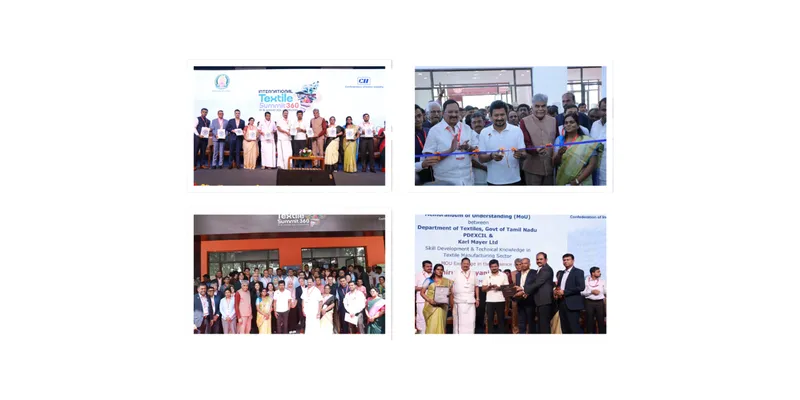
Following our conversation in Frankfurt, the TVC Media Team reconnected with Ms Lalitha at the landmark First International Textile Summit 360 held in Coimbatore on January 29-30, 2026. This historic event marked Tamil Nadu's commitment to showcasing its rich textile legacy and announcing significant policy initiatives for the sector.
Could you brief us about this conference—what is the objective and your vision for this summit?
Greetings to all the viewers. Our Honourable Minister had made an announcement on the floor of the assembly for the FY 2025-26 that we would be conducting an International expo every year. This is the first edition of that announcement, which we have organised in partnership with CII as our event organiser, at Codissia, Coimbatore.
The entire aim of this first edition is to showcase the rich Textile legacy of Tamil Nadu. We have been leaders, we are still the leaders, and we will be the future leaders—that is what we want to re-emphasise through this textile summit.
What are the key components of this summit?
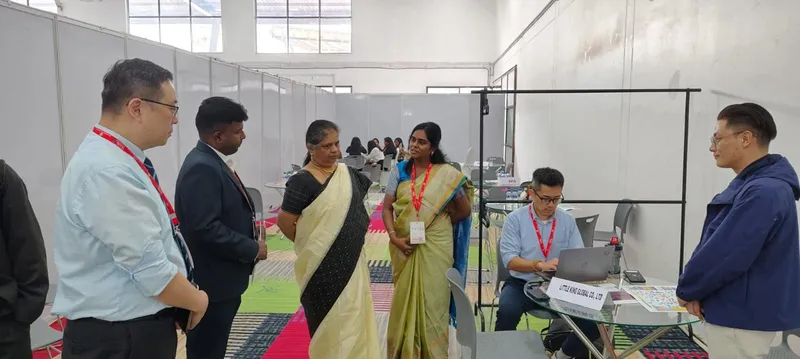
We have organised four key components. Firstly, several high-level panel discussions were conducted over the two days, bringing together policymakers, industry leaders, global buyers, technology providers and sustainability experts to deliberate on Tamil Nadu Textiles & Apparel @2030, global and domestic market opportunities, smart manufacturing and automation, sports textiles (SPORTECH), sustainability and circularity, and strategies to position Tamil Nadu as a globally competitive, future-ready textile hub. Second, we have organised a reverse buyer-seller meet, which is a first-of-its-kind attempt by our department, wherein around 26 international delegates have been invited, and around 60 industries across Tamil Nadu interacted with them in structured meetings. This resulted in around 300+ B2B meetings conducted over 2 days. The interaction primarily focused on direct sourcing opportunities, technology collaboration and capacity expansion.
Third, there is a fashion show being organised with the help of Tirupur Export Association members, wherein manufacturers in Tamil Nadu are showcasing their products through a modern fashion show concept, displaying the latest designs and garments. Finally, we have around 91 stalls with 79 exhibitors showcasing products across the entire textile and handloom value chain of Tamil Nadu and witnessed a footfall of approximately 2,000 visitors.
-800x533.webp?2026-02-24T20:40:08.515Z)
Could you tell us about the new policy announcements made at the summit?
We had the grand launch of International Textile Summit 360 on 29.01.2026 by our Honourable Deputy Chief Minister, who inaugurated the event and unveiled the Tamil Nadu New Integrated Textile Policy 2025-26, which has schemes for all sectors in the textile value chain—starting from spinning, weaving, processing, cut-and-sew garmenting, market initiatives, and also the recent sunrise sector of technical textiles.
During the inauguration, our Honourable Deputy Chief Minister announced a major amendment to the existing 6% Interest Subvention scheme for the spinning sector, which was earlier applicable only to the spinning machinery component. Now, pre-spinning and post-spinning machineries will also be covered under this scheme.
The function was also addressed by the Honourable Chief Minister of Tamil Nadu through video Conference, wherein he highlighted various strengths of our textile industry and made a major announcement introducing a capital investment subsidy for advanced fabric formation machineries like high-speed air jet and water jet looms and warp and circular knitting machineries, etc.
I must proudly say that the Department of Textiles, Government of Tamil Nadu, is actively working for the betterment of the textile industry in the state, and our textile policy now has components for each segment of the textile value chain.
As part of this event, we had footfalls from international buyers—nearly 50 delegates from more than 10 countries participated in various textile panels, reverse buyer-seller meets, and other discussions. The first edition was a grand success, and we hope to continue similar textile summits in the coming years.
What are the plans for future editions of this summit?
For the next edition, we have tied up with Messe Frankfurt, wherein we will be conducting the Techtextil India event in November 2026. Last year, the Techtextil India event happened in Mumbai, which is a biennial event. Now, in alternate years to Mumbai, we will have Techtextil in Tamil Nadu, preferably Coimbatore. The first edition of Techtextil India Tamil Nadu will be organised by the Department of Textiles, Guidance Tamil Nadu, Government of Tamil Nadu, in partnership with Messe Frankfurt, in November 2026.
-800x533.webp?2026-02-24T20:40:07.253Z)
What is the main objective of partnering with Messe Frankfurt for this exhibition?
The entire aim of tying up with Messe Frankfurt is to promote technical textiles in the state. We are established leaders in cotton and cotton-allied knitwear, weaving, and home textiles. However, we have seen that technical textiles is an area where our state needs to diversify for value addition and better market opportunities.
To promote technical textiles, we have launched various schemes like the Tamil Nadu Technical Textile Mission and R&D schemes for technical textiles and MMF. Apart from these initiatives, to make our industry aware of the various leading fronts of technical textiles, we have partnered with Messe Frankfurt.
We all know, Messe Frankfurt is the leading organisation to conduct expo related to the textiles sector and Techtextil, organised by Messe Frankfurt, is the premier exhibition for technical textiles globally. The Indian edition happens in Mumbai once every two years. We now want to bring Techtextil India to Tamil Nadu to make our industry advance in the sector of technical textiles.
The first edition will be confex model, wherein leading technical textile associations, manufacturers, and companies will be visiting Tamil Nadu. We plan to conduct more networking events and awareness campaigns regarding technical textiles. Basically, we want our industry to diversify into technical textiles, which is the future of the Textile Industry.
Will the Government of Tamil Nadu be visiting Techtextil Frankfurt as well?
Definitely. The Government of Tamil Nadu's textile delegation will be visiting Techtextil Frankfurt. We are in close touch with Messe Frankfurt and Techtextil. We recently visited their Heimtextil event, and we will definitely be visiting the Techtextil, Frankfurt edition as well.
-300x186.webp?2026-02-24T20:40:06.570Z)
What is the current market size and growth trajectory for technical textiles in Tamil Nadu?
Over the last 20 years, we have been relatively slow initially in taking up the technical textile sector, though we have leading brands that have successfully forayed into this area. Since we were already leaders in spinning and knitwear, the opportunity to diversify easily into technical textiles exists.
Our knitwear cluster can easily diversify into sportswear and athleisure segments. We also have two Centres of Excellence for technical textiles—SITRA for medical textiles and PSG Tech for Indutech. We have a strong automotive industry in and around Coimbatore, Chennai, and the nearby Hosur areas.
We plan to encourage our textile industry to foray into these areas of technical textiles, which are easily diversifiable for them, and also expand into other markets. Athleisure, being the most easily diversifiable segment for our present industry, is a key focus area, though we are equally encouraging them to explore other segments as well.
Is it easy for companies to diversify into technical textiles, given that the technology might be different?
Yes, basically, companies in the state have already have good knitwear plants, so slight modifications will help enable them to easily foray into sportswear and athleisure segments. We have also announced capital investment subsidies for advanced fabric formation machinery like warp knitting and the processing sector, which will further encourage our entrepreneurs to diversify into these sectors.
Ultimately, we want our industries to move more and more toward value addition and technical textiles. As part of encouraging them, we launched the Technical Textile Mission, wherein we empanelled leading consultants who have extensive experience in hand-holding companies to diversify into technical textiles—basically from concept to commissioning.
These consultants provide guidance on what is required in the market, raw material availability, technical knowledge, investment requirements, and market access for technical textiles. So far, we have organised 3 evangelising sessions in various textile clusters of Tamil Nadu – Tirupur, Karur and Madurai.
These sessions were not a general awareness session on technical textiles, rather the consultants were asked to present focused and customised project plans pertaining to each cluster. Almost 300 people attended these sessions across the three meetings. We are also encouraging them by tying up with consultants and machinery manufacturers so they gain the comfort and confidence to successfully move into technical textiles.
There are comments that Tamil Nadu's incentives are not as competitive compared to other states across India. How do you address this concern?
This competitiveness question arises because people are just comparing the initial cost, but we must also consider the ecosystem cost and the already established structural advantages.
Everything we provide to industries are at subsidised rates and also customised according to their requirements. The states giving higher incentives are trying to encourage new investments. Our state also gave similar incentives 20-30 years back. Now we have an established ecosystem and infrastructure which industries have utilised and grown significantly.
The government now wants them to go to a higher level and create a competitive edge while utilising the infrastructure that the government has created. I would not say we are not competitive in rates, but when people compare absolute rates, they may see a difference. However, they must also consider the infrastructure, facilities and set eco-system available to industries.
Why should anyone invest in Tamil Nadu?
For a textile entrepreneur, the reason to invest in Tamil Nadu is the established ecosystem. We are one of the few states with a complete textile value chain present in one state, right from spinning to export markets. We have spinning, weaving, knitting, garmenting, and exporting capabilities all within Tamil Nadu, giving investors the advantage of accessing all these ecosystems in one state.
We are a highly advanced and urbanised state with four international airports, three major ports, and several minor ports. Connectivity, infrastructure, road, rail, electricity, and water—everything is well-established.
We also have a very pro-worker environment and are highly competitive in terms of ESG compliance. We are one of the few states that take ESG compliance very seriously, ensuring environmental sustainability, fair labour practices, and transparent government policies that are continuous over the years.
We honour our commitments and value sustainability. We are the textile hub, the ideal sourcing destination, and the best investment destination.
Do you have any schemes specifically for startups or new entrepreneurs?
For new entrepreneurs, we have Startup TN under the Department of Industries, Government of Tamil Nadu. Depending on the investment they are planning, we also have FAME TN, Startup TN and uGidance Tamil Nadu when investments are substantial.
We have multiple agencies based on the investment level of the entrepreneur. We have incubation centres and hand-holding support for them. So anybody who is newly interested in entering this sector has various schemes available to them as well.
-800x533.webp?2026-02-24T20:40:05.385Z)
In your opinion, which scheme is underrated or not being utilised to its full potential, particularly schemes that are beneficial for the textile industry?
All of our recent schemes have received overwhelming response; however, I feel the scheme which provides support for R&D in the area of Technical Textiles and MMF is one area where more projects can and need to come. We have two CoE’s and many leading colleges having facilities for Textile research. Entrepreneurs and industries who have innovative ideas but feel hesitant to undertake R&D due to fund constraints can utilise this scheme.
Perhaps they had doubts about whether their project would be cleared or whether government subsidies would be provided on time. To allay those fears, immediately after the announcement, we started the action plan. During the summit itself, we issued the orders for 6 R&D projects applied by Research Institutes in association with various Industries.
Through this platform of the textile summit, people gain confidence that if they apply, there will be no delay from the government, and they will immediately receive the subsidy or support.
I think more and more people should apply for R&D support under this scheme.
Conclusion
These interviews with Ms R. Lalitha highlight Tamil Nadu's strategic positioning as India's leading textile state, its commitment to ESG compliance, and its forward-looking vision for technical textiles. With comprehensive policy support, established infrastructure, and a complete textile value chain, Tamil Nadu continues to reinforce its status as the premier textile hub and sourcing destination in India.