Tales of Sohrai: A Tradition that made its way to Textiles
Introduction
Jharkhand, the tribal state is known for its indigenous people, art, craft and culture created by them. Various generations of these communities have stayed and shaped the culture of the state to what it is today. Apart from the Tribal festivals Jharkhand is known for Dokra, Chhau Mask, Bamboo Work, Wood-work, and Various paintings including Sohrai and Kohvar.
http://sita.in/painted-houses-of-hazaribagh-lesser-known-jewel-of-india/
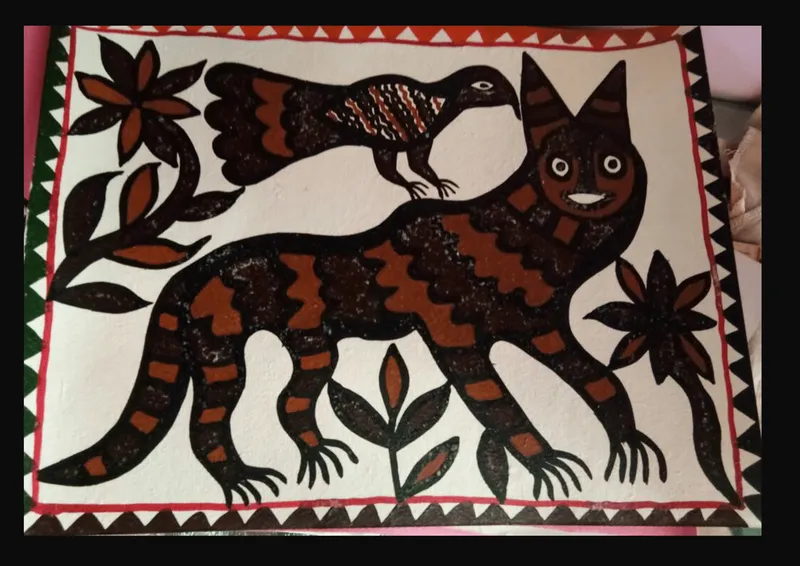
Sohrai, is a ritualistic art practiced by women during their harvest festival. Typically this style of is either monochromatic or colourful. People brush the wall with a white mud paste, and when the coating is already wet, they sketch on it with their fingertips. Their creations vary from fruit and flowers to many other styles influenced by nature. The cow dung used earlier to cake the house's walls is used to add colour.Due to the previously applied contrasting white mud coat the dark outline is visible. Sohrai artists do their painting unconsciously. There is no apparent pre-planning. The size of canvases is up to 12 x 18 feet .. The sketches are typically taken from the imagination of the maker. The artist's own knowledge, and its connection with nature, is the strongest inspiration.
Origin
The beautiful Bhelwara village (Hzaribagh) is the root of the popular art of harvesting, Sohrai. Many hundred houses' walls are adorned with sculptures, which display a striking similarity to the region's ancient rock art. The strongly symbolic and classic, abstract and decorative patterns in each section of the mud house walls are attractively decorated. In 1991, the Squad, the Indian National Trust for Art and Cultural Heritage (INTACH) at the Hazaribagh Chapter since 1987 brought to light the presence of Hazaribagh's first painted shelters in Jharkhand State in eastern India. About a dozen large Mesolithic rockart locations were come to attention over the next several years.
https://indroyc.com/2015/11/11/sohrai-a-festival-of-santhal-tribe/
https://indroyc.com/2015/11/11/sohrai-a-festival-of-santhal-tribe/
It was also observed that a distinct link between the rockart, village mural tradition and painted pottery from Central India, Indus Valley, and Iran. When two limited grants were granted to INTACH by the Australian High Commission in New Delhi (1993-95), it became feasible to render a special project of painting the traditional art on paper.
Evolution
Sohrai is said to adopt common patterns and designs that were once used in the area to build Isko and other rock arts, such as Satpahar. This art style was widespread initially in caves but has now been transferred largely to houses with mud walls. And this has persisted since ancient times. Expert studies have shown that although the rock art is around 10,000 years old, the cave paintings found from the hill of the village of Isko in the district of Hazaribagh date back to the early stone age, which is 30,000 Years old. The drawing was achieved by the tribals in the earlier days either in their mud houses or floors or on a hand-made board utilizing various colored mud and combs and twigs.
Inspiration
Meaning: Inspiration is mainly taken from reproduction, cultivation and marriage proposals, however the types and methods can vary. In Hazaribagh, those drawn at harvest time are referred to as sohrai. Motifs: The main motifs of the paintings include more animal , flowers and trees. Climbers and creepers. Although the motifs are quite detailed but it gives a abstract effect due to its style. Realistic motifs are not preferred. The composition is either monochromatic or very colorful.
Socio-Cultural Context of the Art
During the Sohrai festival, sohrai art in Hazaribagh is done especially by the Santhal men. Talking about the festival-Sohrai, one of the largest festivals in the Indian state of Jharkhand among the indigenous people, is being observed at the very same time as the Hindus observe Diwali.
The tribals around Jharkhand celebrate their festival – Sohrai – the morning after Diwali. The term Sohrai is a Mundaric term for the stone, used both to move cattle and to close the cattle pen gate (Soro). When the paddy has grown it is marked and is about to be harvested. So it is linked to the roots of farming. The cattle and their deity — Pashupati — are idolized in this two-day celebration in order to guarantee the prosperity of the soil and the ensuing harvest. Cattle aids in the production of the crops and is thus worshiped.
https://indroyc.com/2015/11/11/sohrai-a-festival-of-santhal-tribe/
https://indroyc.com/2015/11/11/sohrai-a-festival-of-santhal-tribe/
On its first day, in the morning, the cattle are sent to the fields to graze while in their absence, the house's woman folks decorate the huts by coloring them and laying Aripan for their welcome. The Aripan (floor painting) — originating in the Mithila area of Bihar Indian state — derives from the Sanskrit term Alimpana, meaning 'to powder' or 'to cover with.' While, after the puja food is being cooked which will later act as prasad. In the cattle-sheds they light earthen lamps (diyas) in the dark. The cattle are warmly received upon their return, their horns anointed with olive oil and vermillion. Garlands formed from strewing branches of paddy are wrapped over their foreheads. When the puja is over, the prasad is spread to members of the family and neighbours. Afterwards the cattle rest for the day. The inhabitants of sohrai honor their cattle-shed the next day. They carry from their paddy field some paddy strands which they use in worship. They bind certain plants to the horns of animals after worship. Throughout the afternoon, the cattle are brought to an open area, in the middle of the noisy sound of drums, where they are set loose for games and fun.
Utilitarian aspects of the craft (purpose)
https://www.instagram.com/p/CC8WcZZhS9B/
https://www.instagram.com/p/CC1RXbqhwX1/
https://www.instagram.com/p/CABfH7-pKNS/
https://www.instagram.com /p/CABeh8qJKy6
Ranchi: Sohrai paintings in the state capital make quite a splash. Upon the increase in prominence of the tribal art style, the state art and culture department Jharcraft has started its implementation on on various textiles of jharkhand as surface techniques. The surface techniques include fabric painting, embroidery, print and so on. Many young designers have also taken it up as a main characteristic of their collections and have included it in their graduation projects. Before making its way to the textiles it was first used as vivid murals on the walls of government offices, train stations and airports. Reshma Dutta, an artisan known for terracota was the first person who brought this art into light in 2009. Sohrai motifs were painted on the terracotta tiles which were then added in both sides of the bridge, in collaboration with Jharcraft.
http://www.sohraiart.com/
Social Role and support towards the craft
Jharkhand Handicraft Development Corporation Ltd., also known as JHARCRAFT, is a Jharkhand corporation government. The Jharcraft was founded focused on Sericulture, Handloom, Handicraft and other related practices to establish sustainable livelihood opportunities in rural areas. Jharcraft started as an organisation in the year 2006 to establish new resources in rural areas with the aim of improving lives throughout the state. The company became involved in the organisation of manufacturing units in various types during the first year. Today, for a reliable source of livelihood it offers both progressive and back connection to the Handloom and Handicrafts industries. It was created to deliver aggressive marketing to the products produced by one of the rural artists in the region. Jharcraft funds the whole manufacturing and marketing supply chain including the procurement of raw materials, training, designs and marketing. oJharkhand 's poor craftsmen who have accepted silk output as a source of income have improved their standard skills and commodity varieties by painting or embroidering Sohrai on fabrics, silk sarees, designer apparel , home furnishing etc. The recognition and procurement of this art-form has injected fresh life into the artisans' lives and help enhance their brilliant community. Jharcraft offers funding to encourage crafts, Sohrai included which has also helped it acquire new horizons.
A brief note on the Activity of Tribal Women Artist’s Cooperative, Hazaribagh, Jharkhand
http://tribalartofhazaribagh.blogspot.com/2014/08/tribal-women-artists-cooperative.html
The Tribal Women Artists' Cooperative was established by Bulu Imam at his Sanskriti Center in Hazaribagh in 1995 to promote Khovar and Sohrai 's native village artforms, which is a continuing rockart tradition in the area. TWAC seeks to draw attention to the region's rich cultural heritage and the danger presented to it by industrial production including massive coal mining that ruins the communities in which the art forms are performed and the special woodland ecosystem in which the prehistoric rockart sites are located.Today these areas include wild tigers and elephants portrayed in the paintings. Therefore the mission is one of both advocacy and activism as well as preserving very unusual form of art. The Cooperative supports this practice by exhibitions and marketing of artworks whose profits are split evenly among the creators, Sanskriti Centre's welfare fund, and upkeep. Since 1993, this initiative has been nurtured under the aegis of the Hazaribagh District of the Indian National Trust for Art and Cultural Heritage (INTACH), which currently has over 60 working artists in six villages.After its formation TWAC has organized many foreign displays of artworks created by the Adivasi women of the forest villages of Hazaribagh on handmade art board. The project produced the National Republic Day Parade Bihar Tableau in New Delhi in 1997. In 1999, the Films Division (Govt . of India) created a 35 mm Color Documentary on the Tribal Women Artists programme.
Conclusion
Jharkhand's crafts including the sohrai painting, which forms a very significant part of the Jharkhand state's cultural tradition in India. The Jharkhand crafts show a lot of skills. But, the craftsmanship quality is not balanced with the requisite promotional activities. As a result, the Jharkhand crafts as a whole have not earned the national and foreign acclamation that it deserves. The Kohvar and Sohrai paintings, which are religious, secular and important to a woman's world, are among India's most delicate, frail, artistic and endangered indigenous cultures. It is the craft performed primarily by married women, after weddings and through harvest, and the knowledge and experience are passed on to younger students. So it is necessary to save and promote the artform not only for the culture but also for to uplift these tribal women. The young designers should find creative ways to incorporate the art style in their collections. This would not only give a contemporary twist to the painting but also help in preserving the art. REFERENCES
- https://www.shuru-art.com/blogs/news/sohrai-the-traditional-harvest-art-of-jharkhand
2. https://en.wikipedia.org/wiki/Sohrai 3. http://sita.in/painted-houses-of-hazaribagh-lesser-known-jewel-of-india/ 4. https://www.scribd.com/article/366696371/Painting-A-New-Story-Sohrai-Art-In-Jharkhand 5. indroyc.com/sohrai-a-festival-of-santhal-tribe/ 6. http://www.sohraiart.com/ 7. http://tribalartofhazaribagh.blogspot.com/2014/08/tribal-women-artists-cooperative.html