Swedish Textile Machinery Association TMAS Sets New Benchmarks at Techtextil & Texprocess 2026

Members of the Swedish textile machinery association TMAS will present technologies focused on process control, automation and production stability at the upcoming Techtextil and Texprocess exhibitions. The events will be held concurrently at Messe Frankfurt from April 21–24.
TMAS members will demonstrate solutions covering multiple stages of textile and material production at the Techtextil and Texprocess exhibitions in Frankfurt from April 21–24. According to TMAS, shared priorities among its member companies include process control, intelligent automation and long-term industrial reliability.
“Across different stages of textile and material production, TMAS members are united by a common belief that productivity begins with stability,” says TMAS General Secretary Therese Premler-Andersson. “Rather than focusing on isolated machine functions, the emphasis is on controlling the critical variables that directly influence quality, efficiency and uptime.”
In weaving and related processes, Vandewiele Sweden AB will present its experience in weft feeding and tension control. At Techtextil 2026 in Hall 12, stand C21, the company will explain how predictable yarn delivery at higher loom speeds supports fabric quality while allowing weaving mills to operate closer to technical limits. Its development of data-ready weft feeders reflects an approach to digitalisation aimed at embedding intelligence where it provides operational value.
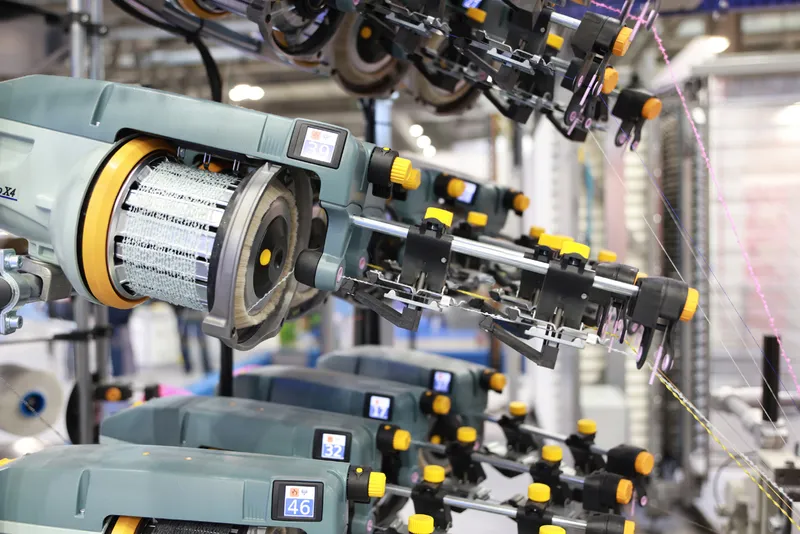
Vandewiele data-ready weft feeders in action.
Eltex of Sweden will address yarn monitoring and early fault detection. Its electronic yarn sensors and tension monitoring systems are designed to identify yarn breaks, end-outs or abnormal tension before they lead to waste, downtime or quality issues. The company’s technology is used in weaving, warping, tufting, braiding, quilting and sewing applications to support automated production processes.
At Techtextil 2026 (Hall 12.0, stand C53), Eltex will present its EyETM Multiact system for heat setting machines. The system monitors and controls individual yarn tension according to a predefined reference tension, with each channel operating independently and including a machine stop function if yarn breakage occurs or if tension exceeds preset limits. Also on display will be the ACT-R system for rapier weaving machines, designed to maintain constant weft yarn tension for recycled fibre yarns and for technical yarns such as Kevlar.
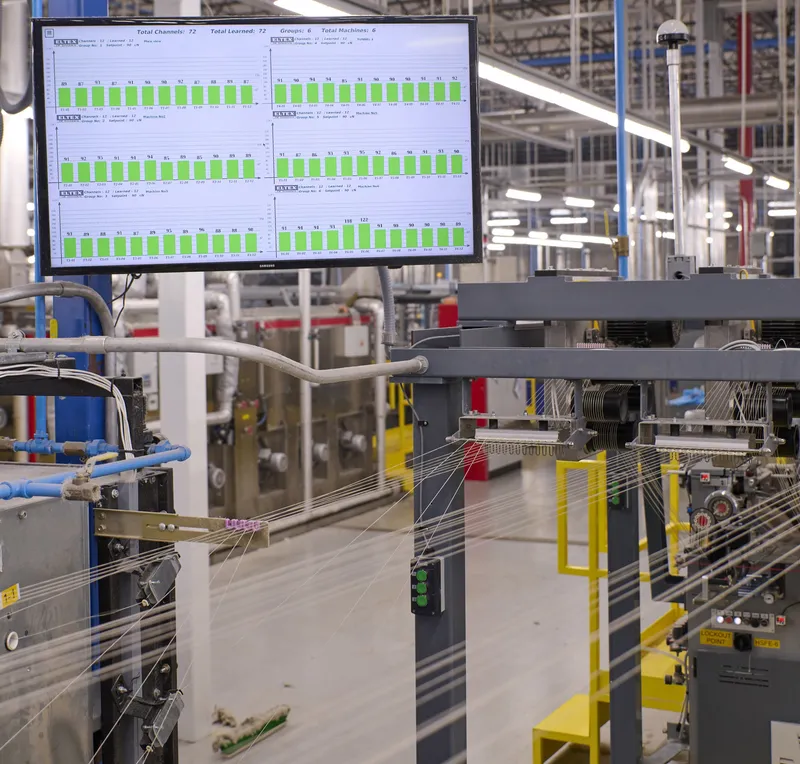
Perfectly uniform tension values with Multi ACT on a heat setting machine.
In dyeing and finishing, BW Converting will exhibit in Hall 12.0, stand C56B at Techtextil 2026. Following the introduction of the Baldwin TexCoat G4 finishing system, the company is launching the Baldwin TexChroma digital spray dyeing system.
“Since its introduction, global textile finishers have embraced TexCoat and are now reaping the benefits,” says vice-president of global business development Rick Stanford. “They have been able to increase profitability, cut energy use and reduce their carbon footprint, in addition to exercising precision control with our patented precision spray technology. In the past two years we have been very active in Asia, and many of these customers have been asking for a similar technology for the dyeing process.”
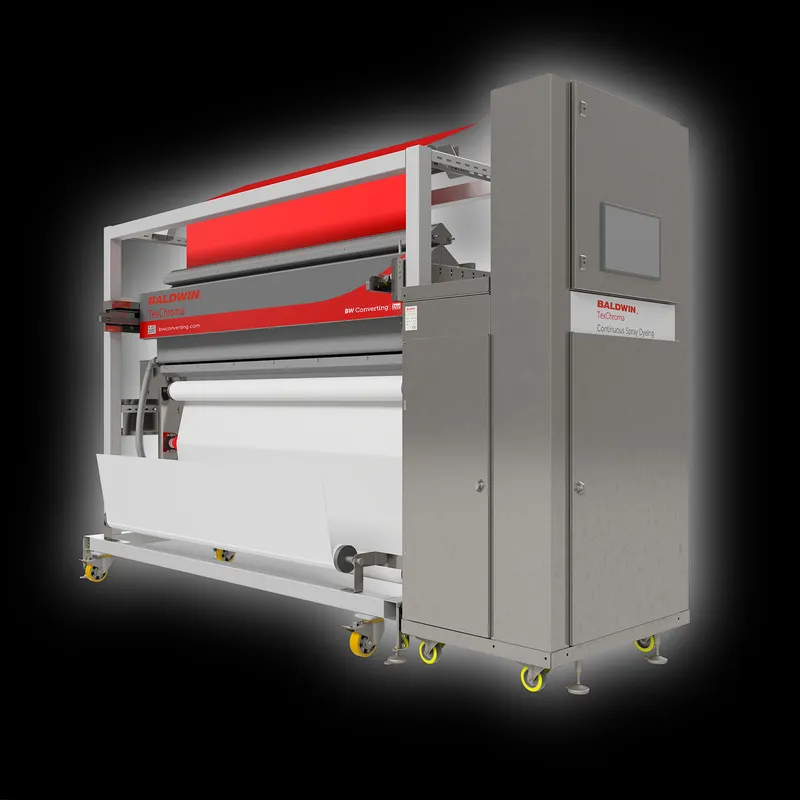
The new BW Converting Baldwin Texchroma.
Production data indicates that TexChroma can achieve savings in energy, dyes and chemicals of more than 30% compared to conventional continuous pad batch dyeing using steam, and up to 50% compared to exhaust reactive dyeing. The system uses technology that mixes reactive dyestuffs and alkali fixation chemicals shortly before spray application to prevent uneven dye application or colour variation.
At Texprocess in Hall 8, stand B38, Eton Systems will outline developments in Industry 4.0 and artificial intelligence applied to its aUPS (AI powered unit production system). The system uses individually addressable product carriers managed by software to reduce manual transportation and handling. It is designed for both mass production and the ability to respond to custom-made orders without disrupting larger production batches. The aUPS is developed for circular garment identification and is intended to expand into quality control for linear production.
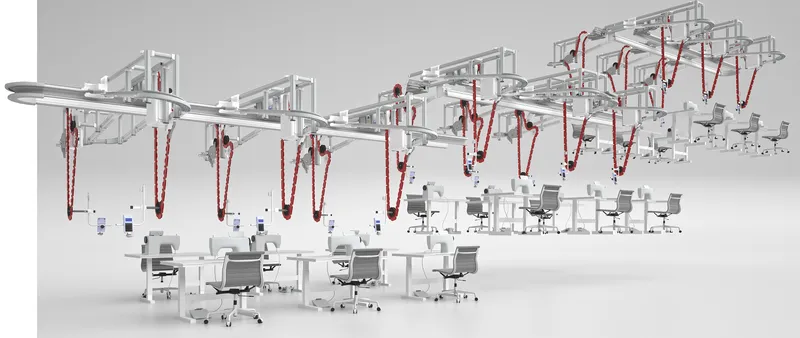
The Eton Systems aUPS.
The automated handling solutions for finished garments, home textiles and furniture are managed by ETONingenious™ software. This web-based real-time data collection system gathers and processes production information and makes it available to supervisors, quality control staff and management.
Svegea will exhibit at Texprocess in Hall 8.0, stand C43, where it will present the EC 200-C colarette cutter and the FA 350 fully automatic roll slitting machine. Svegea’s colarette technology is used in knit garment manufacturing for tubular components such as cuff and neck tapes and seam reinforcements.
“In Europe, while the garment manufacturing sector is relatively limited in size, interest in these machines has increased in recent years, mainly driven by logistics, cost and lead-time considerations as production moves closer to the market,” says Svegea Managing Director Håkan Steene. “The ongoing shortage of skilled operators has also increased the demand for such automated solutions.”
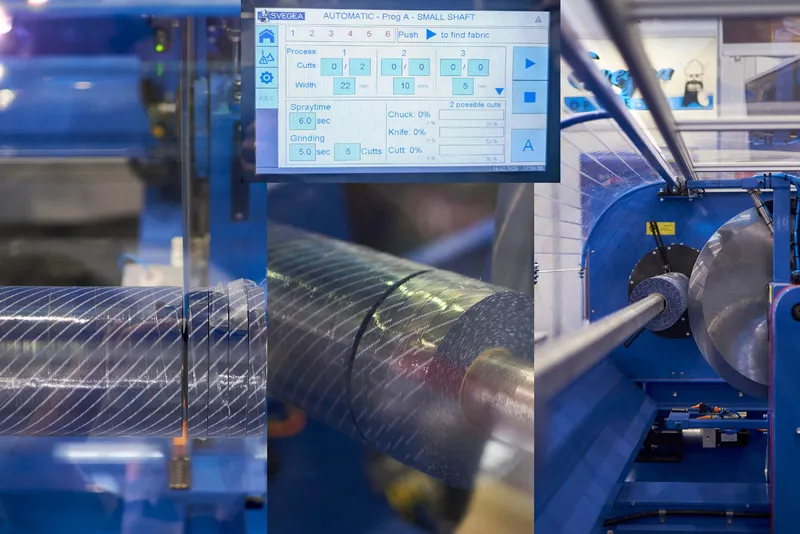
Svegea’s FA 350 roll slitting machine benefits from expanded new setting functions.
The FA 350 roll slitting machine is designed for roll conversion in the technical textiles sector. It combines high capacity with low power consumption and is capable of cutting knitted and woven fabrics produced from a range of technical fibres. The machine accommodates different shaft sizes and is electronically controlled with servo motors. Its touchscreen interface includes functions such as automatic control of knife surface speed during the cutting cycle to maintain consistent cutting conditions as roll diameter decreases. Svegea also produces bespoke bias cutting systems for contoured technical textile components.
A further theme linking TMAS members’ exhibits relates to economic conditions affecting textile manufacturers.
“Rather than promoting automation as an abstract objective, Swedish machinery suppliers focus on tangible productivity gains that help manufacturers in high-cost regions remain competitive,” says Premler-Andersson. “Reduced waste, higher uptime and repeatable quality are the essential foundations for sustainable manufacturing.”