Sustainable Refrigeration Market to Hit USD 125.17 Billion by 2034
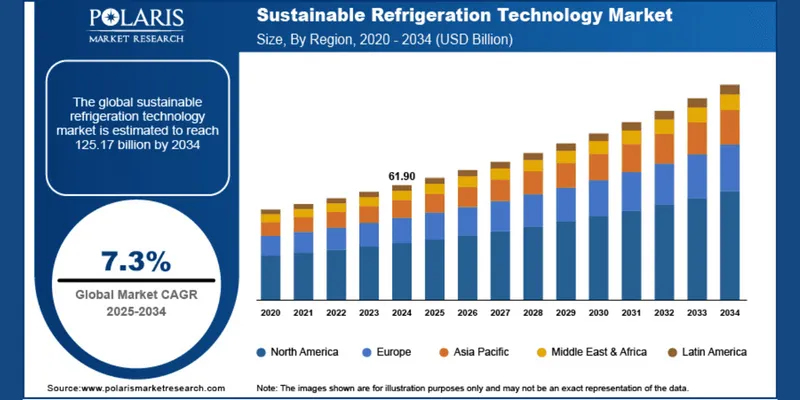
Eco-friendly cooling technologies set for strong global expansion.
The sustainable refrigeration market is projected to reach USD 125.17 billion by 2034, driven by natural refrigerants, clean cooling innovations, and rising climate priorities.
Refrigeration plays an essential role in preserving food, safeguarding medicines, and maintaining indoor comfort. However, traditional refrigeration methods significantly impact the environment. With climate change intensifying, the need for eco-friendly, energy-efficient cooling technologies has become more urgent than ever. This shift has accelerated the adoption of sustainable refrigeration, a set of advanced, low-impact technologies designed to reduce environmental harm.
According to Polaris Market Research, the global sustainable refrigeration technology market, valued at USD 61.90 billion in 2024, is projected to grow steadily at a 7.3% CAGR between 2025 and 2034, reaching USD 125.17 billion by 2034.
What is Sustainable Refrigeration?
Sustainable refrigeration refers to cooling systems engineered to consume less energy and minimize negative environmental effects. These technologies use natural refrigerants, lower greenhouse gas emissions, and significantly enhance operational efficiency — directly contributing to climate protection and reduced carbon footprints.
Why Sustainable Refrigeration Matters
Conventional refrigeration relies heavily on synthetic refrigerants like hydrofluorocarbons (HFCs), which are extremely potent greenhouse gases. Additionally, refrigeration systems rank among the largest electricity consumers, much of which is sourced from fossil fuels. Sustainable alternatives offer meaningful advantages by helping:
- Reduce global warming emissions
- Lower energy consumption
- Shrink refrigeration’s carbon footprint
- Ensure compliance with environmental regulations
Key Sustainable Refrigeration Technologies
A variety of innovative systems are enabling greener cooling solutions:
Transcritical CO₂ Systems
These systems use CO₂ as a refrigerant and perform efficiently at high pressures and temperatures. With extremely low GWP, they are widely used in supermarkets and industrial cooling operations, making them one of the most sustainable refrigeration options.
Ammonia-Based Refrigeration
Ammonia (NH₃) is a zero-ozone-impact refrigerant known for its strong cooling efficiency and low environmental footprint. It is widely deployed in food processing units and commercial cold storage facilities.
Hydrocarbon Refrigerants (R-290 & R-600a)
Propane and isobutane offer low-GWP performance and are popular in household and commercial appliances. Their high efficiency and eco-friendly nature make them among the most accessible sustainable solutions.
Magnetic Refrigeration
An emerging breakthrough, magnetic refrigeration cools through magnetic fields instead of chemical refrigerants. With very low energy usage, it is expected to become a major green alternative in the future.
Solar-Powered Refrigeration
Using solar energy to power cooling units, this technology is ideal for off-grid regions. It reduces fossil fuel dependence and delivers significant operational savings, especially in sunny climates.
Why the Sustainable Refrigeration Market Is Growing
Key drivers accelerating market expansion include:
- Strict global regulations targeting high-GWP refrigerants
- Rapid growth in cold chain infrastructure for food, pharmaceuticals, and vaccines
- Increasing use of IoT and smart systems to monitor and optimize cooling performance
- Rising consumer preference for environmentally responsible products
Future Outlook
The next decade will see stricter mandates, broader adoption of natural refrigerants like CO₂ and ammonia, and greater integration of IoT, automation, and renewable-powered systems. As industries push for higher energy efficiency and reduced emissions, sustainable refrigeration is expected to become a core part of food logistics, pharmaceuticals, and industrial cooling operations.
Final Thoughts
Sustainable refrigeration is central to global climate goals. With advanced energy-efficient technologies and natural refrigerants, the sector is poised to deliver meaningful emissions reductions while supporting sustainable growth. Continued innovation will drive the market forward, helping industries adopt greener refrigeration solutions in the years ahead.