Sustainable Fashion on the Rise: Algae Fiber Textile Market to Grow 11.8% CAGR Through 2032
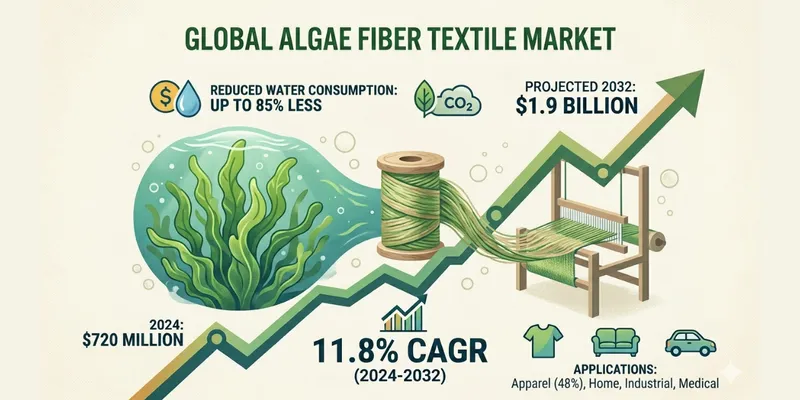
The global Algae Fiber Textile market is rapidly emerging as a sustainable alternative to conventional fibers, driven by increasing environmental regulations and demand for biodegradable materials. According to recent insights by Marketintelo, the market was valued at approximately $720 million in 2024 and is projected to reach $1.9 billion by 2032, growing at a compound annual growth rate (CAGR) of 11.8%.
Algae-based fibers reduce water consumption by up to 85% compared to cotton, while lowering carbon emissions by 30–40%. With textile waste exceeding 92 million tons annually, algae fiber textiles are gaining traction as part of circular economy initiatives.
Historical Market Performance (2016–2024)
The Algae Fiber Textile industry has witnessed consistent growth over the past decade, fueled by advancements in biomaterials and eco-conscious consumer behavior.
• 2016 market size: $210 million
• 2018 market size: $320 million (+52% from 2016)
• 2020 market size: $450 million (+40.6% from 2018)
• 2022 market size: $610 million (+35.5% from 2020)
• 2024 market size: $720 million (+18% from 2022)
The growth rate slowed slightly post-2022 due to supply chain disruptions, but investments in biofabrication increased by 22% between 2022 and 2024, stabilizing production.
Year-over-Year Growth Trends (2020–2025)
The Algae Fiber Textile market demonstrates strong year-over-year (YoY) expansion: • 2020–2021: +12.5% growth (pandemic recovery phase)
• 2021–2022: +14.8% growth driven by sustainable fashion demand • 2022–2023: +9.6% growth due to raw material constraints
• 2023–2024: +8.3% growth with increased industrial adoption
• 2024–2025 (projected): +10.2% growth as production scales
Notably, biofiber adoption in apparel increased by 27% between 2021 and 2024, indicating strong downstream demand.
Key Numerical Highlights
• Global textile industry contributes 10% of total carbon emissions, algae fibers reduce emissions by up to 40%
• Over 65% of sustainable fashion brands explored algae-based materials in 2024 • Production cost of algae fiber dropped by 18% between 2020 and 2024 • Asia-Pacific accounts for 42% of global production volume
• R&D investment in algae biomaterials exceeded $310 million globally in 2023 • Biodegradation time: 6–12 months, compared to synthetic fibers (20–200 years)
Regional Market Breakdown with Data
Asia-Pacific
Asia-Pacific dominates the Algae Fiber Textile market with the largest production capacity. • Market share (2024): 42%
• Market value: $302 million
• Projected CAGR (2024–2032): 12.6%
• China and India collectively contribute 58% of regional output
• Government funding for bio-textiles in China exceeded $120 million in 2023 North America
• Market share (2024): 24%
• Market value: $173 million
• CAGR: 10.9%
• U.S. sustainable textile adoption increased by 31% from 2021 to 2024 • Private investments in algae startups reached $95 million in 2023
Europe
• Market share (2024): 26%
• Market value: $187 million
• CAGR: 11.2%
• EU allocated €220 million (~$240 million) toward bio-based textiles under Green Deal initiatives
• Germany, France, and Italy account for 68% of European demand
Rest of the World (RoW)
• Market share: 8%
• Market value: $58 million
• CAGR: 9.5%
• Growth driven by eco-tourism apparel and niche luxury markets
Industry Investments and Company-Level Data
The Algae Fiber Textile sector is attracting substantial capital:
• Global venture funding increased from $120 million in 2019 to $310 million in 2023 (+158%)
• Top 10 companies control approximately 54% of global revenue
• Average production capacity per facility increased by 22% between 2021 and 2024 Notable industry statistics:
• Average algae yield per hectare: 15–25 tons annually
• Fiber extraction efficiency improved from 62% in 2018 to 78% in 2024 • Manufacturing cost per kg reduced from $9.8 (2019) to $7.2 (2024)
Application Segmentation with Market Share
The Algae Fiber Textile market is segmented by application:
• Apparel: 48% market share ($345 million in 2024)
• Home textiles: 21% ($151 million)
• Industrial textiles: 17% ($122 million)
• Medical textiles: 14% ($102 million)
Medical textiles are the fastest-growing segment, with a projected CAGR of 13.5% through 2032, driven by antimicrobial properties of algae fibers.
Table: Algae Fiber Textile Market Snapshot (2020–2032)
Year | Market Size (USD Million) | Growth Rate (%) |
2020 | 450 | — |
2021 | 506 | 12.5% |
2022 | 610 | 20.6% |
2023 | 668 | 9.6% |
2024 | 720 | 7.8% |
2026 | 890 | 10.4% |
2028 | 1,210 | 11.2% |
2030 | 1,550 | 11.6% |
2032 | 1,900 | 11.8% |
Technological Advancements and Efficiency Gains
Technological innovation is accelerating adoption of Algae Fiber Textile: • Bioengineering efficiency improved fiber strength by 28% since 2019 • Waterless dyeing technologies reduced processing costs by 22%
• Automated algae cultivation systems increased output by 35% per cycle
Additionally, over 70% of new textile patents filed in 2023 involved bio-based materials, including algae derivatives.
Sustainability Metrics and Environmental Impact
The environmental benefits of Algae Fiber Textile are quantifiable:
• Water usage: 90 liters/kg vs. 10,000 liters/kg for cotton (99% reduction) • Carbon footprint: 2.1 kg CO₂/kg vs. 3.5 kg CO₂/kg for polyester
• Waste reduction potential: up to 25% in textile landfills by 2030
A 2024 survey showed 72% of consumers are willing to pay 12–18% more for algae-based garments.
Future Outlook and Forecast (2025–2032)
The future of Algae Fiber Textile is strongly growth-oriented:
• Global production volume expected to reach 2.8 million tons by 2032 • Adoption in fast fashion projected to increase by 38% between 2025 and 2030
• Government subsidies for bio-textiles expected to exceed $500 million globally by 2028
Emerging markets such as Southeast Asia and Latin America are projected to grow at CAGR above 13%, driven by low-cost production and favorable climates for algae cultivation.
Conclusion: Data-Backed Growth Trajectory
The Algae Fiber Textile market is transitioning from niche innovation to mainstream adoption, supported by strong numerical indicators. From a valuation of $720 million in 2024, the market is projected to reach $1.9 billion by 2032, maintaining a robust 11.8% CAGR.
Historical growth exceeding 3.4x since 2016, combined with declining production costs (−26% over five years) and rising consumer adoption (+27% since 2021), underscores its scalability. Regionally, Asia-Pacific leads with 42% share, while Europe and North America collectively contribute 50%+ demand.
With over $500 million in expected government funding, increasing R&D investments, and measurable environmental benefits, Algae Fiber Textile is positioned as a key pillar in the future of sustainable textiles.
Read A Full Report: https://marketintelo.com/report/algae-fiber-textile-market