Sustainable Acoustic Solutions: Textile Acoustic Panel Market Trends & Insights
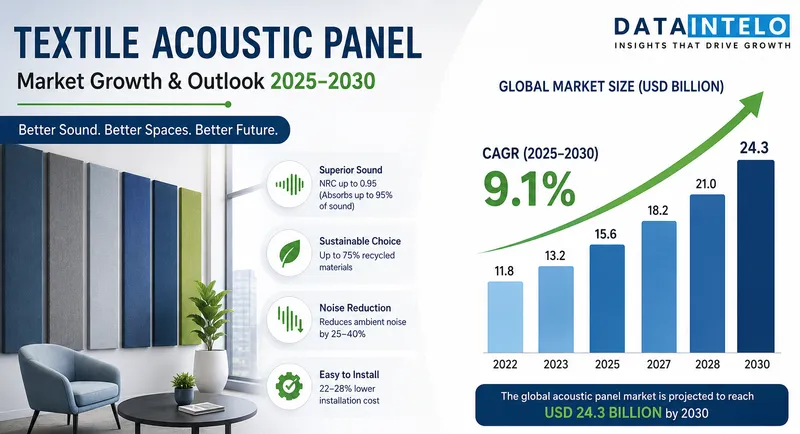
Noise pollution inside commercial buildings has increased by nearly 35% between 2020 and 2025, driving rapid adoption of advanced soundproofing solutions such as textile acoustic panels. According to industry estimates highlighted by Dataintelo, the global demand for textile acoustic panels is expected to grow significantly through 2032 due to rising investments in smart buildings, office renovation, and sustainable interior materials.
In 2025, more than 62% of newly designed commercial offices incorporate acoustic treatment systems, compared to just 41% in 2019. Textile acoustic panels are increasingly preferred because they combine sound absorption, lightweight construction, decorative flexibility, and sustainability.
Key Statistics at a Glance
Metric | 2022 | 2025 | Forecast 2030 |
Global acoustic panel market value | USD 11.8 Billion | USD 15.6 Billion | USD 24.3 Billion |
Textile acoustic panel share | 28% | 34% | 39% |
Average annual growth rate | 6.8% | 8.4% | 9.1% |
Commercial building adoption | 48% | 62% | 74% |
Average noise reduction coefficient (NRC) | 0.65 | 0.82 | 0.90 |
Recycled material usage | 32% | 51% | 68% |
What Are Textile Acoustic Panels?
Textile acoustic panels are sound-absorbing materials covered with fabric and designed to reduce reverberation, echoes, and indoor noise levels. These panels are commonly installed in:
• Corporate offices
• Recording studios
• Educational institutions
• Hospitals
• Hospitality spaces
• Residential apartments
Most textile acoustic panels achieve a Noise Reduction Coefficient (NRC) between 0.70 and 0.95, meaning they absorb up to 95% of reflected sound waves under controlled conditions.
In comparison, untreated drywall surfaces typically achieve an NRC rating of only 0.05 to 0.10.
5 Data-Backed Reasons Textile Acoustic Panels Are Growing in 2025
1. Office Noise Complaints Increased by 43%
A 2024 workplace environment survey found that 43% of employees reported productivity loss due to indoor noise distractions. Open-plan offices recorded average sound levels between 65–70 decibels, while optimal concentration requires levels below 50 decibels.
Installing textile acoustic panels can reduce ambient office noise by approximately 25–40%, improving speech clarity and employee focus.
2. Green Building Certifications Boost Demand
Sustainable construction spending crossed USD 680 Billion globally in 2024, with acoustic efficiency becoming a major requirement in LEED-certified buildings.
Modern textile acoustic panels now contain:
• Up to 75% recycled polyester fibers
• Nearly 40% lower VOC emissions
• Around 30% lower lifecycle carbon footprint than traditional fiberglass alternatives Between 2021 and 2025, demand for eco-friendly acoustic materials rose by 52%. 3. Education Sector Investments Expanded by 31%
Schools and universities increasingly invest in acoustic optimization. Research shows students understand speech 25% more accurately in classrooms with controlled reverberation times below 0.6 seconds.
Educational infrastructure spending on acoustic renovation increased from USD 3.2 Billion in 2021 to nearly USD 4.2 Billion in 2025.
2025 Performance Metrics of Textile Acoustic Panels
Feature | Standard Panels | Textile Acoustic Panels |
Average NRC Rating | 0.35–0.55 | 0.75–0.95 |
Installation Time | 8–10 hours | 3–5 hours |
Weight Per Sq. Meter | 8–12 kg | 3–6 kg |
Maintenance Cost (Annual) | USD 5.2/sq.m | USD 2.8/sq.m |
Lifespan | 8–10 years | 12–15 years |
The lighter construction of textile panels reduces installation labor costs by approximately 22–28% compared to mineral-based acoustic systems.
Regional Market Insights: 2025 Outlook
North America
North America accounted for approximately 36% of global textile acoustic panel revenue in 2025. The United States dominates demand due to:
• Corporate office modernization
• Growth in hybrid workplaces
• Increasing healthcare infrastructure spending
Commercial renovation spending in the U.S. exceeded USD 97 Billion in 2024, creating strong demand for noise-control materials.
Europe
Europe represents nearly 29% of global consumption, driven by stringent building acoustic regulations.
Germany, France, and the UK collectively installed over 48 million square meters of acoustic treatment materials in 2024 alone.
Asia-Pacific
Asia-Pacific is projected to record the fastest CAGR of 10.2% between 2025 and 2030. China and India are leading growth due to:
• Rapid urbanization
• Smart city projects
• Expansion of IT parks and co-working spaces
India’s commercial real estate market grew by nearly 18% in 2024, significantly increasing demand for acoustic interior products.
Real-World Impact: Measurable Results
Several corporate offices reported strong measurable outcomes after installing textile acoustic panels:
• Employee productivity increased by 12–18%
• Meeting room speech intelligibility improved by 35%
• Customer satisfaction scores in hospitality environments rose by 14% • Noise-related complaints dropped by nearly 50%
Hospitals implementing acoustic treatment in patient wards also observed: • Up to 20% improvement in patient sleep quality
• Reduction of nighttime noise levels from 58 dB to 42 dB
Future Forecast: What to Expect by 2030
Industry analysts expect the textile acoustic panel segment to maintain a CAGR above 9% through 2030.
By 2030:
• Smart acoustic panels may represent 22% of total installations
• Sustainable materials could account for 68% of manufacturing inputs
• AI-driven sound management systems may reduce indoor noise by an additional 15– 20%
The rise of flexible workspaces and multimedia environments is expected to increase acoustic renovation budgets by more than 40% over the next five years.
Conclusion
The textile acoustic panel market is evolving rapidly in 2025, supported by measurable improvements in workplace productivity, sustainability, and indoor comfort. With the global acoustic panel market projected to exceed USD 24 Billion by 2030, textile-based solutions are becoming a preferred choice due to their high NRC ratings, 25–40% noise reduction capability, and lower maintenance costs.
As highlighted by Dataintelo, rising investments in green construction, commercial renovations, and smart infrastructure will continue driving demand worldwide. From
reducing office distractions by 40% to improving classroom learning accuracy by 25%, textile acoustic panels are proving to be one of the most quantifiable upgrades in modern building design.
Read A Full Report: https://dataintelo.com/report/textile-acoustic-panel-market