Supply Chain Transparency
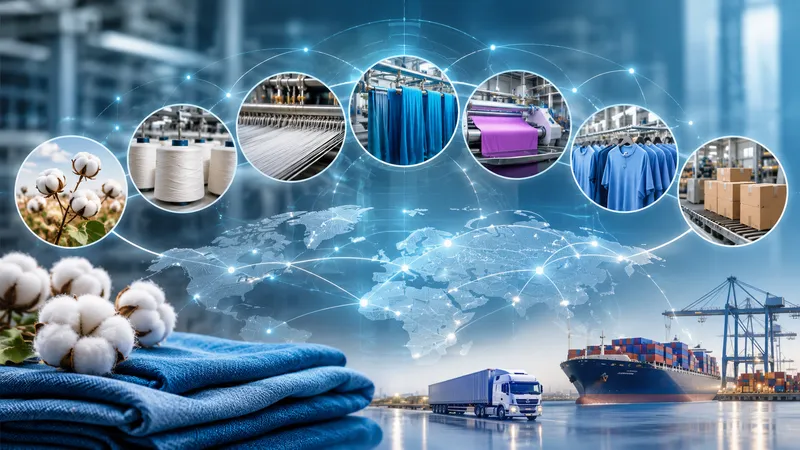
Improving visibility across spinning, weaving, knitting, dyeing, processing,
garment manufacturing, and distribution
Dr. Iti Dubey
Assistant Professor
Abstract
The textile and apparel supply chain is characterized by multiple material transformations and organizational handovers, extending from fiber sourcing and yarn formation to fabric construction, wet processing, garment assembly, and distribution. Because these operations are frequently distributed across separate facilities and subcontractors, product origin, process history, material composition and environmental performance may become difficult to verify. Supply chain transparency addresses this information gap by improving the visibility, traceability, and controlled sharing of reliable records at each stage. This article examines the information requirements of spinning, weaving, knitting, dyeing, processing, garment manufacturing, and distribution. It discusses batch identification, chain-of-custody documentation, supplier mapping, QR codes, RFID, Internet of Things (IoT), integrated enterprise systems, blockchain-enabled records, and Digital Product Passports. A stage-wise transparency framework and illustrative line diagrams are presented to show how input lots, process events and output batches can be connected. The article also considers data quality, supplier participation, environmental and social due diligence, implementation barriers, and performance indicators. It concludes that transparency is not simply the publication of supplier names; it requires consistent identifiers, verified evidence, traceable transactions, and corrective action across the entire textile value chain.
Keywords: Textile supply chain; transparency; traceability; spinning; weaving; knitting; dyeing; garment manufacturing; digital product passport; sustainability.
1. Introduction
Supply chain management coordinates the movement of materials, information and financial resources between suppliers, manufacturers, distributors, retailers, and consumers. The supplied report describes three principal flows—product, information and finance—and identifies the textile chain as a sequence involving fiber production, spinning, fabric formation, processing, garment production and retailing. These foundations remain directly relevant to the present topic: transparency depends on the information flow being sufficiently complete to explain where a material came from, what happened to it, who handled it and where it moved.
In textile manufacturing, one finished garment may contain fibers from different sources, yarns from one or more spinning units, fabric from weaving or knitting facilities, dyes and auxiliaries supplied by chemical manufacturers, and components assembled by a garment factory. Additional subcontracting, reprocessing, warehousing, and transport can introduce further handovers. The OECD describes garment and footwear supply chains as fragmented and multi-tiered, with visibility often decreasing further upstream from direct suppliers [1].
Transparency and traceability are related but distinct. Traceability is the ability to follow the history, application, or location of a material or product through recorded identification and events. Transparency is the appropriate availability and communication of that information to relevant stakeholders. Traceability creates the evidence trail; transparency determines how that evidence is accessed, interpreted, and used. The objective is to establish end-to-end visibility without disclosing confidential or personal information unnecessarily.
2. Stage-wise Transparency Across the Textile Supply Chain
The core principle is to preserve the identity of incoming materials when they are transformed, combined, divided, transferred or reprocessed. Each operation should create a record linking its input identifiers to the output identifier. The level of detail can vary with the risk, product type, customer requirements and technical capacity of the organisation.

Figure 1. End-to-end textile and apparel value chain. Visibility is required at each stage and at every transfer between organisations.
2.1 Spinning: fibre-to-yarn traceability
At the spinning stage, transparency begins with the identification of fibre lots or bales received by the mill. Records should capture fibre type, supplier, lot or bale number, declared origin where available, blend composition, receipt date and incoming inspection status. During blow-room, carding, drawing, combing, roving and spinning, the mill should connect the fibre inputs to the resulting yarn batch.
Important yarn-level records include yarn count, twist, blend ratio, spinning system, machine or production line, production date, waste or loss, and relevant quality results. If several fibre lots are blended, all contributing lots and their proportions should remain linked to the yarn batch. This enables investigation of strength variation, contamination, count irregularity or composition-related claims.
2.2 Weaving and knitting: yarn-to-fabric traceability
In weaving, warp and weft yarn lots are converted into woven fabric through interlacement. In knitting, yarn is converted into fabric by loop formation. Transparency records should identify the yarn lots used, machine or loom reference, production order, fabric construction, production date, roll or batch number and inspection status. For woven fabrics, construction details such as ends and picks per unit length may be recorded where relevant; for knitted fabrics, machine gauge and structure may be included.
Fabric roll identity is especially important because rolls within one order may differ in width, mass per unit area, shade, defects or production history. Each roll should be linked to its yarn inputs and inspection records. Nonwoven production, where included in the product chain, should similarly record fibre inputs, web-forming and bonding operations, and output batch identity.
2.3 Dyeing, printing and wet processing: process transparency
Dyeing and finishing are critical points for transparency because they involve dyes, auxiliaries, water, energy and wastewater. Records should connect the fabric batch to the processing facility, machine, recipe or formulation reference, chemical and dyestuff inputs, batch quantity, process conditions and final test results. Depending on the process, relevant conditions may include temperature-time profile, pH, liquor ratio, washing sequence, drying and curing conditions.
Environmental records should include clearly defined measures such as water and energy consumption per kilogram of material processed, wastewater treatment and discharge monitoring, chemical inventory and waste handling. Measurements must state the reporting boundary and method. A broad claim such as 'green processing' is not meaningful unless supported by verifiable data and a clear description of the process covered.
Quality records may include shade approval, colour fastness, dimensional stability, pH, appearance and other performance tests specified for the product. Re-dyeing, re-finishing or other reprocessing should be recorded as an additional event so that the complete process history is retained.
2.4 Garment manufacturing: facility and subcontractor visibility
Garment manufacturing generally includes design and product development, pattern and marker preparation, spreading, cutting, sewing, finishing, inspection and packing. The garment order should be linked to the fabric roll identifiers, trims and accessories, production facility, subcontracted processes, production dates and final inspection results.
Where cutting, stitching, embroidery, printing or washing is outsourced, the actual operating facility should be recorded. A supplier's registered office or buying agent is not a substitute for identifying the site where the work was performed. Facility-level information can include process capability, location, assessment status, occupational health and safety records, and corrective-action progress, subject to appropriate privacy and confidentiality safeguards.
2.5 Distribution and retail: shipment-to-product visibility
After packing, product and shipment identifiers should be retained through warehousing, dispatch, transport, distribution and retail. Useful records include purchase order, SKU or style number, carton and pallet ID, quantity, dispatch and receipt dates, carrier, destination and custody-transfer events. Barcode, QR code and RFID scanning can reduce manual entry and improve inventory accuracy.
Transparency can continue beyond the point of sale by recording returns, repair, resale, take-back and recycling events where such systems exist. Product composition, care information and component details can help repairers and recyclers determine appropriate handling and recovery routes.
3. Essential Data to Be Captured at Each Stage
Stage | Minimum visibility / traceability information | Why it matters |
Spinning | Fibre supplier and lot IDs; blend recipe; yarn batch; count and twist; machine and production date; test results | Connects fibre origin and blend to yarn identity and quality |
Weaving | Warp/weft yarn IDs; loom; construction; production order; roll ID; width/GSM; inspection | Maintains yarn-to-fabric lineage and roll-level quality history |
Knitting | Yarn-feed lots; knitting machine and gauge; structure; batch/roll ID; inspection | Identifies inputs and process route for knitted fabric |
Dyeing/processing | Fabric batch; recipe reference; dye/chemical inputs; machine; process conditions; water/energy; effluent and test records | Supports process reproducibility, chemical control and environmental monitoring |
Garmenting | Fabric roll allocation; trims; cutting/sewing facility; subcontractors; order; inspection and packing records | Links finished garments to materials and actual production sites |
Distribution | Carton/pallet/SKU IDs; shipment, carrier, dates, destination; custody events; returns | Maintains product visibility through logistics and retail |
4. Digital Technologies Enabling Transparency
4.1 QR codes and barcodes
A unique code can connect a physical roll, carton or garment to a digital record. QR codes can provide access to selected product information for consumers or business users, while barcodes are widely used for internal identification and inventory control. A code is only a pointer to information; it does not by itself prove the accuracy of the underlying claim.
4.2 RFID and IoT
Radio-frequency identification (RFID) can support automated identification of fabric rolls, cartons and products as they move through production or warehouses. Internet of Things (IoT) sensors can capture selected process or logistics conditions, such as temperature, humidity, machine status, location or energy use. Sensor calibration and correct association with the relevant batch are necessary for reliable data.
4.3 ERP, PLM and manufacturing systems
Enterprise resource planning (ERP), product lifecycle management (PLM), manufacturing execution systems (MES), warehouse management systems (WMS) and laboratory information systems may each hold part of the required record. Interoperability between these systems is important: a shared product or batch identifier should connect purchasing, production, testing, inventory and dispatch data.
4.4 Blockchain and distributed records
Blockchain-enabled systems can provide time-stamped, shared records of selected transactions, custody transfers and batch events. However, a distributed ledger cannot independently establish whether information entered by a supplier is true. Governance, identity management, evidence checks, audit procedures and correction protocols remain essential.
4.5 Digital Product Passport
A Digital Product Passport (DPP) is a digital information container associated with a product, component or material. Depending on the applicable product-specific rules, it may support access to information on identity, composition, origin, sustainability, repair, reuse and recycling. The European Commission identifies textiles and apparel as a priority product group in its Ecodesign for Sustainable Products framework; textile-specific requirements are to be set through future product-specific rules [2, 3].
5. Batch-Level Traceability: How the Link Is Maintained
A practical traceability record should capture the relationship between input lots, a transformation event and output batches. The record should be created at the point of operation or handover, not reconstructed only when a customer or auditor requests it. Where one input batch is split into several outputs, or multiple inputs are blended into one output, the system should preserve all parent-child relationships.
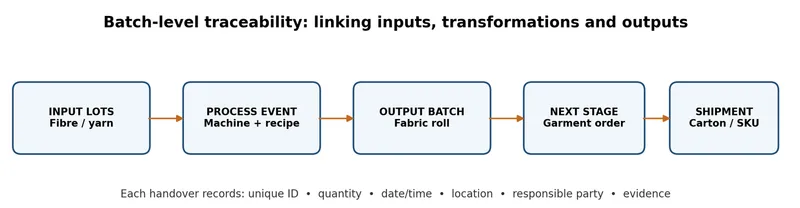
Figure 2. Line diagram of batch-level traceability from input lots to shipment.
A minimum event record can include: (i) unique input and output identifiers; (ii) quantity and unit of measure; (iii) date and time; (iv) facility and process; (v) responsible organisation; (vi) supporting documents or test evidence; and (vii) exception or rework status. Quantity reconciliation can help identify unexplained losses, additions or substitutions.
6. Transparency, Sustainability and Responsible Sourcing
Transparency is useful only when information supports decisions and action. Environmental information may include fibre sourcing, recycled content, chemical inputs, water and energy use, wastewater treatment, emissions and waste. Social information may include facility identity, occupational health and safety, working conditions, working hours, wage-related risks, grievance mechanisms and corrective actions. The OECD's garment and footwear guidance recommends risk-based due diligence across supply-chain relationships, including identifying, preventing and addressing adverse impacts [1, 4].
Supplier disclosure should not be confused with proof of performance. A published supplier list does not demonstrate that a facility meets environmental or labour requirements. Similarly, certificates and audit reports have a defined scope, validity period and limitations. Claims should be proportionate to the evidence, and significant findings should be followed by documented corrective action and verification.
7. Future Scope
Future development is likely to centre on interoperable product data, automated capture of production events, AI-assisted anomaly detection, supplier collaboration and product-level digital records. For textile manufacturers, the priority is not to adopt every available technology at once, but to establish accurate identifiers and reliable records first. Digital tools can then automate collection, improve reconciliation and provide controlled access to information.
Further research can evaluate the effect of transparency systems on material loss, defect investigation time, inventory accuracy, unauthorised subcontracting, environmental performance and corrective-action closure. Case studies across spinning mills, weaving and knitting clusters, dyeing and finishing units, and garment exporters would help establish scalable models for both integrated companies and small and medium-sized enterprises.
8. Conclusion
Supply chain transparency in textiles requires visibility across the complete journey from fibre and yarn to fabric, wet processing, garment manufacture and distribution. The central technical requirement is to maintain a reliable link between input materials, production events, output batches and subsequent custody transfers. QR codes, RFID, IoT, integrated enterprise systems, blockchain-enabled records and Digital Product Passports can strengthen this process, but their effectiveness depends on data quality, standardisation, verification and supplier participation.
By combining stage-wise traceability with environmental and social due diligence, textile businesses can improve quality assurance, identify risks, strengthen accountability and support more informed decisions. A phased approach—mapping suppliers, assigning identifiers, capturing transformation events, validating evidence and sharing relevant information—offers a practical route towards a more transparent and responsible textile and apparel value chain.
References
[1] OECD. (2018). OECD Due Diligence Guidance for Responsible Supply Chains in the Garment and Footwear Sector. OECD Publishing, Paris. https://doi.org/10.1787/9789264290587-en
[2] European Commission. (2026). Textile apparel and the Digital Product Passport. Directorate-General for Internal Market, Industry, Entrepreneurship and SMEs. https://single-market-economy.ec.europa.eu/single-market/digital-product-passport/textile-apparel_en
[3] European Commission. Digital Product Passport. https://single-market-economy.ec.europa.eu/single-market/digital-product-passport_en
[4] OECD. (2026). Due diligence essentials for responsible garment and footwear. 26 February 2026. https://www.oecd.org/en/publications/responsible-business-conduct-spotlights_03a75bf9-en/due-diligence-essentials-for-responsible-garment-and-footwear_c7ae4e4a-en.html
[5] Dubey, I. (2022). Supply Chain Management in Textiles and Apparel. Original report.