Suncity Synthetics Ltd

1. Introduction
The Indian textile industry is currently dealing with structural changes driven by volatile input costs, disrupted global supply chains, and aggressive domestic competition. For micro-cap entities, this environment is particularly unforgiving, often necessitating radical pivots to maintain even a semblance of any operational viability. Suncity Synthetics Ltd (SSL), a micro-cap player with a market capitalization of just ₹4.91 Crore, serves as a stark case study in the struggle for survival within this sector. This report evaluates the financial trajectory and operational health of SSL over the last three fiscal years (2023–2025). By analyzing the company’s quantitative results against its historical strategy, we aim to determine whether SSL is undergoing a disciplined consolidation or a terminal decline. This strategic adaptability, however, is only as strong as the history of the business model itself.
2. Company Overview
Before branching out into the production of nylon chips, SSL, which was founded in 1988, first established its reputation in the yarn industry. Notably, the company was one of the first in India to manufacture high-grade nylon double chips using specialized German technology, targeting heat-resistant applications in technical textiles and the automotive sector.
However, by FY17, management acknowledged that high competition and weakening demand for nylon had made its original niche unsustainable. Consequently, SSL pivoted entirely to Polyester Staple Fibre (PSF) and Nylon Staple Fibre (NSF).
So What? Layer: This shift from a specialized technical niche (nylon double chips) to a more commoditized market (PSF) indicates management’s willingness to adapt, but it also reflects a retreat into a high-volume, low-margin segment where the company lacks the scale to compete with industry giants. While ISO 9001:2000 and 14001 certifications validate their process quality, they offer little protection against the broader revenue erosion seen in recent years. This strategic navigation is guided by a leadership team that remains deeply entrenched in the company’s equity.
3. Promoter / Founder Introduction
In the micro-cap space, promoter stability is often the only factor preventing a total collapse of investor confidence during revenue droughts. The promoters of SSL have been active in the textile trade since the late 1980s, steering the company through multiple technological upgrades and the critical integration of German manufacturing processes. Their decision to consolidate operations into PSF was a defensive maneuver intended to mitigate the extreme volatility of the nylon market.
So What? Layer: Despite the company’s shrinking scale and persistent losses, the promoter holding has remained rock-solid and unchanged at 45.46%. For a company with a market cap under ₹5 Crore, this level of "skin-in-the-game" suggests that the founders are committed to the entity's survival rather than seeking an exit. This stability provides a psychological floor for the stock, though it does not fundamentally offset the quantitative results of their recent leadership decisions.
4. Financial Statement (2023–2025)
To distinguish between temporary volatility and systemic decline, one must look at multi-year trends. Isolation of single quarters often masks the broader trajectory of a company’s operational base.
Metric (Rs. Cr) | FY 2023 (Mar) | FY 2024 (Mar) | FY 2025 (Mar) |
Revenue (Sales) | 4.63 | 2.00 | 1.17 |
Operating Profit | 0.16 | 0.05 | -0.39 |
Net Profit (PAT) | -0.12 | 0.13 | -0.56 |
Total Assets | 5.38 | 5.54 | 2.09 |
Total Liabilities | 5.38 | 5.54 | 2.09 |
Equity (Net Worth) | -0.04 | 0.09 | -0.48 |
ROCE (%) | 4.25% | -0.21% | -21.40% |
Debtor Days | -7.88* | 142.35 | 21.84 |
*Note: The negative debtor day figure in FY23 is an accounting outlier likely resulting from reporting adjustments rather than operational collection efficiency. |
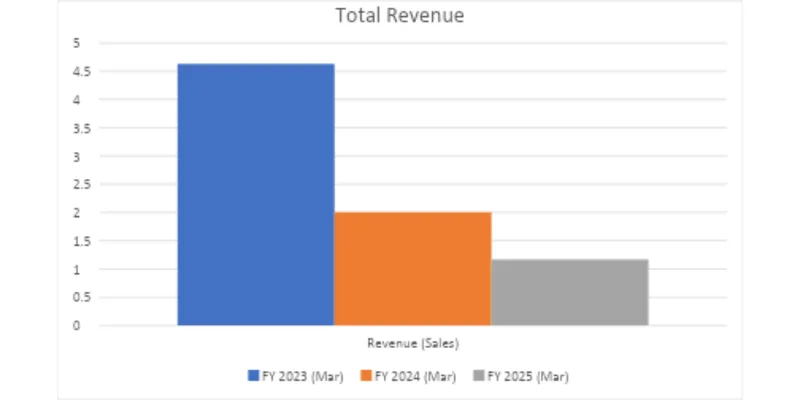
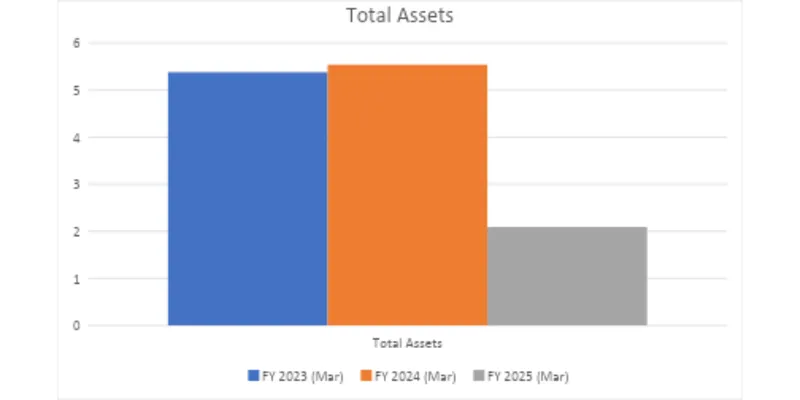
So what? Layer: The most critical observation is the 75% collapse in revenue from ₹4.63 Crore in 2023 to just ₹1.17 Crore in 2025. This precipitous drop directly threatens the company’s "Going Concern" status. Even more telling is the contraction of the balance sheet; Total Assets plummeted from ₹5.38 Crore to ₹2.09 Crore. A deeper look at the source data reveals that Fixed Assets specifically dropped from ₹2.99 Crore to a mere ₹0.45 Crore over the period. This indicates a massive liquidation of plant and machinery, suggesting that SSL is essentially winding down its manufacturing capacity. This quantitative reality provides the necessary context for the company’s qualitative "strengths."
5. Insights
The company’s strategic profile can be viewed through a SWOT lens, showing a contrast between improved financial management and weakening operations.
- Strengths: The company made a strong move to reduce its debt, bringing borrowings down from ₹4.75 crore in 2023 to almost zero (₹0.05 crore) by March 2025, significantly lowering its financial burden.
- Weaknesses: SSL suffers from persistent negative sales growth (-39.8% over five years). With a negative Return on Capital Employed (ROCE) of -21.40%, the company is currently a value-destroyer.
- Risk Factors: The company faces a negative Book Value (-₹0.93) and a total lack of scale to compete in the PSF market.
- Future Outlook: Any potential recovery is speculative and hinges on a stabilization of PSF demand. However, with the liquidation of fixed assets, the company’s ability to ramp up production is severely compromised.
So what? Layer: While the "improved debtor days" (settling at 21.8) appear as a "pro" on paper, it is a mathematical illusion caused by plummeting sales. The reduction in collection time is not a sign of improved credit management efficiency; it is a result of the collapse in new credit sales. When revenue hits such low levels, receivables naturally dry up, artificially improving turnover ratios while the underlying business fundamental withers.
6. Conclusion
The company is currently in a state of extreme contraction. The company has essentially transitioned from an active manufacturer to a defensive shell, liquidating its manufacturing assets to extinguish liabilities.
From a financial health perspective, SSL is a high-risk entity. While management has successfully navigated a significant de-leveraging process, they have sacrificed the company’s manufacturing core to do so. From an investment perspective, there is a massive disconnect between the valuation and the fundamentals: with a Market Cap of ~₹5 Crore against Trailing Twelve Month (TTM) sales of less than ₹1 Crore, the company trades at a highly speculative Price-to-Sales multiple for an entity with negative book value. For professional portfolios, SSL remains a speculative entity that lacks the top-line growth or asset base required for a serious turnaround thesis.
Source: Screener, Annual Reports (2023-2025)