Strategic Performance Review: Kush Industries Limited (2023–2025)

1. Introduction
In the volatile landscape of the Indian industrial sector, few narratives are as telling as the fundamental business pivot. Kush Industries Limited is currently attempting a high-stakes migration from its historical roots in textile manufacturing toward a specialized trading model focused on ceramics and solar components.
The company was formerly known as SNS Textiles, and is essentially fighting for relevance in a market that has surpassed its legacy capabilities. This analysis assesses the company's operational changes and financial sustainability over a crucial three-year period.
While the company frames its move from "weaving" to "trading" as strategic diversification, the underlying data suggests this is a survival move born of exhaustion. The transition represents an attempt at an asset-light future, but to understand where the company is headed, we must first look at the foundational structure of the organization.
2. Company Overview
Kush Industries has navigated several structural identities since its incorporation in 1992, including previous incarnations as Suzlon Fibres and SNS Textiles. A persistent layer of administrative inertia remains; title deeds for company land are still held under the "Suzlon Fibres" name, decades after the name change. Historically a manufacturer of polyester yarns, the company recently pivoted to trading ceramics and solar parts to escape the capital-heavy requirements of textile weaving.
The disposal of the Ankleshwar undertaking (Plot 129) was not merely a sale; it was a total redefinition of the firm’s physical footprint. By divesting its primary manufacturing asset, the company has locked itself into an asset-light model. This shift appears less like a modern choice and more like a retreat. Kush Industries is now a micro-cap player navigating a fragmented sector with a diminished tangible asset base to use as a safety net. To understand the momentum behind these high-stakes decisions, we move from the corporate entity to the leadership driving them.
3. Promoter / Founder Introduction
Leadership continuity is anchored by Mr. Mansukh K. Virani, the 71-year-old Chairman and Whole-time Director. With four decades of experience, Mr. Virani is the architect of the current restructuring. Supporting the board is Mrs. Kiran M. Virani, while the company has recently introduced independent oversight through Mr. Hiren B. Hirpara to support its strategic management.
The reappointment of Mr. Virani for another five-year term provides institutional stability, yet it highlights a potential deficit in modern strategic agility. Interestingly, market records show Mr. Virani slightly increased his holding from 1,009,041 to 1,034,041 shares recently—a minor vote of confidence. However, the reliance on a veteran founder raises questions about whether the firm can truly innovate in the fast-paced solar trading market. We now turn to the hard numbers to see if this leadership has translated strategy into financial health.
4. Financial Statement Analysis
The financial trajectory reveals a company in operational stasis. The 2024 "profit" is a classic accounting mirage that masks a terminal lack of core business activity.
Metric | 2025 (Actual) | 2024 (Actual) | 2023 (Actual) |
Sales | ₹0.01 Cr | ₹0.66 Cr | ₹0.82 Cr |
Profit After Tax | (₹0.05 Cr) | ₹2.27 Cr | (₹0.12 Cr) |
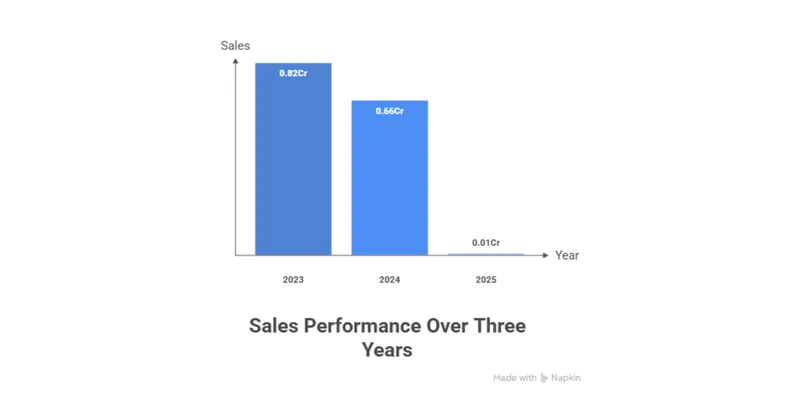
Income Statement: Revenue has effectively vanished, collapsing to a negligible ₹0.01 Cr in 2025. The ₹2.27 Cr profit in 2024 was entirely driven by ₹231.04 Lakh in exceptional income from the sale of the Ankleshwar land. Without this "exit gain," the company would be reporting consistent losses.
Balance Sheet: The company is burdened by a negative net worth and accumulated losses exceeding ₹2,211 Lakh. Operations are entirely dependent on inter-corporate deposits and interest-free loans from the promoter group.
Key Ratios: A Current Ratio of 0.37 signals severe liquidity distress. Most alarming is the Trade Receivables Turnover of 0.36. For a trading firm, this implies a collection cycle of nearly three years—a figure that is functionally terminal and suggests that reported sales may be non-recoverable.
These numbers tell a story of a company at a crossroads, leading into the qualitative insights regarding its survival.
5. Insights
- Strengths: Zero promoter pledge and a technical improvement in book value per share following asset sales.
- Weaknesses: Near-zero revenue, negative net worth, and a collection cycle that suggests operational paralysis.
- Risk Factors: Pending litigation involving Income Tax and Customs disputes exceeds ₹200 Lakhs, threatening the firm's meager cash reserves.
- Future Outlook: The ceramics focus lacks any demonstrable momentum.
The move to an "Asset Light" model is clearly a forced necessity. Without access to traditional bank financing, the company has no choice but to shrink.
6. Conclusion
Kush Industries is in a state of terminal decline rather than a turnaround. While the interest-free promoter debt serves as a vital lifeline, it is a stay of execution, not a strategy for growth.
The business would become insolvent right away without this internal funding. Sales for the year 2025 have virtually stopped, thereby indicating that the switch to ceramics has not been successful. Without a significant external catalyst, the business model cannot be sustained.
7. Data Source
- Kush Industries Limited 32nd Annual Report 2023-24.
- BSE/NSE Data 2024-25 and ICICI Direct Research.