Strategic Financial Analysis: GTN Textiles Ltd. (FY 2023-2025 Transition Report)
1. Introduction: Setting the Stage
GTN Textiles Ltd. serves as a stark, humanized case study in the high-stakes world of corporate restructuring. In an era where the Indian textile industry is increasingly pivoting toward lean, asset-light models to combat rising power costs and labor volatility, GTN’s radical departure from its manufacturing roots is particularly noteworthy. Following the suspension of its spinning operations in June 2022—a casualty of unsustainable wages and a global surge in cotton prices—the company has undergone a surgical extraction of its manufacturing overhead.
The "So What?" Layer
For the discerning analyst, the "so what" of this transition is survival through evolution. By abandoning its legacy spindles, GTN has transformed from a capital-intensive manufacturer into a nimble trading and realty entity. The long-term shareholder value no longer depends on factory throughput but on the leadership’s ability to monetize a 60-year-old brand legacy and a cleared balance sheet to dominate new trading corridors.
2. Company Overview: Evolution and Business Model
Founded in 1966 as a cornerstone of the Kerala-based GTN Group, the company was once synonymous with fine cotton yarns, specializing in the 30s to 120s count range. However, the manufacturing-heavy model that sustained the company for decades eventually became its primary liability.
Today, GTN has embraced a radical "asset-light" strategy. The transition is anchored by the monetization of 25.72 acres of freehold land, which realized Rs. 87.14 Cr. Crucially, this liquidity allowed the company to settle all bank dues in full without any "haircuts." This rare feat in a distressed sector has restored GTN to a "Standard" account status. In the language of credit, this is a strategic reset: the company has effectively traded its physical plant for the financial credibility required to restart operations as a trading house.
3. Leadership Transition: The Patodia Legacy
The GTN narrative is inextricably linked to Shri B.K. Patodia. Over a 60-year tenure, Patodia did not just lead a company; he globalized Indian cotton yarn, securing over 50 export excellence awards. As of August 2025, he has transitioned to Chairman Emeritus, providing a visionary "north star" for the firm.
Shri Umang Patodia, appointed Managing Director effective August 2025, represents the strategic bridge to the future. His concurrent leadership at Patspin India—the group’s manufacturing associate—is a critical piece of the puzzle. This dual role suggests a sophisticated group synergy: while GTN sheds its manufacturing weight to become a lean trading arm, it can potentially leverage Patspin’s production capacity to fulfill its own trading obligations, creating a vertically integrated ecosystem without the individual burden of fixed costs.
4. Financial Statement Analysis: The Numbers Behind the Pivot
The financial data from 2023 to 2025 traces the contraction of a legacy giant and the birth of a lean shell.
Consolidated Financial Summary (FY 2023-2025)
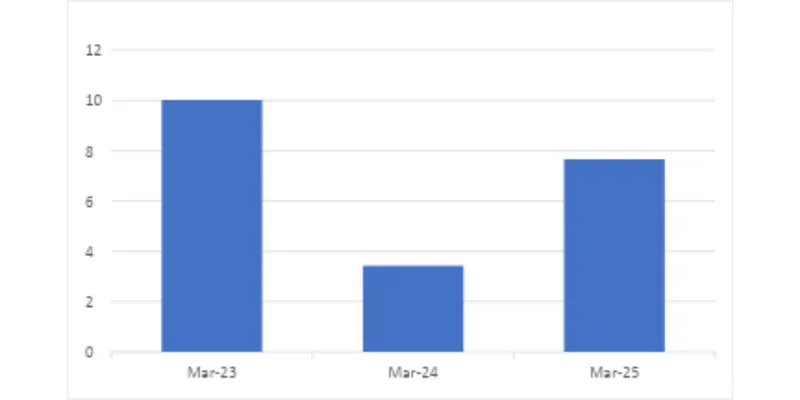
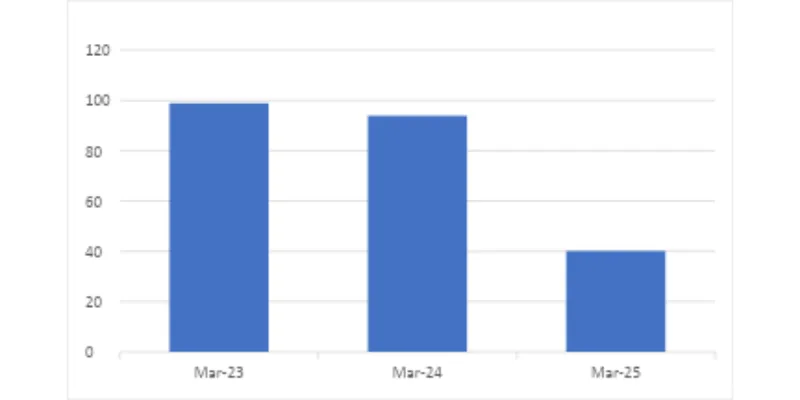
Metric (Rs. Cr) | Mar 2025 | Mar 2024 | Mar 2023 |
Sales | 0.00 | 0.00 | 9.99 |
Total Income (inc. Other) | 7.67 | 3.43 | 10.01 |
Net Profit (Loss) | (7.82) | (12.04) | (17.96) |
Total Assets | 40.20 | 93.94 | 98.94 |
Borrowings | 31.45 | 45.07 | 26.03 |
Interpretation and Ratio Analysis
The "Derived" Total Income of Rs. 10.01 Cr in 2023 (9.99 Cr Revenue + 0.02 Cr Other Income) marks the sunset of the manufacturing era. By 2025, core sales vanished as operations ceased, yet losses narrowed significantly to Rs. 7.82 Cr, aided by Rs. 6.90 Cr profit from the sale of plant and equipment.
A critical nuance lies in the debt profile: while bank dues were cleared in full, the remaining Rs. 31.45 Cr in borrowings primarily comprises Inter-Corporate Deposits (ICDs) and unsecured loans from promoters. Regarding ratios, the current negative ROCE (-1.48% in 2025) is effectively a "distorted metric"; capital is not yet being "employed" in revenue-generating assets, but is instead being held as liquidity for the next phase.
5. Strategic Insights & Interpretation
Strengths & The "Standard Account" Logic
The restoration to "Standard" account status is the lifeblood of the new business model. In cotton yarn trading, liquidity is secondary to creditworthiness; the ability to open new Letters of Credit (LCs) is what allows a trading house to move large volumes with minimal capital. GTN’s clean slate with banks makes this possible. Furthermore, the successful Rs. 1.26 Cr VRS settlement in 2024 has removed the "labor overhang" that typically scares off new investors.
Weaknesses & Risks
The primary weakness is the eroded net worth, which stood at negative Rs. 24.62 Cr as of late 2025. The company is currently a "debt-free shell" with no active manufacturing revenue. It is entirely dependent on the volatile margins of yarn trading and the successful rollout of the Bharat Trade Net digital platform.
The Takeaway: GTN is no longer a textile company; it is a financial vehicle with a legacy brand.
- Integrity Premium: Clearing bank dues in full without a "haircut" provides a rare reputational moat.
- The Pivot: Success depends on whether procurement expertise can replace factory floor efficiency.
- Verdict: It is a high-conviction "startup" with a 60-year-old safety net of brand equity.
6. Conclusion: The Verdict for 2025
GTN Textiles has successfully navigated the "valley of death" that typically follows a manufacturing shutdown. By prioritizing the settlement of bank and labor dues, the Patodia leadership has preserved the most valuable asset: the company’s integrity.
Is this a "phoenix rising"? Perhaps. The 2025 verdict is one of cautious optimism. The company has evolved from a heavy, legacy manufacturer into a lean, credit-ready trading house. The transition is a strategic masterclass in asset monetization to fund a business model pivot. However, the ultimate test remains: can a digital-forward trading avatar generate the margins necessary to rebuild a shattered net worth? For now, GTN is less an investment in cloth and more an investment in the strategic agility of its leadership.
Data Source: GTN Textiles Annual Reports (2023-2025) and Screener.in Financial Database.