STADLER Develops Integrated Textile Sorting Solution for IGERS Recycling Plant in Italy
New facility in San Pietro Mosezzo can process up to 19,200 tonnes of textile waste annually, with an overall recovery rate exceeding 96%
STADLER Group has partnered with IGERS s.r.l. to develop an integrated textile sorting solution for IGERS’ textile recycling facility in San Pietro Mosezzo, Novara, in Italy’s Piedmont region. The project involved process planning, plant layout design, integration of treatment equipment and the supply of a fully automated sorting line to support IGERS’ patented textile recycling process.
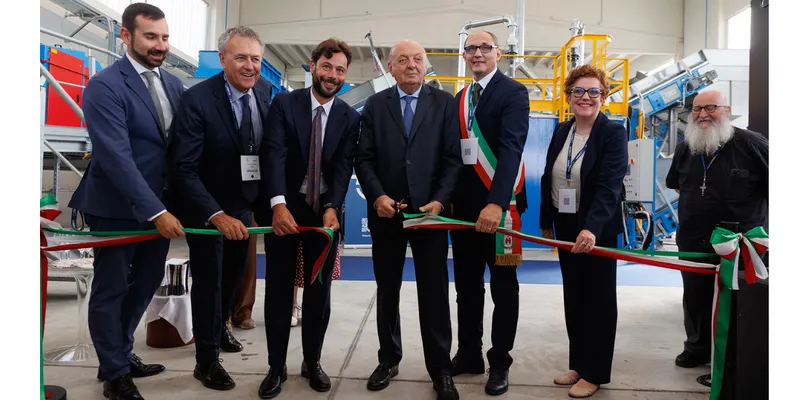
Inaugurated on 21 September 2026, the facility is the first plant in Italy to incorporate all treatment phases of textile recycling. It converts post-consumer and post-industrial textile waste into high-quality flakes and frayed material, with traceability throughout the process.
Plant Capacity and Material Recovery
The facility has a processing capacity of 4 tonnes per hour and is authorised to handle up to 19,200 tonnes of textile waste annually. The total investment amounts to approximately €8 million, including €1.3 million in co-financing from Italy’s National Recovery and Resilience Plan (PNRR).
The plant achieves an overall recovery rate of more than 96% of incoming textile waste. Recovered materials are directed towards different applications, rather than exclusively to spinning-grade fibres. Most of the output is used in nonwoven textiles, while a smaller share goes to spinning and other industrial applications.
The remaining 4% consists of plastics and waste materials. Recovered outputs are supplied primarily to textile manufacturers for new yarns and fabrics and to nonwoven producers. Other applications include furniture and upholstery, construction, automotive and healthcare.
The facility comes amid growing demand for industrial textile recycling solutions in Europe, where separate textile collection and Extended Producer Responsibility requirements are increasing the need to sort and prepare textile waste for high-quality recycling.
IGERS’ Patented Textile Recycling Process
Textile waste presents challenges because it contains different fibre types, composite materials, accessories and contaminants, often with widely varying quality. Transparency regarding sorting decisions and the final destination of recovered materials is also becoming increasingly important.
IGERS has developed a complete textile recycling process, patented in Italy, covering the stages from initial buffering and sanitising to sorting, tearing and final output.
“The distinctive value of our process lies in the integration of impurity separation, technology-based material sorting, mechanical regeneration and digital traceability,” explains Gian Luca Miceli, CEO of IGERS. “We do not consider these stages as isolated activities: they are parts of a single system that enables more accurate decisions to be made about the destination of each material stream.”
Miceli added that the opening of the San Pietro Mosezzo facility marks IGERS’ transition from concept development to industrial-scale operations.
STADLER’s Role in Plant Engineering and Integration
STADLER supported the project from the initial discussions about process requirements through to the final plant layout, which was designed to fit the existing building. The company also integrated key treatment equipment purchased by IGERS, coordinating the individual process stages into a single system.
“We chose STADLER because we were looking for a partner with international experience and a proven ability to translate complex requirements into a reliable engineering solution,” says Miceli. “In a project like this, technology is fundamental, but technology alone is not enough: you also need a structured approach, responsiveness, rigorous interface management and attention to detail.”
The project required coordination among multiple suppliers, integration of existing components and a plant design that could accommodate different sorting operations.
Matteo Zaninelli, Project Manager at STADLER, said the work began with understanding IGERS’ objectives, the characteristics of the incoming material and the required outputs. This informed the development of process flow diagrams, equipment selection and the design of the complete layout.
The collaboration combined IGERS’ expertise in textile recycling with STADLER’s experience in plant engineering, material handling and sorting.
Addressing the Challenges of Textile Handling
Textiles are difficult to handle mechanically because they are soft, flexible and available in different shapes and sizes. They can fold, overlap or become entangled during processing.
STADLER conducted extensive trials at its Test Center, while IGERS carried out additional tests and shared practical knowledge of textile recycling. These trials helped determine suitable configurations for feeding, dosing, conveying and distributing materials throughout the facility.
The positioning of dosing units and the design of distribution hoppers were tailored to textile material behaviour. According to Zaninelli, these design details influence the stability of material flow and the performance of the overall sorting process.
Automated Sorting with Two-Stage NIR Technology
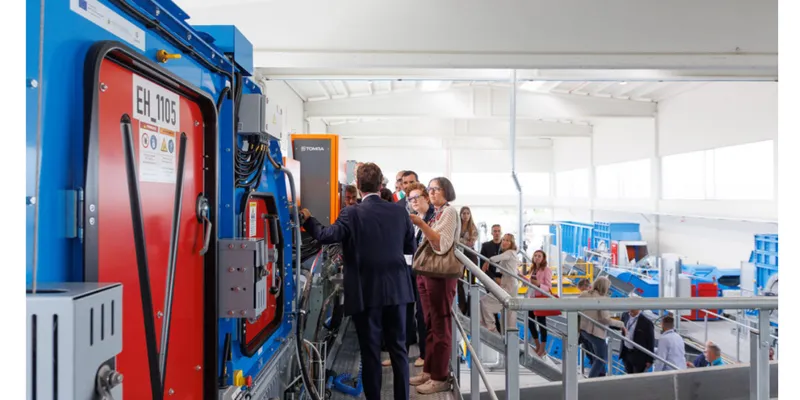
The STADLER sorting line comprises two dosing units, two TOMRA near-infrared (NIR) optical sorters and 16 conveyors. The line prepares textile materials for subsequent recycling stages by separating different fractions and maintaining a continuous, homogeneous material flow.
In the initial sorting stage, the first NIR sorter separates pure textiles, such as 100% cotton or 100% wool, from blended textiles and impurities. The high-value pure fractions are stored in a buffer, while the second NIR sorter separates the mixed textile stream from impurities and non-conforming materials, including pieces of hangers and leather.
During the second stage, buffered material is recirculated through the same sorting equipment, with the NIR sorters configured to separate it according to fibre type.
The system is designed to support different incoming textile streams and processing throughputs. Operators can direct output fractions to a baler, storage containers, a recirculation buffer or the fibre-opening process, depending on material composition and the selected sorting strategy.
The line is fully automated and requires one plant manager to start and stop operations and adjust the NIR sorters’ settings as needed. The resulting fractions can then be directed to different downstream markets according to their composition and quality.
Plans to Expand Textile Recycling Infrastructure
IGERS aims to establish the San Pietro Mosezzo facility as an industrial and technological platform and progressively develop additional recycling hubs, depending on material availability, regional requirements and demand for high-quality recovered materials.
Miceli said wider adoption of the model will partly depend on regulatory clarity, as textile-waste rules continue to develop and create uncertainty for investment and market expansion. Clearer regulatory frameworks could help the sector plan and scale up its operations.
For STADLER, the project builds on experience from previous textile sorting projects and adds to its expertise in integrated sorting and recycling systems.
Zaninelli said the facility demonstrates the importance of combining high-performance machinery, engineering expertise and flexible plant design to manage complex and variable textile waste streams.
STADLER expects textile sorting and recycling to become increasingly industrialised, with sorting technologies evolving alongside the recycling processes they supply. Consistent material quality and appropriate sorting are important for supporting downstream recycling operations and the development of a more circular textile value chain.