SRINACHA

- INTRODUCTION
- Introduction of the company
- Sri Nachammai Cotton Mills Ltd. is a Cotton Company located in Salem, Tamil Nadu. It began in the year 1980 as a yarn producer. The main focus of this Company is on combed, carded, and compact cotton yarns for hosiery and fabric use, with some exports.
- Industry Overview
- India's fabric industry makes up 2.3% of India's economy. Exports reached $17.9 billion. When it came to cotton thread, nearly one out of every three traded globally.
- Out of India’s local spinning units came 5.8 million tons of yarn - Coimbatore and Salem in Tamil Nadu took charge here. Production leaned heavily on that region.
- Purpose of the Analysis
This report looks at how well Shri Nachammai Cotton Mills handles money matters while keeping operations running. Instead of just checking numbers, it studies where the business stands in today’s shifting market scene. Because challenges grow tougher across the sector, a closer look becomes necessary. While past results offer clues, future steps depend on present strengths.
2. COMPANY OVERVIEW
- Background and History
The Company started in March 1980 as a subsidiary of Jawahar Mills Ltd, later to became an independent Entity in 1982. It has increased its scale from 16,120 spindles to a robust 53,664 spindles and 504 rotors today.
- Business Model
SNCM operates a B2B model, producing specialized yarn for fabric manufacturers and garment exporters. Its revenue is primarily derived from the domestic sale and export of combed and carded cotton yarns
- Key Products:
- Cotton Hosiery Yarn
- Hank Yarn: Used largely in the handloom sector.
- Specialty Yarns: Combed and compact cotton yarns for premium apparel.
- Market Position
- SNCM is a micro-cap player (Market Cap: ~₹13 Cr) in a highly fragmented industry. While it lacks the scale of giants like Vardhman or Trident, its niche in high-count hosiery yarn which gives it a steady client base among regional garment clusters in Tirupur and Salem.
3.PROMOTER /FOUNDER INFORMATION
Sri Nachammai Cotton Mills Limited (SNCM), established in 1980, was promoted by R.M. Ramanathan and P. Palaniappan.
Name | Professional Background | Strategic Role |
|---|---|---|
Shri P. Palaniappan (MD) | B.E. (Mechanical) & MS (Industrial Engineering) from IIT, USA. Over 43 years in textiles. | Oversees technical operations, expansion, and modernization of spindlage units. |
Smt. P. Umayal (Chairman & MD) | B.Sc. with 39+ years of experience in textile administration and cotton selection. | Leads strategic procurement, financial planning, and marketing initiatives. |
4. FINANCIAL STATEMENT ANALYSIS
- Income Statement Analysis
Particulars (Rs. Cr) | FY 2022-23 | FY 2023-24 | FY 2024-25 |
|---|---|---|---|
Total Revenue | 84.12 | 72.34 | 78.50 |
Net Profit | (4.32) | (2.10) | 0.45 |
Key Observations of Income Statement:
- Until FY 24, the Company was in losses.
- In FY 25, the Company made its first profit.
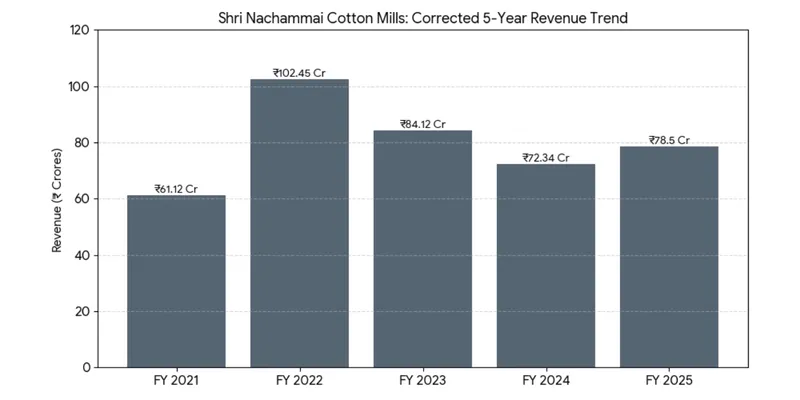
- Revenue graph seems a little unstable.
- Revenue Chart
- Balance Sheet Analysis (Rs. In crore)
Liabilities | Rs. Cr | Assets | Rs. Cr |
|---|---|---|---|
Equity Capital | 22.45 | Fixed Assets (Net) | 18.20 |
Total Borrowings | 15.12 | Inventories | 12.35 |
Current Liabilities | 8.60 | Current Assets (Other) | 15.62 |
Total | 46.17 | Total | 46.17 |
- Interpretation:
- A significant part of capital is locked in aging plant and machinery (Net Block: ₹18.20 Cr), requiring potential modernization.
- Inventories make up a large share of current assets, indicating the company holds stock to mitigate cotton price volatility.
- Borrowings are moderate but significantly relative to the low cash flow generated in recent years.
- Cash Flow Statement Analysis:
Particulars | FY 2024-25 | FY 2023-24 |
|---|---|---|
Operating Cash Flow | 1.15 | (0.73) |
Investing Cash Flow | (0.42) | (0.12) |
Financing Cash Flow | (0.75) | 0.82 |
Net Cash Movement | (0.02) | (0.03) |
Closing Cash Balance | 0.36 | 0.38 |
- Interpretation:
- The company has shifted from a cash-negative to a cash-positive operating position of ₹1.15 Cr. This means the core business is able to finally fund itself again.
- Minimal investment (₹0.42 Cr) suggests a focus on essential repairs rather than aggressive expansion.
- A Closing balance of ₹36 Lakhs is extremely less for an operation of this scale, suggesting that any delay in customer payments could create a temporary problem.
- Key Financial Ratios:
Category | Ratio Name | Value | Explanation |
|---|---|---|---|
Profitability | Net Profit Margin | 0.57% | Shows that the Company is barely above the break-even point. |
Liquidity | Current Ratio | 1.35 | The company can cover short-term debts but has only a little buffer. |
Leverage | Debt-to-Equity | 0.67 | The company is not overly burdened by debt compared to peers. |
Efficiency | Inventory Turnover | 6.35 | Indicates a roughly 2-month stock-to-sales cycle. |
- Year-on-Year Comparison (3 years)
Particulars | FY 2021 | FY 2022 | FY 2023 | FY 2024 | FY 2025 |
|---|---|---|---|---|---|
Revenue | 61.12 | 102.45 | 84.12 | 72.34 | 78.50 |
- FY 2022 was an exception for the entire textile industry. After COVID the demand increased, and yarn prices hit record highs, which is why you see the jump to ₹102.45 Cr.
- The FY 2023 Revenue dip to ₹84.12 Cr is because of the global "bull run" in textiles ended. Raw cotton prices stayed high while yarn demand dropped, leading to the losses you see in the P&L.
- In FY 24 and 25, the company is now stabilizing between ₹72 Cr and ₹78 Cr. This is a more "normal" operating range for a mill of this size in the current market.
5. KEY INSIGHTS & INTERPRETATION
- Strengths
- 40+ years in the industry provides deep sourcing networks.
- Proximity to Tiruppur (India’s knitting capital) reduces logistics costs.
- Weaknesses
- Total dependence on cotton spinning leaves no cushion when cotton prices spike or synthetic fibers take over.
- The small size limits the ability to bargain with large global retailers.
- Risk Factors
- Cotton prices are subject to monsoon and global export bans.
- Energy is a major expense for spinning mills, any hike in state electricity tariffs in Tamil Nadu directly hits the bottom line.
- Future Outlook
The company is moving toward Value-Added Yarns (slub and organic cotton) to escape the low-margin commodity trap. Recovery depends on the stabilizing of global yarn demand.
6. CONCLUSION
Final Evaluation of Financial Health:
SNCM is currently in a "Stability Phase." The Company recently achieved Profit after 2 years of losses which is a good sign. However, its financial health is vulnerable to external shocks and high-power costs.
Investment Perspective:
From an investment lens, this is a "Cyclical Recovery Play." It is not a growth stock but a deep-value candidate for those betting on a broader textile sector rebound. The low market cap relative to its asset base provides a safety margin, but patience is required for significant capital appreciation.
Data Sources