Spinning Gold from Rags: Europe’s Textile Waste Revolution
A business worth billions could be hiding in our wardrobes – or more specifically, in the mountains of textile waste Europe generates each year. While technology is evolving to give old clothes a second life, regulation, consumer habits, and the complexity of fabrics still stand between Europe and a true circular economy for fashion. A Finnish research project has been at the forefront of studying these opportunities, showing just how vast the potential is if Europe can create a coordinated textile recycling ecosystem. “In Europe alone, around 10 billion kilograms of textile waste are discarded annually. Textile fibre’s price per kilogram ranges between 2 and 3 euros, so this field offers enormous business potential,” explains Ali Harlin, Research Professor at VTT Technical Research Centre of Finland. But despite the eye-watering figures, only about 1% of textiles worldwide ever find their way back into new clothing. The culprits, according to Harlin, are both the tricky mix of materials found in modern garments and the absence of clear, continent-wide regulation to push the sector forward.
Towards Shared Responsibility
Change, however, is on the horizon. The European Union has been working on an update to the Waste Framework Directive, which will apply Extended Producer Responsibility (EPR) to the textile industry. If adopted widely, brands and manufacturers will be legally responsible for managing the end-of-life of their products. “The EU is a global leader in textile recycling regulation, but even here, progress has been slow. Proper regulation needs to be in place before we can expect significant advancements in textile recycling rates,” Harlin stresses.
The Science of "Minimal Processing"
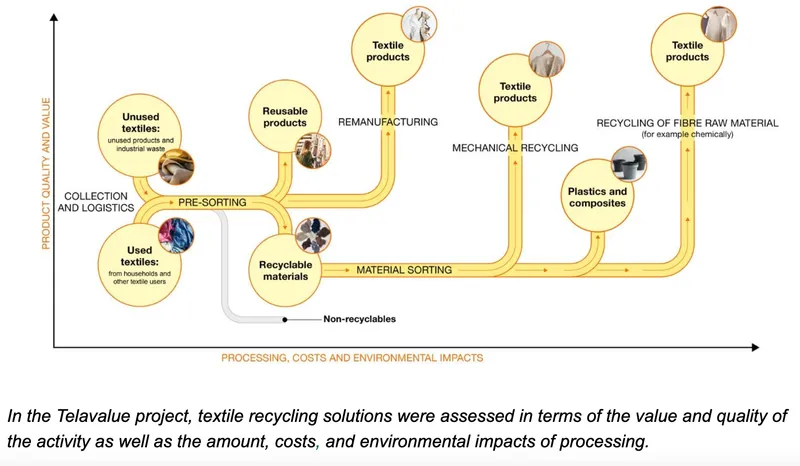
For years, Finland has been exploring innovative approaches to recycling through the Telaketju network of researchers, industry actors, and policymakers. One of its flagship research efforts, the Telavalue project, concluded recently, focusing on solutions to the textile sector’s mounting waste challenges. According to Pirjo Heikkilä, Principal Scientist at VTT, less is more when it comes to recycling. “If a textile can no longer be repaired or reused, the preferred option is mechanical fibre recycling, where collected and sorted textile waste is opened by shredding the fabric and yarn structure into fibres that can be reused in textile production. When the waste is heavily worn or of low quality, it makes sense to move towards chemical recycling, where fibres are broken down and rebuilt at the polymer and even monomer level,” she explains.
A Chance to Revive European Manufacturing
Recycling doesn’t just reduce waste – it could also reconnect Europe with parts of the textile supply chain it long ago outsourced. Technology leadership is already strong in Northern and Western Europe, while much of the hands-on manufacturing skill remains in the south and east. Harlin believes success lies in scaling and cooperation. “Individual countries are too small to act alone. Europe could see the rise of five to ten chemical recycling plants. To feed one chemical plant with textile raw material, we need approximately ten mechanical fibre plants,” he calculates.
The Good, the Bad, and the Ultra-Fast
The potential of recycling is impressive, with companies like Finland’s Infinited Fiber Company already pioneering fibre recovery at an industrial scale. Cotton-based garments are prime candidates, and even stubborn fabric combinations such as polyester-cotton blends are getting closer to efficient large-scale recycling. Innovators are also diversifying the applications of recycled fibres. “Used textiles can be made into not only new textiles but also nonwoven fabrics, wind turbine blades, and even vehicle sound insulation. When textile fibre is mixed with concrete, the structure becomes lighter and more fire-resistant. In asphalt, textile fibre reduces the formation of ruts in the road,” Harlin notes. Yet the rise of ultra-fast fashion remains a thorn in the system. Poorly made, low-cost garments are often complex blends with little resale or recycling value, making their recovery economically unviable. By contrast, the professional workwear sector showcases what a circular model can look like. “Workwear is mainly purchased as a service, which means that the quality, maintenance, washing, and repair of the clothes are in order. Textiles are used for as long as possible, and the business model encourages the use of durable, high-quality materials. When a garment reaches the end of its lifecycle, recycling back to textiles is easier because the materials of the textiles are well known,” Heikkilä explains. Not every textile will make it back into a shirt or a pair of jeans – and that’s okay. Eetta Saarimäki, Senior Scientist at VTT, points to alternative pathways: “Not all complex textile structures and blended materials can be recycled into new textiles. However, through thermo-mechanical recycling, these materials can be used to produce composite products, giving them a new life one more time.”
Research Without Borders
The Telavalue project – carried out by VTT, LAB University of Applied Sciences, and Turku University of Applied Sciences, alongside 17 industry partners and with funding from Business Finland – forms part of Metsä Group’s and Fortum’s ExpandFibre ecosystem. Research is ongoing with EU-backed projects like tExtended and PESCO-UP, which are working to quantify both the financial and environmental impact of different recycling methods.
The Road Ahead
Europe’s textile recycling journey is still in its infancy. Regulation must catch up with innovation, and consumer habits need to align with durability rather than disposability. But as the possibilities expand – from turning worn-out cotton into luxurious new fibres to using shredded textile blends to fortify asphalt – one thing is clear: textile recycling could become both a climate solution and a billion-euro business. The next time you clear out your wardrobe, it might not just be about charity donation or landfill avoidance – it could be fueling an entirely new industrial revolution.