South Africa’s 2025 Economic Outlook Shows Slow but Stable Recovery
Revised forecasts highlight fiscal improvements, policy reforms, and moderate growth.
South Africa’s latest economic update shows slower growth projections but improved fiscal stability, supported by reform momentum, stronger revenue, and easing domestic constraints.
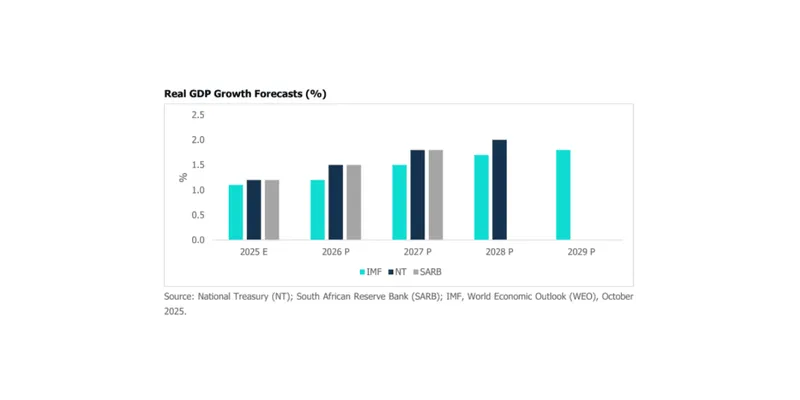
South Africa’s November 2025 economic update shows that the National Treasury (NT) has adjusted its 2025 GDP growth outlook to 1.2%, down from the 1.4% projected in May, aligning it with the South African Reserve Bank (SARB) and close to the IMF’s estimate of 1.1%. The downward revision stems from weaker growth in the first half of 2025. Forecasts for 2026 and 2027 remain nearly unchanged at 1.5% and 1.8%, respectively. Over 2026–2028, growth is expected to average 1.8%, supported by higher infrastructure spending, structural reforms, rising private sector investment, and an easing monetary cycle. Risks remain if reform execution is delayed, hindering investment.
The NT has outlined three alternative scenarios for 2026–2027: Scenario A assumes higher US tariffs that reduce growth by 0.3–0.5 points through weaker exports; Scenario B anticipates lower tariffs, lifting growth by 0.2 points; and Scenario C models accelerated structural reforms under Operation Vulindlela, with growth rising 1.1–1.3 points due to better logistics, energy, water infrastructure, and higher investor confidence.
The IMF’s October 2025 Outlook slightly raised South Africa’s 2025 growth forecast to 1.1%. Growth is expected to improve from 2024’s 0.5% but remains fragile amid global uncertainty. Domestically, improved power availability and new renewable capacity support activity, while constraints in ports and rail continue to weigh on key exporters. Globally, US protectionist policies and weaker demand pose downside risks. Growth is projected at 1.2% in 2026, with medium-term potential capped at around 1.5%, though reforms could lift this.
The 2025 Medium-Term Budget Policy Statement (MTBPS) presents a more positive fiscal outlook. The fiscal deficit is expected at 4.7% of GDP in FY26, declining to 2.9% by FY29 due to stronger revenue and slower growth in expenditure such as wages and debt service costs. However, gross government debt is still expected to peak at 77.9% in FY26 and remain elevated at around 77% by FY29. The government plans to introduce a fiscal anchor in 2026.
Revenue outperformed expectations in the first half of FY26, exceeding projections by ZAR 19.7 billion. VAT benefited from solid household consumption, and Company Income Tax (CIT) was supported by high mineral prices and strong retail performance. Tax revenue is expected to grow at an average of 6.1% between FY27 and FY29. Expenditure growth has been revised upward to 7.9% for FY26 due to allocations for freight rail rehabilitation, the 2026 municipal elections, and other spending commitments. Over the medium term, expenditure is expected to grow at 3.4% annually. Public sector wages rose 5.5% in FY26 and will moderate to around 4% under the multi-year agreement. Debt service costs are projected to rise by 9.3% in FY26 but remain slightly below initial estimates. The Social Relief of Distress (SRD) grant has been extended to March 2027, reflecting ongoing social pressures.
The fiscal deficit is marginally better than earlier forecasts, while gross debt is slightly higher due to lower nominal GDP estimates. Borrowing requirements for FY26 are projected at ZAR 586.2 billion, ZAR 20 billion lower than earlier expectations but still well above FY25 levels due to a large redemption schedule.
Between May and October 2025, the Rand strengthened 4.7% against the US Dollar, with gains driven by global risk appetite following the US Fed’s rate cut, robust commodity prices, and a positive shift in US-China trade relations. Domestically, improved investor sentiment followed South Africa’s removal from the FATF grey list and the government’s renewed fiscal consolidation efforts. The SARB’s decision to pause rate cuts helped maintain the currency’s appeal.
South Africa posted a trade surplus of ZAR 21.8 billion in September 2025, supported by 9.1% growth in exports, particularly vehicles and mineral products. Imports rose 4.2% amid stronger domestic demand. Between January and September, exports totaled ZAR 1.5 trillion and imports ZAR 1.4 trillion, both lower year-on-year due to reduced global trade volumes, but still resulting in a surplus. Future trade performance will hinge on commodity prices, global demand, and tariff developments, including newly introduced tariff measures that may affect bilateral trade with the US.
Headline inflation rose slightly to 3.4% in September from 3.3% in August due to higher housing and utilities inflation and slower declines in fuel prices. Food inflation eased significantly, led by lower cereal, fruit, and vegetable prices despite meat inflation rising due to livestock disease pressures. Electricity tariffs approved by NERSA (12.7% for FY26) and food supply challenges may keep some price pressures elevated, though lower fuel prices could help ease overall inflation.
The National Treasury also announced a revised inflation target of 2–4%, with a 3% midpoint, replacing the previous 3–6% range. This aims to sustainably reduce inflation, foster lower interest rates, and create more fiscal space by reducing borrowing costs.