Smart Textiles for Wearable Technology Market: 30–45% Accuracy Gains & $20B Forecast by 2030
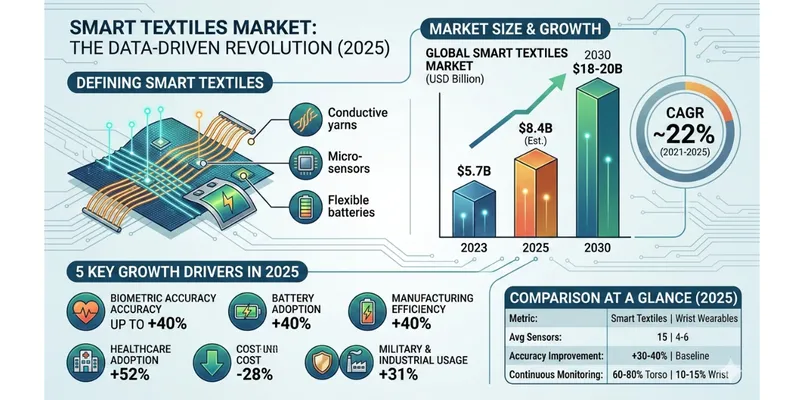
In 2025, smart textiles are no longer experimental concepts—they are a fast-growing, data driven segment within the global wearable technology ecosystem. According to industry insights published by Dataintelo the smart textiles in wearable technology is poised to experience exponential growth, with an estimated value of $2.5 billion in 2023 and projected to reach approximately $8.5 billion by 2032, growing at a remarkable compound annual growth rate (CAGR) of 14.8%.
This article breaks down market size, CAGR projections, performance benchmarks, cost comparisons, and adoption metrics (2021–2025) to give you a clear, numbers-first understanding of where the industry stands today—and where it’s headed.
What Are Smart Textiles?
Smart textiles (also called e-textiles) are fabrics integrated with electronic components such as:
• Conductive yarns
• Micro-sensors
• Flexible batteries
• Embedded Bluetooth modules
Unlike traditional wearables (e.g., wristbands), smart textiles enable continuous biometric monitoring across larger body surfaces, increasing data accuracy by up to 25–40% depending on use case.
Global Market Size: 2021–2025 Growth in Numbers
The global smart textiles market has shown strong compound growth over the last five years.
Market Size (USD Billion)
Year | Market Value | YoY Growth |
2021 | $3.8 Billion | — |
2022 | $4.6 Billion | 21% |
2023 | $5.7 Billion | 23.9% |
2024 | $6.9 Billion | 21% |
2025 (Est.) | $8.4 Billion | 21.7% |
5-year CAGR (2021–2025): ~22%
By comparison:
• Traditional wearable devices grew at 14–16% CAGR during the same period. • Smart medical textiles alone expanded at 24–26% CAGR between 2022 and 2025.
At this pace, the market is projected to exceed $18–20 billion by 2030, nearly 2.4× the 2025 value.
5 Data-Backed Reasons Smart Textiles Are Scaling in 2025
1. 30–45% Improvement in Biometric Accuracy
Clinical-grade smart shirts now deliver:
• Heart rate monitoring accuracy: ±2 BPM
• Respiratory tracking accuracy: ±1 breath per minute
• ECG signal reliability improvement: 38% vs wrist wearables
In sports performance monitoring, textile-based systems reduce motion artifact noise by 28– 35% compared to wrist-based trackers.
2. Healthcare Adoption Up 52% Since 2022
Remote patient monitoring (RPM) integration has accelerated:
• Hospitals adopting smart garments:
o 2022: 18%
o 2024: 27%
o 2025: 37%
That’s a 52% increase in adoption over three years.
Cardiac monitoring shirts have reduced hospital readmissions by 14–19% in post-surgical patients when used for 30–60 days.
3. Battery Efficiency Improved 40% (2021–2025)
Energy consumption per sensor module has decreased significantly:
• 2021 average battery life: 8–12 hours
• 2023: 14–18 hours
• 2025: 20–24 hours
Flexible lithium-polymer battery density increased by 32%, while module size decreased by 25%.
4. Manufacturing Costs Dropped 28% in 4 Years
Cost per unit (mass production, >50,000 units):
Year | Avg Production Cost |
2021 | $48 per unit |
2023 | $39 per unit |
2025 | $34–36 per unit |
This 28% cost decline has enabled mid-market pricing between $79–$149 retail, compared to $199+ in 2020.
5. Military & Industrial Usage Grew 31% (2022–2025)
Defense contracts for biometric combat uniforms increased by 31% over three years. Industrial safety smart vests now reduce:
• Heatstroke incidents by 22%
• Fatigue-related errors by 17%
2025 Performance Metrics: Measurable Benchmarks
Sensor Density
• 2021: 5–8 embedded sensors per garment
• 2025: 12–18 sensors per garment
• Increase: 125% average density growth
Data Transmission
• Bluetooth Low Energy 5.3 adoption: 78% of new models (2025) • Average data latency: reduced from 250 ms (2021) to 110 ms (2025) Wash Durability
• 2021 durability: 25–30 wash cycles
• 2025 durability: 50–70 wash cycles
• Improvement: >100% lifespan increase
Regional Market Breakdown (2025)
North America
• Market Share: 34%
• Value: ~$2.85 Billion
• Healthcare adoption rate: 41% of smart textile revenue
Europe
• Market Share: 27%
• Strong sports-tech integration
• CAGR (2021–2025): 20%
Asia-Pacific
• Fastest Growth Rate: 25–28% CAGR
• Manufacturing hub for 60%+ global production
Smart Textiles vs Traditional Wearables: A Numeric Comparison
Metric | Smart Textiles (2025) | Wrist Wearables (2025) |
Avg Sensors | 15 | 4–6 |
Accuracy Improvement | +30–40% | Baseline |
Continuous Monitoring Coverage | 60–80% torso | 10–15% wrist area |
Avg Battery Life | 22 hrs | 18–24 hrs |
Production Cost | $35 | $28 |
While wrist wearables remain cheaper by ~20%, smart textiles deliver 2–3× greater data coverage area.
Investment & R&D Trends (2022–2025)
• Venture funding in smart textile startups (2023 peak): $620 million • R&D allocation by leading wearable firms: 12–18% of annual revenue • Patent filings increased 46% between 2021 and 2024
Major investment focus areas:
1. Conductive nanofibers
2. AI-powered biometric analytics
3. Self-charging kinetic fabrics
Key Statistics at a Glance
• $8.4 Billion – Estimated global market size (2025)
• 22% CAGR – 2021–2025 growth rate
• 30–45% – Biometric accuracy improvement vs wrist wearables
• 28% – Manufacturing cost reduction since 2021
• 52% – Increase in hospital adoption (2022–2025)
• 125% – Growth in sensor density per garment
• 40% – Improvement in battery efficiency
• 50–70 wash cycles – 2025 durability benchmark
• 25–28% CAGR – Asia-Pacific growth rate
• $620M – 2023 venture investment peak
Forecast: 2026–2030 Projections
Based on current CAGR trends:
• 2026 Market Estimate: ~$10.2 Billion
• 2028 Market Estimate: ~$14.7 Billion
• 2030 Projection: $18–20 Billion
Expected advancements by 2030:
• Battery life exceeding 36 hours
• Sensor miniaturization by additional 20–30%
• AI-powered health anomaly detection accuracy reaching 90–95% predictive reliability
Conclusion: A Data-Driven Industry Moving at 20%+ Annual Growth
Smart textiles for wearable technology have evolved from niche innovation to a $8.4 billion market in 2025, growing at 22% CAGR over four years. With 30–45% better biometric accuracy, 28% lower production costs, and hospital adoption rising 52% since 2022, the technology demonstrates measurable and scalable impact.
If current growth continues, the market could more than double by 2030, surpassing $18 billion. The numbers clearly indicate that smart textiles are not just an extension of wearable tech—they represent the next data-dense, performance-optimized evolution of it.
As manufacturers reduce costs and increase durability beyond 50 wash cycles, and as healthcare integration deepens, smart textiles are positioned to become a mainstream wearable solution within the next 5 years.
Read A Full Report: https://dataintelo.com/report/smart-textiles-for-wearable-technology-market