Smart Textile LED Display Market to Reach USD 9.4 Billion by 2033 with 17.2% CAGR Growth
The global Smart Textile LED Display industry is transitioning from experimental wearable technology into a commercially scalable market. According to market intelligence trends and industry analysis, smart textiles and embedded display technologies are entering high growth phases across healthcare, sports, fashion, defense, industrial wearables, and interactive advertising. Marketintelo identifies increasing integration of flexible LEDs, micro LEDs, conductive fibers, and display-enabled fabrics as a major catalyst shaping industry expansion in 2026 and beyond.
Smart textile technologies are now moving from niche deployments toward mass adoption. Global smart textiles revenue reached approximately USD 2.43 billion in 2025, while broader interactive textile markets are projected to grow aggressively through the next decade.
Key Numerical Highlights
• Global smart textiles market: USD 2.43 billion (2025) → USD 8.48 billion (2034) at 14.9% CAGR
• Smart and interactive textiles industry: USD 5.2 billion (2025) → USD 48.6 billion (2035) at 24.9% CAGR
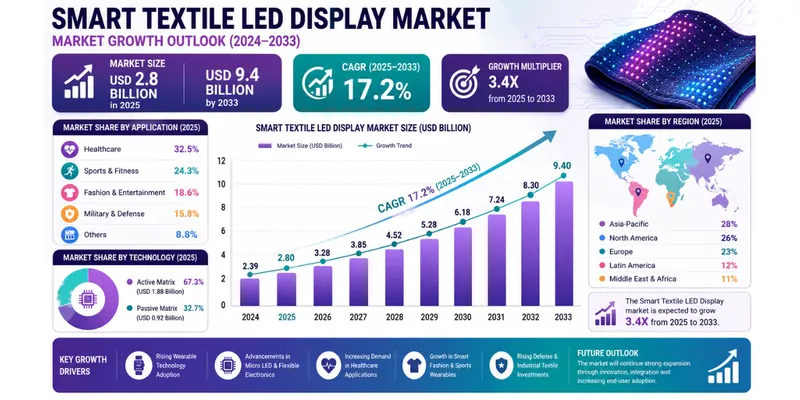
• Wearable micro-LED textile market: USD 2.8 billion (2025) → USD 9.4 billion (2033) at 17.2% CAGR
• Wearable display market: USD 5.3 billion (2025) → USD 34.7 billion (2035) at 20.7% CAGR
• Flexible wearable display segment: USD 2.09 billion (2024) → USD 13.53 billion (2030) with 37.4% CAGR
• Asia-Pacific held approximately 28% smart textile market share in 2025
Smart Textile LED Display Market Overview
The Smart Textile LED Display market combines conductive fabrics, embedded micro-LED arrays, flexible electronics, and low-power display systems to transform traditional textiles into interactive surfaces.
Between 2019 and 2025, investment intensity increased as manufacturers improved durability, washability, and energy efficiency. Smart textile display products now support:
• Dynamic apparel graphics
• Medical visualization garments
• Sports performance displays
• Military communication fabrics
• Interactive retail installations
• Automotive interior textiles
The wearable micro-LED textile segment reached approximately USD 2.8 billion in 2025, with expectations of reaching USD 9.4 billion by 2033, creating more than USD 6.6 billion in incremental opportunity.
Historical Growth Analysis (2016–2026)
The evolution of Smart Textile LED Display technology shows accelerating
commercialization.
Year-wise Industry Expansion
Year | Estimated Industry Trend |
2016 | Early prototype phase |
2018 | Flexible LED textile commercialization begins |
2020 | Increased wearable electronics demand |
2022 | Growth in healthcare textile integration |
2024 | Flexible display revenue exceeds USD 2.08B |
2025 | Smart textile market surpasses USD 2.43B |
2026 | Large-scale commercialization expands |
Flexible wearable display revenue increased from under early-stage deployment levels to USD 2.09 billion by 2024, creating one of the fastest-growing subsegments in wearable electronics.
Year-over-year acceleration also became visible:
• 2024→2025 smart textiles value increased from USD 2.21B to USD 2.61B (+18%) in one market estimate
• 2025→2026 wearable display expanded from USD 5.3B to USD 6.4B (+20.8%)
• 2026→2030 flexible wearable displays expected to expand by more than 6×
Regional Performance Breakdown
North America
North America remains a leading innovation center for Smart Textile LED Display technologies.
The region benefits from:
• High wearable penetration
• Defense textile procurement
• Healthcare digitization
• Strong venture funding
North America historically accounted for nearly 35% of smart textile activity in earlier market cycles, while continuing strong expansion in premium applications.
Europe
Europe continues growth through:
• Sustainable smart fabric initiatives
• Automotive interior integration
• Fashion-tech collaborations
Countries investing in advanced textile engineering are accelerating commercialization across industrial and luxury applications.
Asia-Pacific
Asia-Pacific dominates production and scale.
Key numbers:
• 28% global smart textiles market share in 2025
• Largest region in wearable display manufacturing
• China represented 42% of global wearable shipments in Q2 2025
Regional manufacturing scale and semiconductor ecosystems continue reducing LED textile costs.
Middle East & Latin America
These markets remain smaller but increasingly attractive for:
• Smart uniforms
• Retail media textiles
• Tourism applications
• Event-driven wearable displays
Technology Segmentation Driving Revenue
The Smart Textile LED Display ecosystem is becoming more specialized. By Technology (2025)
Segment | Market Share |
Active Matrix | 67.3% |
Passive Matrix | 32.7% |
Active matrix technology generated approximately USD 1.88 billion in 2025 due to better brightness control and lower power consumption.
By Application
Application | Share | 2025 Value |
Healthcare | 32.5% | USD 910M |
Sports & Fitness | 24.3% | USD 680M |
Fashion & Entertainment | 18.6% | USD 520M |
Military & Defense | 15.8% | USD 442M |
Healthcare remains the largest adoption area because smart garments improve patient monitoring and real-time data visibility.
Competitive Landscape and Investment Momentum
The Smart Textile LED Display market remains fragmented but increasingly competitive. Major investment areas include:
• Flexible micro-LED manufacturing
• Conductive fiber production
• Washable display modules
• AI-integrated wearable interfaces
• Battery miniaturization
Industry participants are focusing on reducing power draw by 20–40%, increasing display flexibility, and improving textile lifespan.
Wearable display technologies are projected to generate USD 34.7 billion by 2035, creating strong downstream opportunities for textile-integrated displays.
Micro-LED wearable displays alone are forecast to expand from USD 160 million in 2025 to USD 1.2 billion by 2030, while shipments could rise from 300,000 units to over 3 million units.
Future Outlook: 2030–2035
The next growth phase for Smart Textile LED Display will likely be defined by: • AI-enabled adaptive fabrics
• Energy-harvesting textiles
• Transparent LED fibers
• Medical monitoring garments
• Interactive retail apparel
Forecast indicators suggest:
• Smart textile industry approaching USD 10 billion by 2033
• Interactive textile ecosystems reaching USD 48.6 billion by 2035
• Wearable displays expanding beyond USD 34 billion by 2035
Conclusion
The Smart Textile LED Display industry has moved beyond concept validation into measurable commercial growth. From USD 2.8 billion wearable micro-LED textile revenue in 2025 to an expected USD 9.4 billion by 2033, the category is positioned for sustained double-digit expansion. Asia-Pacific leads manufacturing scale, healthcare leads application adoption, and flexible display innovation continues lowering barriers to deployment.
As investment, production efficiency, and textile-electronics integration improve, Smart Textile LED Display solutions are expected to become a mainstream digital interface across apparel, healthcare, defense, and consumer experiences.
Read A Full Report: https://marketintelo.com/report/smart-textile-led-display-market