Smart Textile Dyeing: AI and Colour Consistency
-2-300x300.webp?2026-10-19T07:47:07.907Z)
Kshipra Kulkarni
In textile dyeing, achieving the desired colour is only part of the challenge. The larger challenge is achieving that colour consistently, efficiently and at production scale. A shade that matches the approved laboratory standard may still behave differently when transferred to a bulk dyeing machine because fibre characteristics, water quality, dye concentration, temperature, pH, liquor ratio, auxiliaries and process conditions can all influence the final result.
This complexity has traditionally made colour matching a combination of scientific calculation and practical experience. However, the modern dyehouse is increasingly becoming a data-driven environment. Digital colour measurement, automated dosing, recipe prediction, process monitoring and artificial intelligence are changing how dyeing decisions are made.
The objective is increasingly moving towards a right-first-time approach, where the correct shade is achieved with fewer trial dyeings and less corrective processing.
Why Getting the First Dyeing Right Matters
A dyeing recipe is more than a list of dyes and quantities. It represents the interaction between colourants, fibres, chemicals, water and processing conditions.
Reactive dyes used on cotton, for example, depend on factors such as electrolyte concentration, alkali addition, temperature and fixation conditions. Polyester dyeing with disperse dyes involves different temperature and diffusion behaviour. Blended fabrics introduce an additional level of complexity because different fibres may require different dye classes and processing conditions.
Even when the same recipe is used, variations in fibre lots, pretreatment, water chemistry or machine conditions can affect the resulting shade.
When a bulk batch does not meet the required colour tolerance, correction may involve additional processing, overdyeing or, in some cases, stripping and redyeing. Such interventions consume additional time, dyes, chemicals, water and energy.
Consequently, right-first-time dyeing is not simply a quality objective. It is also a productivity and resource-efficiency objective.
From Colour Perception to Measurable Data
Human colour perception remains important, but modern dyehouses increasingly complement visual assessment with instrumental colour measurement.
Spectrophotometers can quantify colour using numerical colour spaces such as CIELAB. Instead of relying exclusively on whether two samples appear visually similar, colourists can examine measurable differences in lightness, redness-greenness and yellowness-blueness.
This creates a digital link between the approved standard and the production process.
The resulting colour data can become part of a broader digital workflow. Historical recipes, substrate information, dye combinations and previous production results can be stored and retrieved rather than remaining solely within the experience of individual colourists.
This is particularly valuable when a dyehouse handles thousands of colourways. A previous successful recipe can provide a starting point for a new production order, while data from unsuccessful attempts can help identify patterns that may otherwise be overlooked.
Recipe Prediction Becomes More Intelligent
Recipe prediction has been an important area of textile colouration research for years. Traditional approaches include mathematical models such as Kubelka-Munk theory, while newer systems use statistical modelling and machine learning.
Recent research is pushing this concept further. A 2026 study published in Digital Chemical Engineering investigated inverse machine learning for dye recipe design, predicting dye concentrations from target CIELAB colour coordinates. The study combined Gaussian process regression with optimisation and physical constraints and experimentally evaluated predicted recipes on dyed microfiber fabrics.
Another recent study in Coloration Technology proposed a data-driven framework for predicting and optimising reactive dye recipes for cotton.
The significance of such developments lies in changing the direction of the conventional process. Instead of repeatedly asking which recipe may produce a target shade, computational systems can increasingly work backwards from the desired colour and identify a suitable recipe.
The technology does not eliminate the chemistry of dyeing. It makes the chemistry more data-accessible.
The Dyehouse as a Connected System
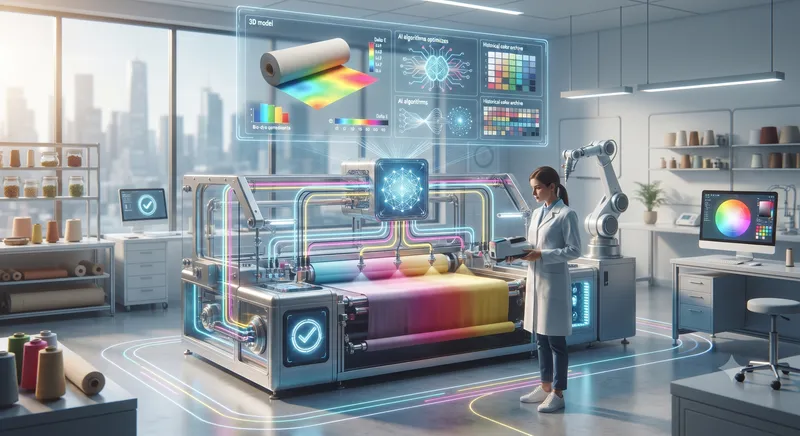
Smart dyeing extends beyond recipe prediction. A modernised workflow can connect laboratory colour development with production machinery, chemical dosing and quality control.
The process may begin with a digital colour standard. A laboratory system then develops or retrieves a recipe based on the fibre, dye class and available chemicals. Once approved, production parameters can be transferred into the dyeing system.
Automated dispensing equipment can measure and deliver dyes and auxiliaries with greater precision than manual handling. Production machines can record parameters such as temperature, time, pH and dosing stages. Colour measurement at the laboratory or production stage can then provide feedback on the outcome.
This creates a continuous information loop:
Target colour → recipe prediction → laboratory validation → automated dosing → controlled dyeing → instrumental colour measurement → data feedback.
Such connectivity can reduce the gap between laboratory development and bulk production.
Automation and the Human Factor
Automation does not make the colourist obsolete. Instead, it changes the nature of the colourist's role.
Experienced colourists understand variables that may not always be adequately represented in historical datasets. They recognise unusual substrate behaviour, interpret visual differences and understand how particular dyes and auxiliaries behave under specific processing conditions.
Digital systems are strongest when they support this expertise.
For example, a recipe prediction system can identify several technically suitable recipes, while the colourist can select the most appropriate option based on dye availability, process limitations, fastness requirements, cost and production conditions.
The future dyehouse is therefore more likely to be a collaboration between human expertise and computational intelligence than a completely autonomous environment.
Right-First-Time and Resource Efficiency
The environmental implications of better colour accuracy are significant because failed or corrective dyeing creates additional processing.
If a batch requires reprocessing, the resource requirement of the original dyeing does not disappear. Additional water, energy, chemicals, labour and machine time may be required to achieve the final result.
Reducing the number of unsuccessful dyeing attempts therefore has a direct relationship with resource efficiency.
Chemical management is another important part of this equation. The ZDHC framework focuses on safer chemical inputs, process management and measurement of outputs such as wastewater. Its Wastewater Guidelines provide harmonised expectations for sampling, testing and reporting industrial wastewater and sludge from wet-processing facilities.
Digital process control can support this broader chemical-management objective by making recipes, chemical inputs and process parameters more traceable.
Beyond Colour Accuracy
The value of smart dyeing should not be measured only by whether a sample matches a colour standard.
A truly efficient system considers several variables simultaneously: colour difference, reproducibility, dye utilisation, process time, water consumption, energy demand, chemical input, machine capacity and production cost.
This changes the definition of a successful recipe.
The ideal recipe may not simply be the one that produces the closest colour. It may be the one that achieves the required colour tolerance while offering reliable fixation, appropriate fastness, efficient processing and practical production economics.
This is where data analytics can become particularly valuable. Historical production information can help identify recurring causes of shade variation, allowing dyehouses to move from reactive correction towards predictive process control.
The Next Generation of Colour Consistency
The next stage of smart dyeing is likely to involve increasingly connected systems in which colour development, chemical management and production data are treated as parts of a single ecosystem.
Machine learning can support recipe development. Automated dispensing can improve dosing accuracy. Sensors can monitor process conditions. Digital colour measurement can quantify the final result. Manufacturing data can then feed back into future recipes.
The objective is not simply to digitise an existing dyeing process. It is to make the process more predictable.
For textile manufacturers, this shift could transform colour consistency from an outcome that is checked at the end of production into a parameter that is continuously managed throughout production.
The concept of right-first-time dyeing therefore represents more than a technological upgrade. It signals a change in manufacturing philosophy. Colour becomes measurable data, recipes become increasingly predictive, machines become more responsive and production decisions become better informed by historical evidence.
In a sector where every additional dyeing cycle can translate into additional resources, time and cost, getting the colour right the first time may become one of the most important measures of a truly smart dyehouse.
References:
1. Cho, H. & Lee, S. G. (2026). Extrapolative machine learning for resource-efficient dyeing recipe design in recycled PET/PCT microfiber. Digital Chemical Engineering, 20, 100335.
2. Li, F. et al. (2022). A novel approach for recipe prediction of fabric dyeing based on feature-weighted support vector regression and particle swarm optimisation. Coloration Technology, 138(5), 495–508.
3. ZDHC Foundation, Wastewater Guidelines.