Small Orders, Real Margins: What Combat Sports Apparel Teaches About Low-MOQ Production
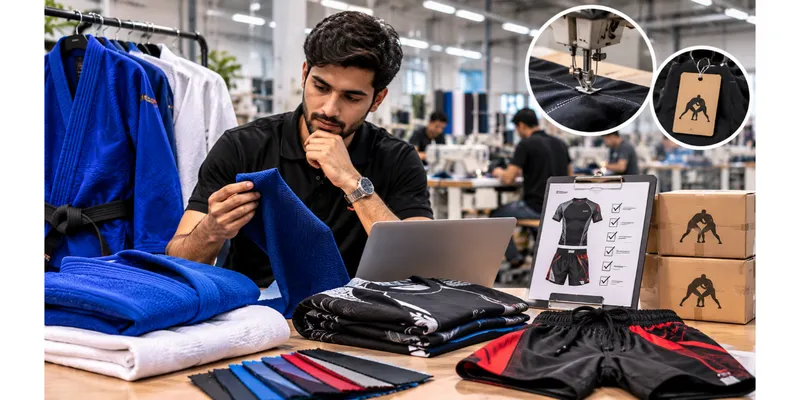
Highlight: Gyms, academies and new fightwear labels buy in runs of 30 to 300 pieces, not thousands. Drawing on day-to-day production of BJJ gis, martial arts uniforms, rash guards and fight shorts in Sialkot, this article explains why demand in combat sports apparel stays fragmented, how one order can span heavy woven cotton and sublimated stretch knits, where short runs usually fail (shrinkage, colour matching, size curves, rushed sampling), and how factories can make low-MOQ production pay through standard bases, documented samples and reorder economics.
Most apparel sourcing conversations still treat minimum order quantities as a volume problem. The brand wants fewer pieces; the factory wants more; the compromise is usually an uncomfortable middle number at a higher unit price. In combat sports apparel, that framing has never matched how the market actually buys. Gyms, academies and first-time fightwear labels routinely need 30 to 300 pieces, not thousands. Factories that can make those runs profitable have built a different operating model — one that the wider industry keeps rediscovering whenever inventory risk becomes expensive.
I work with an OEM and private-label workshop in Sialkot, Pakistan, making Brazilian jiu-jitsu gis, martial arts uniforms, rash guards and fight shorts. Our minimum is 30 pieces per design. The lessons below come from that daily work, not from a consulting slide deck.
Why the order size stays small
Combat sports demand is real, but it is fragmented. A BJJ academy selling branded gis to its own members may need a few dozen jackets across a wide size range. A coach launching a label often wants one colourway of rash guards to test before committing cash. A club ordering for a tournament needs a short, dated run — not a season's forecast.
Those buyers cannot absorb dead stock the way a national retailer can. If the only path to production is a thousand-piece minimum, many simply do not launch, or they launch once, sit on unsold sizes, and never reorder. Neither outcome helps a supplier that wants repeat business. Low MOQs in this niche are therefore not a concession to "small" customers. They are how demand actually presents itself.
Two product worlds inside one category
A single combat sports order often spans two manufacturing systems that behave very differently.
Heavy woven cotton covers gis and many traditional uniforms. Jackets are built to be gripped and pulled, so the fabric is dense, the collar is multi-layer, and stress points are reinforced. Quality hinges on fabric weight and construction, shrinkage control after washing, and stitching that holds under load. Sampling means washing and measuring, not only approving a photo. Lead times depend on fabric availability as much as on sewing capacity.
Sublimated polyester-spandex knits cover rash guards, spats and many fight shorts. Here the skills sit closer to performance activewear: print alignment on stretch fabric, colour consistency across sizes, flatlock seams that sit flat against the skin, and pattern grading so artwork does not distort on larger bodies. Setup is file-heavy. A wrong colour profile or a stretched logo on an XXL can spoil a whole short run.
Mixing both product types in one buyer relationship is common — a gym wants gis and rash guards under the same brand — but the factory processes, failure modes and QC checklists are not interchangeable. Treating them as one "sportswear" line is where many small-batch plans go wrong.
Where short runs fail
Small orders leave little buffer. A few recurring mistakes account for most of the pain.
Shrinkage on woven cotton. A gi that fits the sample before washing and tightens unevenly after is not a minor complaint; it can make an entire size curve unusable. Pre-shrunk fabric, wash tests on each lot, and measurements recorded after laundering matter more on 40 pieces than on 4,000, because there is no spare inventory to absorb the error.
Colour matching across fabrics. The same Pantone reference rarely looks identical on pearl-weave cotton and on polyester knit. Buyers who approve colours separately for each fabric avoid the surprise of a "matching" set that does not match under store lighting or on camera.
Size curves copied from apparel defaults. Combat sports populations skew differently from fashion retail. Ordering too many mediums and too few large and XL sizes is a classic way to turn a successful design into stranded stock. The safer approach is to build the curve from the buyer's actual members or past sell-through, then reorder the sizes that moved.
Rushing sample approval. On a short run, the sample is the specification. Skipping a wash test, a print strike-off or a written measurement sheet saves a few days and often costs the whole order.
None of these disciplines are unique to low MOQs. Short runs simply make skipping them unaffordable.
How factories make 30–300 pieces work
From the supplier side, margins on small orders depend less on heroic efficiency and more on reducing repeated setup cost.
Keep a small set of proven base patterns and fabric options, and put customisation on the surface: colours, patches, embroidery, sublimation artwork. Batch fabric and trim purchases across several clients where shade lots allow it. Treat the first order as the expensive one — sampling, files, grading — and price reorders so that consistency is rewarded. Document every approved sample so the second and third runs match the first.
The economics change when the relationship is a series of reorders rather than a one-off trial. A 50-piece first order that returns four times is better business than a single 500-piece run that never comes back because sizing or colour drifted. That is the real margin story in this niche: not the unit price on day one, but the lifetime of a clean specification.
What this asks of South Asian suppliers
South Asian sportswear exporters, Sialkot included, have long competed on craft skill, decoration and responsiveness as much as on headline volume. Low-MOQ combat apparel sharpens that advantage — and exposes the gaps.
Flexibility wins when workshops can sample quickly, communicate clearly in writing, and ship small cartons without the landed cost destroying the quote. It loses when fabric lots vary between reorders, when QC is informal, or when the only commercial model on offer is a high minimum designed for a different buyer.
Competing on flexibility rather than volume means investing in the unglamorous parts of the process: recorded measurements, shade continuity, embroidery and print files that are version-controlled, and honest lead times that include decoration and packing. Buyers in this category compare total reliability across a year of reorders, not only the first proforma invoice.
The wider lesson
Apparel at large has spent years talking about overproduction, inventory risk and nearer-demand manufacturing. Combat sports apparel did not adopt small runs as a sustainability slogan. It adopted them because the customers never had warehouses full of forecasted stock to begin with.
Low MOQs done properly are not charity to small brands. They are a way to match production to real sell-through, to replace a shaky forecast with a reorder, and to keep unsold goods out of discount bins and landfills. The factories that treat 30-piece orders as a serious operating system — with the sampling, documentation and reorder economics to match — will keep earning that work. The ones that treat low minimums as a temporary favour will keep wondering why the margin never appears.
References
No external sources are quoted. The article is based on the author's production experience; no photographs are used in the article.
About the author: Muhammad Asad works with Combatwear Factory (https://combatwearfactory.com/low-moq-manufacturing/), an OEM and private-label manufacturer of martial arts uniforms and combat sports apparel in Sialkot, Pakistan.