Six Companies Nominated for Best CO2 Utilisation 2026 Innovation Award
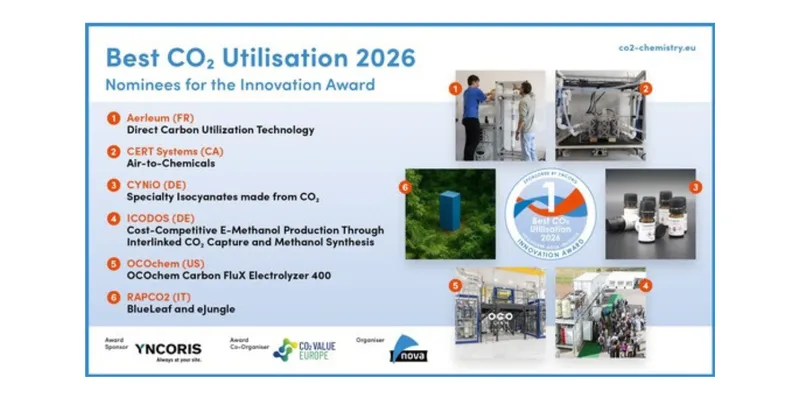
Six companies have been nominated for the “Best CO2 Utilisation 2026” Innovation Award, which will be presented at the CO2-based Fuels and Chemicals Conference 2026. The conference will take place in Cologne, Germany, and online on 28–29 April 2026, highlighting technologies that convert carbon dioxide into fuels, chemicals, and industrial materials.
As part of the conference programme, six companies have been nominated for the “Best CO2 Utilisation 2026” Innovation Award. The award recognises developments in technologies and materials that utilise CO2 as a resource.
The award is organised by nova-Institut and CO2 Value Europe, with sponsorship from Yncoris. During the conference, the six nominees will present their technologies, and the audience will select three winners through a live vote.
Previous nominees and winners have presented a range of CO2-based applications, including battery-grade carbon materials, carbon nanotubes, polyurethanes derived from CO2 for use in textiles or footwear, and electrochemical methods for producing methanol fuels. The 2026 nominees present additional approaches for converting CO2 into industrial products.
The nominated technologies represent different pathways for industrial CO2 utilisation, including electrochemical conversion, integrated carbon capture and synthesis systems, and direct air capture technologies linked to chemical production.
Aerleum (FR) has developed Direct Carbon Utilisation technology that converts atmospheric or industrial CO2 into fuels and chemical products. The first application is e-methanol, which can be used in aviation after conversion into jet fuel and in maritime shipping as a fuel. E-methanol can also serve as a feedstock for chemical production.
CERT Systems (CA) has developed an Air-to-Chemicals process that captures atmospheric CO2 and converts it directly into ethylene within a single integrated system. The process avoids the regeneration step typically required to produce pure CO2. Ethylene produced through this process is used in plastics manufacturing and can also serve as an intermediate for Sustainable Aviation Fuel (SAF).
CYNio (DE), a spin-off from TU Bergakademie Freiberg, is developing a CO2-based production process for specialised isocyanates. The method uses CO2 instead of phosgene to produce isocyanates used in products such as adhesives, coatings, and pharmaceuticals.
ICODOS (DE) has developed a technology integrating CO2 capture with methanol synthesis for e-methanol production. According to the company, the hybrid process reduces energy demand by more than 70% compared with current technologies and achieves more than 95% CO2 utilisation. The system also features modular plant units designed to reduce project execution time to less than three years.
OCOchem (US) is presenting the Carbon FluX Electrolyzer (CFX) 400, which converts captured carbon dioxide and water into formic acid or potassium formate through electrocatalytic processes. The system uses four industrial-scale CO2 electrolyzer cells and produces 60 tons per year. The first carbon-negative formates were shipped in October 2025 to five customers.
RAPCO2 (IT) is introducing two indoor Direct Air Capture systems called BlueLeaf and eJungle. BlueLeaf captures CO2 from indoor environments such as offices or shops, while eJungle combines multiple BlueLeaf units. The captured CO2 is converted into acetate through a patented bioreactor and later processed into isopropyl alcohol (IPA).
The conference programme also examines the transition of Carbon Capture and Utilisation (CCU) technologies from pilot projects to industrial-scale deployment. Discussions will address integrated capture and conversion systems, business models for investment, and regulatory frameworks influencing project development.
Additional sessions will cover renewable hydrogen availability, identification and use of CO2 sources including biogenic streams, and certification and sustainability assessment methods for CO2-based products.
The annual conference brings together more than 230 international participants from industry, research, and policy sectors for presentations, poster sessions, and networking across the CCU and Power-to-X value chain.
The CO2-based Fuels and Chemicals Conference 2026 is supported by sponsors GIG Karasek and Holcim. Mona Neubaur, Minister for Economic Affairs, Industry, Climate Protection and Energy of the State of North Rhine-Westphalia, has taken on the patronage of the conference.