Shanti Gold International Ltd.
Introduction
Introduction of the Company
Shanti Gold International Limited works in the jewellery sector in India. This sector is growing fast. The main thing that Shanti Gold International Limited does is make gold jewellery and export it to countries. They are good at making jewellery in India and then exporting it to other places.
Industry Overview
The industry is over the place but people want the things it makes so it does well. This is because of things like what people like to buy, weddings and selling to countries like the Middle East and the United States of America. The industry is really driven by what people want to buy. It is also affected by things like cultural consumption, weddings, and export markets.
Purpose of the Analysis
This analysis aims to evaluate whether Shanti Gold is just another volume-driven jeweller or a fundamentally strong business with sustainable financial health.
Company Overview
Background & History
Shanti Gold is a jewellery maker from Mumbai. They have been around for many decades. They make gold jewellery and export it to countries.
They work with retailers and wholesalers from other countries. They have built relationships with these international partners.
Business Model
The company follows a B2B export-driven model, manufacturing jewellery and supplying to overseas clients. Margins are typically thin due to high competition and gold price volatility.
Product Offerings
- Gold jewellery (chains, bangles, rings).
- Export-oriented collections.
- Custom manufacturing for global clients.
Market Position
Shanti Gold is not a dominant brand—it’s a backend manufacturer, which means: Lower branding power, Higher dependency on bulk orders, Vulnerability to price competition.
Promoter Introduction
Professional Background:
Traditional jewellery business family. Deep industry experience in gold trading and jewellery exports.
Role in Company Growth:
- Built export relationships
- Scaled manufacturing capacity
- Positioned the company in international markets
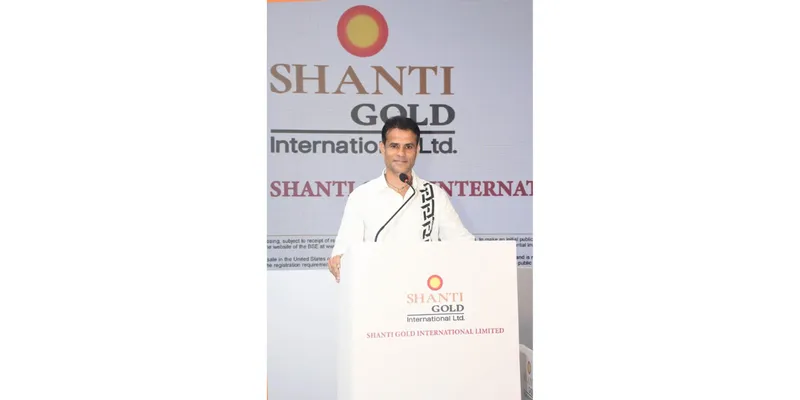
Pankaj Kumar H. Jagawat
Financial Statement Analysis
Income Statement
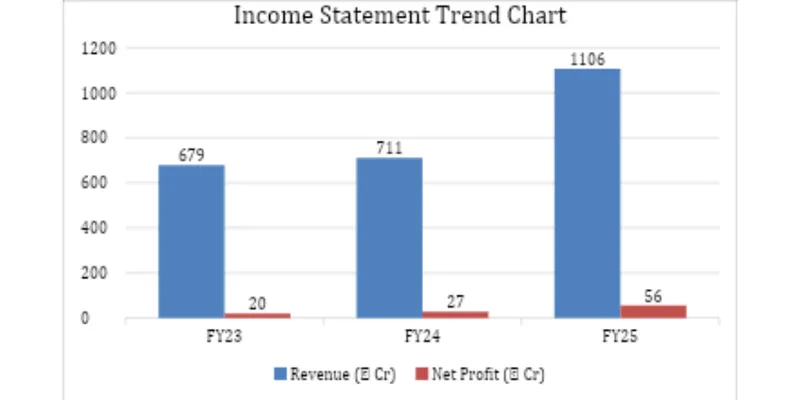
- Revenue spike in FY25 after a weak FY24 suggests growth may be inconsistent and order-driven.
- Profit growth is likely volume-led, not due to stronger pricing or business quality.
- Margins improved (6% → 8%) but remained low, reflecting a competitive industry.
- EPS stagnation in FY24 raises concerns about value creation for shareholders.
- Fast growth with a capital-intensive model makes sustainability a key risk.
Year | Revenue (₹ Cr) | Net Profit (₹ Cr) | EPS | OPM % |
FY23 | 679 | 20 | 15.33 | 6 |
FY24 | 711 | 27 | 15.33 | 7 |
FY25 | 1106 | 56 | 17.31 | 8 |
Balance Sheet
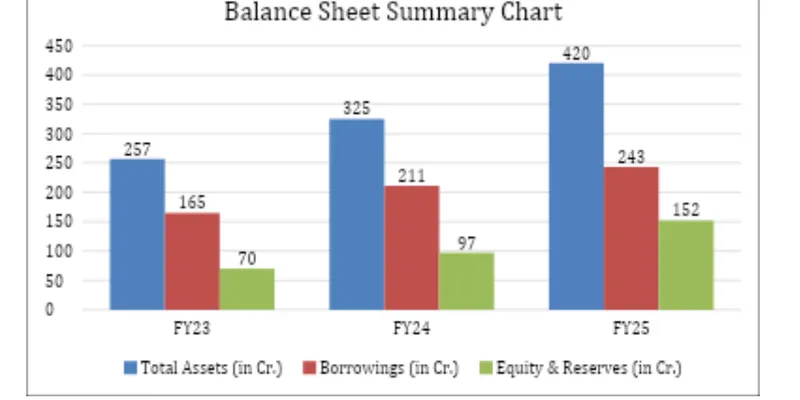
- The company’s assets are largely tied up in inventory, mainly gold stock, which makes the balance sheet look strong but not necessarily efficient.
- On the liabilities side, it relies heavily on working capital borrowings to fund daily operations.
- Equity growth is limited, indicating that the business is not significantly building long-term shareholder value.
- The key issue is that most assets are in gold inventory, which does not generate returns on its own unless sold.
- This means the company appears asset-rich, but in reality, much of that capital is simply locked and not productively deployed.
Cash Flow Statement
- Operating cash flow is inconsistent, meaning profits don’t always convert into real cash.
- The business requires high working capital to manage inventory and daily operations.
- A large amount of cash gets locked in gold stock and customer receivables.
- This delays cash availability and puts pressure on liquidity.
- As a result, growth may look strong, but financial flexibility remains limited.
Key Financial Ratios
- ROCE: 10–12% → Mediocre
- ROE: 11–13% → Average
- Debt-to-Equity: 1.0–1.3 → Slightly high
- Debtor Days: Increasing → Warning sign
- Inventory Days: High → Capital locked
Key Insights & Interpretation
Strengths:
- Consistent revenue growth.
- Export presence (diversified demand).
- Experienced promoter.
Weakness:
- Thin profit margins.
- High working capital dependency.
- Low pricing power (commodity-driven business).
Risk Factors
- Gold price volatility.
- Currency fluctuations (export exposure).
- Increasing debtor days → potential cash stress.
- Industry competition (unorganized + branded players).
Future Outlook:
Growth will likely continue Unless:
- Branding improves OR
- Operational efficiency sharply increases
The company remains a volume game, not a value creator.
Conclusion
Final Evaluation of Financial Health:
Shanti Gold is financially stable but not exceptional. It shows steady growth, but returns remain moderate due to structural limitations of the jewellery manufacturing business.
Investment Perspective:
This is not a high-conviction investment. It fits a low-margin, working-capital-heavy model with limited upside in returns. Suitable only if valuations are attractive—not for long-term wealth compounding.
Data Sources
https://www.screener.in/company/SHANTIGOLD/
https://www.nseindia.com/get-quote/equity/SHANTIGOLD/Shanti-Gold-International-Limited