Samarth: The Scheme Building India’s Textile Workforce
-3-800x400.webp?2026-08-03T11:54:09.782Z)
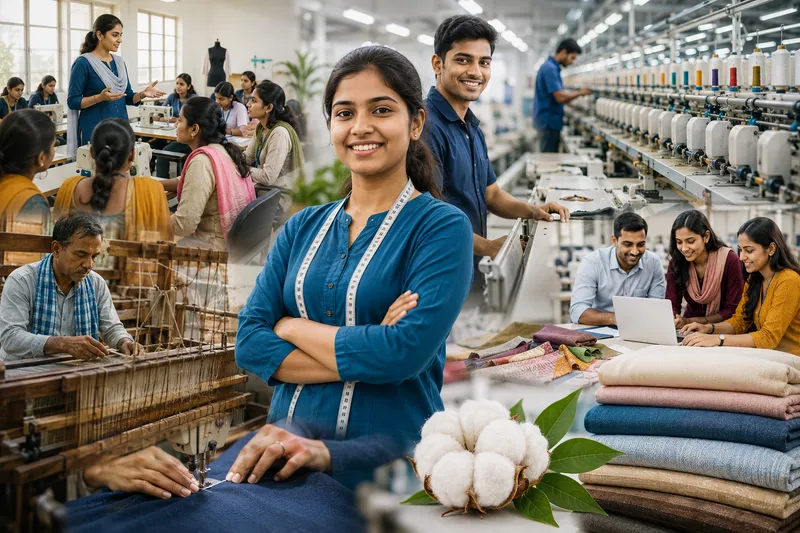
India’s textile and apparel industry employs over 45 million people directly (as per the Ministry of Textiles), second only to agriculture. It runs from cotton fields to finished garments and touches almost every state in the country. Yet for years, the industry faced a basic problem: not enough workers trained to modern standards. Samarth, the Scheme for Capacity Building in the Textile Sector, was designed to fix exactly this gap.
This article explains what Samarth is, how it works, what it has achieved so far, and what businesses, students, and job seekers should know about it, using only official government data.
What Is Samarth
Samarth (Scheme for Capacity Building in Textile Sector, or SCBTS) is run by the Ministry of Textiles. It was first approved for 2017-18 to 2019-20 with an outlay of Rs 1,300 crore, as a continuation of the Integrated Skill Development Scheme from the 12th Five Year Plan. It has since been extended, most recently up to 31 March 2026, with an outlay of Rs 495 crore for 2024-25 and 2025-26.
The scheme covers the entire textile value chain except organised-sector spinning and weaving, and also supports traditional sectors such as handloom, handicrafts, sericulture, silk, jute and wool.
Objectives:
- Provide demand-driven, placement-oriented, NSQF-compliant skill training.
- Support skill upgradation in traditional and craft-based sectors.
- Create sustainable livelihoods, through wage employment or self-employment, for all sections of society.
How the Scheme Works
Training is delivered by Implementing Partners such as textile companies, industry associations, state agencies, and bodies under the Ministry of Textiles, including the Development Commissioners for Handlooms and Handicrafts, the Central Silk Board and the Central Wool Development Board.
Feature | Requirement |
Attendance | Aadhaar-enabled biometric attendance, minimum 80 percent required |
Trainers | Must be certified through Training of Trainers programmes |
Monitoring | CCTV recording of training and assessment |
Certification | Third-party assessment and certification |
Placement target | 70 percent wage employment in the organised sector (entry level); at least 50 percent wage employment (balance self-employment) in traditional sectors |
Post placement tracking | One year after placement |
Credit linkage | Connected to Pradhan Mantri MUDRA Yojana for self-employment |
Funds to Implementing Partners are released in stages tied to performance, an initial share on commencement of training, a larger share once trainees are placed, and the balance only if trainees remain employed for a minimum period. This structure is meant to keep the focus on actual jobs, not just enrolment numbers.
Courses span garment construction, knitting, processing, handloom weaving, jute, silk, wool, technical textiles, handicrafts, and soft skills. The full course list and infrastructure norms are published on the official portal.
Where the Scheme Stands Today
The most reliable figures come from a written reply given by the Minister of Textiles, Shri Giriraj Singh, in the Rajya Sabha on 20 March 2026, and from the scheme’s official public dashboard.
Indicator | Figure |
Beneficiaries trained, 2020-21 to 2024-25 | 3,90,512 |
Beneficiaries trained, 2025-26 (up to 10 March 2026) | 2,04,668 |
Active training centres (as on 10 March 2026) | 4,430 |
Beneficiaries placed, including weavers and artisans (as on 10 March 2026) | 4,64,812 |
Women among those trained (last five years) | 3,44,696 |
SC beneficiaries (last five years) | 1,03,181 |
ST beneficiaries (last five years) | 49,259 |
Later dashboard figures (as on 25 July 2026) put cumulative training at around 7.18 lakh, with roughly 6.91 lakh assessed/certified and about 5.50 lakh placed. The scheme’s reach now spans 28 states and 7 Union Territories, 440 districts including 66 aspirational districts, 368 empanelled Implementing Partners, over 4,500 active centres, and more than 5,000 certified trainers across 120 NSQF-aligned courses.
Tamil Nadu, Karnataka and Uttar Pradesh account for the largest share of trained and placed beneficiaries, reflecting their existing textile manufacturing base. States with a smaller textile footprint, particularly in the North East, show comparatively lower numbers, something the scheme’s own review processes have flagged for correction through satellite training centres in underserved areas.
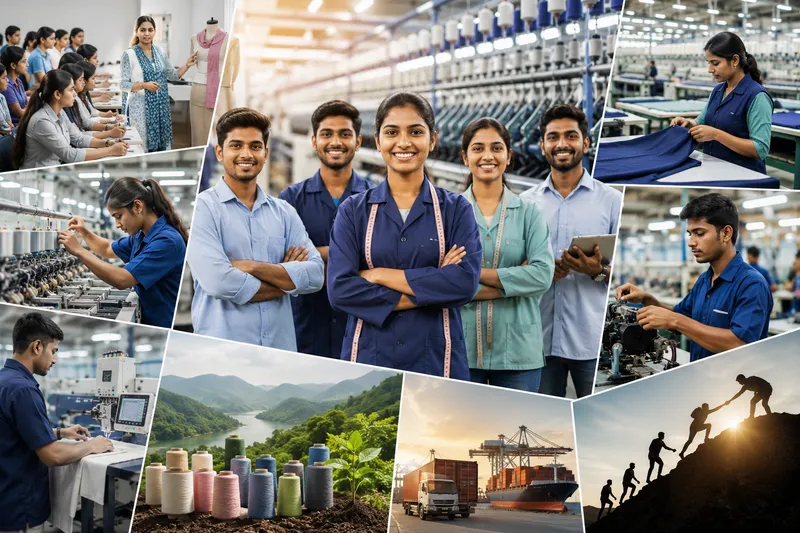
Samarth Scheme: Participating Companies by Textile Sector
Textile Sector | Samarth Coverage | Key Participating Companies (Verified) | Training Focus |
Yarn / Spinning | Not Covered | Excluded from scheme (organised sector) | Organised sector spinning explicitly excluded |
Fabric / Weaving | Not Covered | Excluded from scheme (organised sector) | Organised sector weaving explicitly excluded |
Fabric Processing (Dyeing, Printing, Finishing) | Covered | Not independently verified by company name | Chemical processing, quality control, dye management |
Garment & Apparel | Primary Focus (Largest Segment) | Shahi Exports Pvt. Ltd., Gokaldas Exports Ltd., Aditya Birla Fashion and Retail Limited (Mancheshwar Apparels) | Pattern cutting, stitching, quality checking, CAD, garment construction, industrial sewing |
Knitting | Covered | Not independently verified by company name | Circular knitting, flat knitting, yarn management |
Home Textiles / Made-ups | Covered | Welspun India Ltd. | Towels, bed linens, furnishings, home furnishing production |
Technical Textiles | Covered (Growing Segment) | Flexituff Ventures International Ltd., Commercial Syn Bags Ltd., Shri Tirupati Balajee FIBC Ltd., Mohini Health & Hygiene Ltd., Jagannath Plastics Pvt. Ltd. | Non-woven fabrics, flexible intermediate bulk containers (FIBC), packaging, industrial textiles, hygiene products |
Traditional Sectors (Handloom, Handicrafts, Silk, Jute, Wool) | Covered (Separate Track) | Central Silk Board, Office of Development Commissioner – Handlooms, Office of Development Commissioner – Handicrafts, Central Wool Development Board | Traditional weaving, embroidery, handicraft techniques, silk production, jute crafts, wool processing |
Source: Official Samarth public dashboard (samarth-textiles.gov.in), Samarth AEBAS registry (samarth-textiles.ac.in), Ministry of Textiles press releases (PIB, March 2026).
Note: Company names verified through official Samarth training centre data as of July 2026. Samarth explicitly excludes organised-sector spinning and weaving. Traditional sectors are implemented through central and state government bodies rather than private companies.
Samarth 2.0
In the Union Budget 2026-27, the government announced Samarth 2.0 as part of a broader Integrated Programme for the Textile Sector. The next phase is meant to modernise the skilling system through deeper industry-academia collaboration. Expected focus areas include:
- Industry-academia partnerships
- Centres of Excellence
- Special projects and innovation
- Entrepreneurship development
- E-learning and new age courses
- Institutional capacity building
The aim is a workforce that is ready for organised, traditional and academic segments of the value chain alike, including technical textiles and advanced manufacturing, areas where India has been playing catch-up.
The Industry Backdrop
Samarth is not operating in isolation. Indian textile exporters are currently dealing with a difficult external environment. The United States, India’s largest textile export market at close to 11 billion dollars a year, has imposed additional tariffs on Indian goods, and rival exporting nations such as Bangladesh, Vietnam and Cambodia have gained certain quota advantages. India’s textile and apparel exports still grew through FY26, supported by government export facilitation measures such as RoSCTL and RoDTEP, and industry bodies expect upcoming trade agreements with the UK and EU to help offset some of the pressure. The government has stated an ambition of reaching 100 billion dollars in textile exports by 2030.
In this environment, a trained and productive workforce is not a side benefit, it is a competitiveness requirement. Buyers, both international and increasingly domestic, are paying closer attention to quality, compliance and traceability, and skilled labour is central to meeting those expectations.
What This Means for Different Stakeholders
For textile businesses: Samarth offers access to trained, job-ready manpower without bearing the full cost of training. Companies with adequate infrastructure and financial standing can register as Implementing Partners on the official portal.
For workers, youth and women: Certified, short-duration training with a strong likelihood of placement. Women have made up close to 90 percent of beneficiaries in recent years.
For artisans in traditional sectors: A route to upgrade traditional skills, often supporting self-employment through MUDRA-linked credit.
For institutions and researchers: Samarth 2.0 opens room for academic collaboration and Centres of Excellence, relevant for those working on textile innovation, sustainability or new-age course design.
Where to Apply or Get Information
- Website: https://samarth-textiles.gov.in/
- Helpline: 1800-258-7150 (available in eight languages)
- Email: nmcc-mot@nic.in
- Grievance redress: pgportal.gov.in
The portal carries the full scheme guidelines, course lists, infrastructure norms, and empanelment process for organisations wanting to become Implementing Partners.
A Fair Assessment
Samarth has demonstrably moved workers from informal to formal employment at real scale, and its performance-linked funding model keeps some pressure on training quality. Parliamentary review has also pointed out gaps, particularly the tendency for funds to be released late in the financial year, which squeezes implementing partners’ planning. Regional imbalance, with the North East lagging established textile hubs, is another area the scheme continues to work on.
None of this takes away from the basic value on offer. For a textile business trying to scale, a young person looking for a certified trade skill, or an artisan wanting to formalise traditional work, Samarth remains one of the most direct and accessible government programmes in the sector. With Samarth 2.0 on the way, the next few years should show whether the scheme can extend that value to technical textiles and higher-skill roles as well.
This article is based on official information from the Ministry of Textiles’ Samarth portal, Press Information Bureau releases, and Rajya Sabha parliamentary records, current as of July 2026. Readers are advised to check the official portal for the latest updates before applying.