SAITEX Releases 2025 Impact Report Detailing Progress in Responsible Apparel Manufacturing
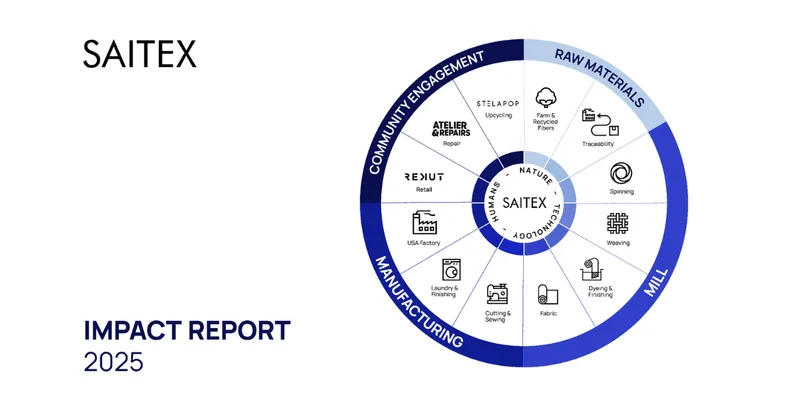
Report outlines operational metrics, cleaner chemistry, renewable energy projects, circular systems and industry knowledge-sharing initiatives
SAITEX has released its 2025 Impact Report, documenting operational performance, engineering decisions, manufacturing systems and lessons from its vertically integrated operations in Vietnam and the United States. The report focuses on measurable developments in apparel manufacturing rather than presenting sustainability goals alone.
Sanjeev Bahl, CEO, SAITEX, said, “We don’t believe better ways of working should be guarded. We believe they should be shared, tested and improved. Our Impact Report is about passing on what we’ve learned, because good ideas are meant to travel.”
SAITEX reports improvements in manufacturing efficiency
The 2025 report outlines developments across SAITEX's integrated manufacturing operations, including its work on cleaner chemistry, renewable energy, circular material systems, digital product intelligence and environmental performance.
At the SAITEX Fabric Mill, production increased by 22% during the reporting period. At the same time, electricity consumption per meter fell by 22%, greenhouse gas emissions per meter declined by 20%, water consumption per meter decreased by 9%, and waste generation per meter fell by approximately 25%.
The company said these changes reflect improvements in manufacturing efficiency alongside increased production.
Approximately 85% of SAITEX's denim fabric production aligns with the chemistry requirements for Cradle to Cradle Certified® Material Health Gold and bluesign®.
Product-level environmental data
Through Made2Flow, SAITEX provides product-level Life Cycle Assessment data that supports the creation of Digital Product Passports (DPP) across its product portfolio.
The system is intended to provide brands with greater visibility into the environmental profile of the materials and garments they source.
Report highlights areas where progress was delayed
The report also records areas where planned progress did not meet expectations.
Several renewable energy and infrastructure projects, including planned solar installations and closed-loop water systems, experienced delays. SAITEX attributed changes in timelines to construction requirements, permitting processes, infrastructure limitations and the continued lack of economically viable battery storage and direct renewable energy access in Vietnam.
The report also points to the influence of product design and sourcing decisions on factory-level environmental performance.
During 2025, increased demand for garment-dyed products, vintage washes and heavier-weight fabrics resulted in higher water and steam consumption.
Production volumes for Cradle to Cradle Certified® Material Health Gold and bluesign®-aligned fabrics also declined as customer demand changed, rather than because of a change in manufacturing capability.
Meanwhile, the share of Better Cotton (BCI) used at the SAITEX Fabric Mill increased from 9% to 21% in response to customer purchasing decisions. According to the report, this moved the company further from its long-term objective of maximizing regenerative, organic and recycled fibers.
SAITEX said these examples highlight the role of closer collaboration between brands and manufacturers in achieving further environmental improvements.
Expanding industry knowledge-sharing
Knowledge-sharing is another focus of the 2025 Impact Report.
During 2025, SAITEX expanded its participation in To the Finish Line, an initiative supported by the German Federal Ministry for Economic Cooperation and Development (GIZ).
As one of 18 subject matter experts, the company delivered three environmental management training sessions and contributed an article to To Walk the Talk – Manufacturer Voices: Peer Learning for Environmental Performance.
Together, these activities reached more than 2,100 participants representing 790 manufacturing facilities, providing guidance on environmental management and operational practices.
SAITEX was also selected during 2025 to participate in ZDHC's Supplier to Zero pilot program. The collaboration will be included as a best-practice case study in the 2026 ZDHC Smart Sourcing Handbook, focusing on SAITEX's approach to chemical management across the apparel supply chain.
90/10 Onshoring Model
During 2025, SAITEX published its 90/10 Onshoring Model white paper, which proposes a hybrid manufacturing framework aimed at rebuilding U.S. manufacturing jobs while maintaining global cost competitiveness.
Under the model, 90% of production would remain in Vietnam and 10% would be located in Los Angeles, supported by targeted policy incentives intended to strengthen supply chain resilience, reduce lead times and expand domestic employment.
The framework is designed for industries with modular production systems and could extend beyond apparel to consumer products, automotive parts, electronics, home goods and medical products.
Chemical management and continuous improvement
The report also details collaboration with brand partners to improve SAITEX's manufacturing systems.
Following a PFAS-focused audit by Inditex, no PFAS were discovered at SAITEX. The team identified an opportunity to replace one approved chemistry with an equivalent alternative from Inditex's preferred chemical list.
The alternative was subsequently implemented across all facility production, rather than only for Inditex orders.
The report documents other projects and innovations developed through testing, measurement and refinement across SAITEX's manufacturing operations.
Focus on renewable electricity and environmental intelligence
SAITEX continues to invest in renewable energy, circular manufacturing, advanced chemistry, Life Cycle Assessments, Digital Product Passports and product-level environmental intelligence.
The company is also working toward sourcing 100% renewable electricity for apparel manufacturing by the end of 2028.
The report concludes with SAITEX's view that industry-wide progress depends on manufacturers sharing systems, data and lessons rather than working independently.