Rising Services Exports May Be Affecting India’s Labour-Intensive Goods Exports, Says Analysis
Opinion piece links growth in services exports and remittances to a stronger rupee, while calling for greater focus on AI-driven, skill-intensive exports.
India's services exports, which were almost negligible in 1995, increased to $418 billion in 2025-26, approaching the value of goods exports, which stood at $442 billion. The article also notes that India received $144 billion in remittances from Indians living abroad, describing these inflows as another form of export earnings.
According to the analysis, the acceleration in services exports resembles what economists describe as Dutch disease, a concept that emerged after the discovery of the Groningen gas field in Holland during the 1950s. Gas exports expanded rapidly in the 1970s, leading to an appreciation of the Dutch currency that reduced the competitiveness of traditional exports. While the resource boom benefited the economy overall, it also contributed to job losses in traditional industries.
The article suggests that India's growing services exports are having a similar effect by contributing to a stronger rupee than would otherwise exist, making traditional goods exports less competitive.
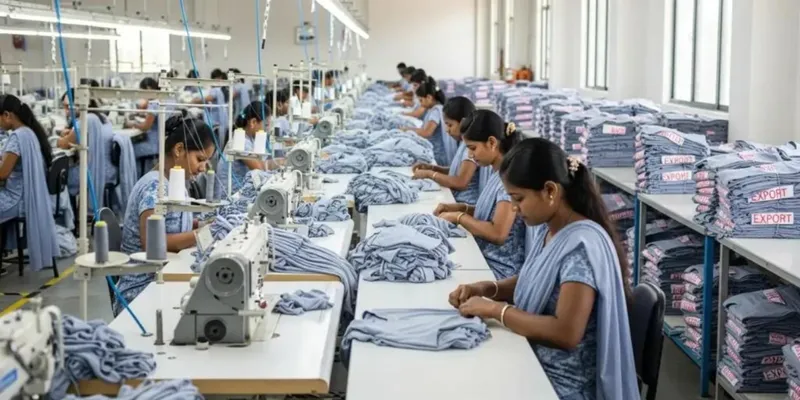
It notes that many economists have argued India did not follow the export-oriented manufacturing path adopted by several Asian economies, particularly in labour-intensive industries such as garments and footwear. These sectors are viewed as significant sources of employment for workers moving out of agriculture.
The analysis attributes part of this challenge to labour-related policies. It states that both the BJP and Congress have maintained close links with organised labour through trade unions, including Bharatiya Mazdoor Sangh (BMS) and INTUC, respectively. The article argues that labour regulations, public holidays, leave provisions and employment protection measures have increased labour costs in the formal sector.
It further states that labour law reforms increased the threshold requiring government permission for layoffs from 100 workers to 300, but argues that this remains insufficient for developing very large manufacturing units comparable to those in Bangladesh. The article also notes that mandatory gratuity eligibility after 12 months has increased labour costs.
Other factors identified as constraints on labour-intensive exports include red tape, inadequate infrastructure, high electricity and logistics costs, elevated land prices, and the cost of unionised labour. However, the article notes that these factors have not affected services exports or skill-intensive manufacturing to the same extent.
India has become a major exporter of pharmaceuticals, engineering goods, automobiles, chemicals and electronics, with the analysis stating that the country's comparative advantage lies in skilled workers rather than low-skilled, low-wage labour.
The article compares export trends over time, noting that in 1995-96, labour-intensive manufactured exports totalled $24 billion, compared with $8 billion for high-skilled manufactures and $6 billion for services. By 2025-26, low-skilled goods exports reached $187 billion, while high-skilled manufactures totalled $254 billion and services exports climbed to $412 billion.
According to the analysis, increasing services exports and remittance inflows have contributed to a stronger exchange rate, making labour-intensive exports relatively less competitive. It argues that sectors dependent on low-skilled labour are affected both by rising labour costs and by exchange rate pressures.
The article concludes that weakening the rupee artificially is unlikely to provide a lasting solution. Instead, it argues that India should prioritise exports shaped by artificial intelligence, improve productivity and competitiveness, and develop a workforce equipped for future skill-intensive industries rather than relying primarily on labour-intensive manufacturing.