Retail Leasing Set to Hit Post-Pandemic High in 2025: Cushman & Wakefield
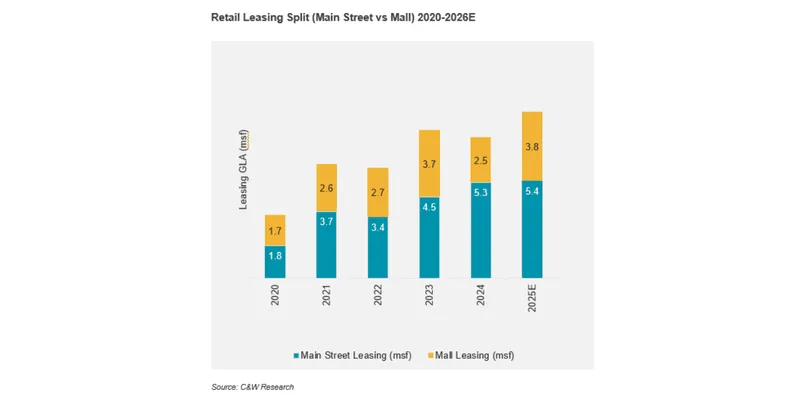
India’s retail real estate sector is poised to close 2025 on a historic high, with total leasing activity expected to touch nearly 9 million square feet (MSF)—the strongest annual performance since the pandemic. This marks a notable jump from approximately 7.8 MSF in 2024, according to Cushman & Wakefield’s India Outlook 2026 report.
The strong year-end performance reflects a decisive revival of mall-led absorption, supported by the commissioning of new Grade A retail assets in key markets during the fourth quarter of the year. While high-street retail has continued to register steady traction, leasing activity that was earlier delayed due to a lack of quality mall supply is now finding opportunities in newly completed developments. This shift is enabling malls to regain market share, with fashion, food & beverage, and entertainment emerging as the primary demand drivers.
The acceleration in leasing has been underpinned by a visible improvement in supply conditions. After a constrained 2024, when Grade A mall completions were limited to just 0.9 MSF, new deliveries in 2025 are projected to close at around 4.3 MSF, largely driven by late-year completions. Although this increase has eased supply tightness, it has not fully bridged the cumulative shortfall created over the past two years. Nevertheless, the improved availability of space has enabled retailers to resume expansion plans that were earlier put on hold.
Leasing Momentum to Strengthen Further in 2026
Looking ahead, Cushman & Wakefield expects retail leasing momentum to remain robust in 2026, with total absorption projected at 10–11 MSF. This growth will be driven by the release of pent-up demand and a stronger pipeline of quality mall supply. The mall development pipeline for 2026 stands at approximately 5.9 MSF, with nearly 76% classified as Grade A+ assets, offering superior design, tenant mix, and operational standards.
Key cities such as Bengaluru, Chennai, Mumbai, and Hyderabad are expected to benefit from this influx of high-quality supply, easing vacancy pressures and supporting expansion-led growth rather than growth constrained by space shortages.
High-street retail, which gained share during periods of mall scarcity, is expected to remain stable in 2026, supported by established corridors and neighbourhood locations. On the rental front, while average mall rents may normalise in markets witnessing higher supply, Grade A+ malls and dominant high-street locations are likely to maintain strong rental momentum. New openings are expected to set higher benchmarks, while re-leasing in top-performing assets could see rental resets amid persistent demand-supply imbalance.
The report further highlights a strengthening trend of premiumisation, supported by global brand expansions, platform-led partnerships, and a growing pipeline of high-quality retail developments. Incremental mall development is also extending into select Tier II cities, driven by rising consumption patterns and improving developer capabilities.
Industry Perspective
Gautam Saraf, Executive Managing Director, Mumbai & New Business, Cushman & Wakefield said,
“India’s retail real estate market is set to record its highest leasing activity since the pandemic, reaching nearly 9 MSF in 2025, driven by a strong year-end surge as new mall supply becomes operational in Q4. This sharp uptick underscores the catalytic role of fresh completions in unlocking pent-up demand and pushing absorption to record levels. With a robust pipeline lined up for 2026, the market is now entering a phase of meaningful capacity addition focused on higher-quality retail formats. This supply expansion is closely aligned with a clear trend of premiumisation, as consumer preferences continue to shift towards experience-led retail and malls evolve into lifestyle destinations anchored by curated formats and premium brands. Platform-led partnerships and global brand rollouts further reflect rising discretionary spending and growing confidence in India’s consumption story.”
“Together, these trends point to a retail market that is scaling up—driven by quality supply, premiumisation and the release of pent-up demand, while resilient consumption fundamentals provide a strong base for sustained growth.”