Renewable Materials Conference 2026 Announces Innovation Award Nominees and Final Programme
RMC 2026 to bring global bioeconomy, CCU and recycling stakeholders together in Germany from 22–24 September
The Renewable Materials Conference (RMC) 2026 will be held from 22–24 September 2026 in Siegburg/Cologne, Germany, bringing together innovators, companies, brands, investors and policymakers working across the renewable carbon economy.
According to organiser nova-Institute, the conference is expected to attract 400–500 participants from around the world.
The 2026 edition is centred on the theme "Defossilisation through innovation", with discussions covering the defossilisation of the chemical industry, fossil-free plastics, renewable carbon frameworks, and biodegradation. The programme also includes the high-level panel discussion titled "Quadruple system shock as catalysts for industrial transformation."
The conference spans the complete value chain, covering alternative carbon feedstocks, the chemical industry, materials, product manufacturers, brand owners, investors and policymakers.
The previous edition attracted 410 participants from 29 countries, with 90% representing the industrial sector. This year's programme includes 75 presentations, 20 panel discussions, more than 16 workshops, and a two-floor exhibition designed to support networking across the industry.
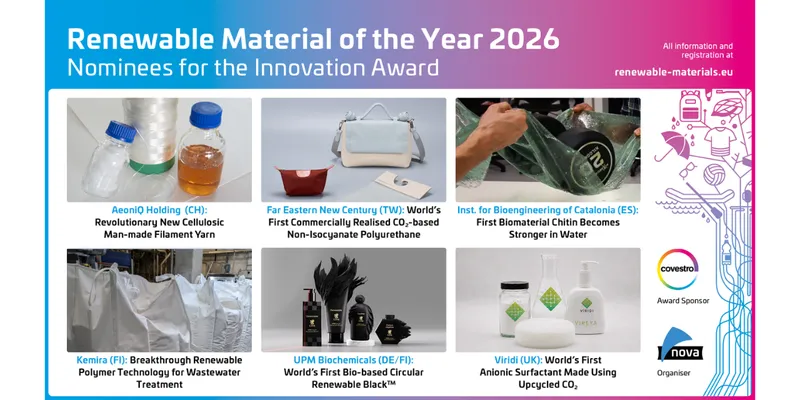
Six Nominees for "Renewable Material of the Year 2026"
The conference advisory board selected six finalists for the "Renewable Material of the Year 2026" Innovation Award, sponsored by Covestro (DE). The award winner will be chosen by conference attendees during the event.
AeoniQ Holding (CH): New Cellulosic Man-made Filament Yarn
AeoniQ™ is a cellulosic man-made filament yarn developed as an alternative to polyester and nylon. The fibre is produced from renewable cellulose sources including wood pulp, textile waste and non-valorised agricultural waste.
The manufacturing process uses 100% renewable energy with a 99.5% closed-loop process. The fibre is biodegradable and has been confirmed to fully degrade within 12 weeks in soil at the end of its lifecycle. Applications include performance wear, fashion, home textiles, automotive and technical textiles.
The company's first industrial production plant is scheduled to begin operations in Portugal in Q4/2026.
Far Eastern New Century (TW): First Commercially Realised CO₂-based Non-Isocyanate Polyurethane
TOPGREEN® AirTek PU is described as the world's first commercially realised CO₂-based Non-Isocyanate Polyurethane (NIPU).
Using carbon capture technology developed by the Far Eastern Group, industrial CO₂ emissions are converted into intermediates containing more than 50% CO₂, before being polymerised into NIPU elastomers.
According to the company, the material achieves 58% lower emissions than conventional TPU and is intended for membranes, shoe materials, elastic fibres and artificial leather.
Institute for Bioengineering of Catalonia (ES): Chitin Becomes Stronger in Water
AquaChitin is a biomaterial produced from unmodified chitosan sourced from crustacean processing byproducts and urban organic waste streams.
The material uses a nickel-mediated network that allows water to increase its mechanical strength rather than weaken it. The biodegradable material is designed for films, containers and wet-use products using a water-based, zero-waste chemistry process that recovers nickel.
Kemira (FI): Renewable Polymer Technology for Wastewater Treatment
KemAlpha® is a renewable polymer technology developed for wastewater treatment.
Produced from alpha-glucan derived from renewable sugar feedstocks, the material is designed to replace fossil-based organic coagulants in industrial and municipal treatment systems. It is available in both liquid and powder forms and has been commercialised through a joint venture between IFF and Kemira.
According to the company, the technology has demonstrated commercial-scale performance at a northern European dairy producer.
UPM Biochemicals (DE/FI): Bio-based Circular Renewable Black™
UPM Circular Renewable Black™ is a bio-based, near-infrared (NIR)-detectable, carbon-negative black pigment developed for plastic packaging.
Unlike conventional carbon black pigments that interfere with NIR sorting systems, the lignin-based pigment enables recyclable black plastic packaging while maintaining colour performance.
The feedstock is sourced from sustainably managed forests and is supported by FSC™ (C210095), PEFC (04-31-3869) and ISCC PLUS certifications. The product forms part of UPM's CO₂-negative solutions linked to its €1.3 billion Leuna biorefinery.
Viridi (UK): Anionic Surfactant Made Using Upcycled CO₂
Vireya™ is described as the world's first anionic surfactant produced using upcycled CO₂.
Containing up to 33% CO₂, the surfactant is reported to reduce the product carbon footprint by up to 70% compared with conventional alternatives while avoiding oil palm-derived feedstocks to support compliance with the EU Deforestation Regulation.
The material is produced using the company's proprietary catalyst technology, which enables CO₂ to be used as a carbon feedstock in polymers. The catalysts are reusable, recyclable and designed for integration into existing chemical production assets.
Sponsors and Industry Support
The nova-Institute acknowledged UPM Biochemicals (FI) as Platin Sponsor, Celluranics (CN), GS Biomats (CN), IFF (BE), Leaf Biotech (CN), L'Oreal (FR) and VERBIO (DE) as Gold Sponsors, and DIN CERTCO (DE), Peterson Solutions (DE) and TÜV Austria Belgium (BE) as Silver Sponsors.
The conference is also supported by industry associations, research organisations and non-profit groups including AVK (DE), BCNP (DE), BIC - Bio-based Industries Consortium (EU), BioBase (AT), bündnis mikroplastikfrei (AT), C.A.R.M.E.N. (DE), ChemCologne (DE), ChemieClusterBayern (DE), CLIB (DE), CO2Value Europe (EU), European Bioplastics (EU), FECC - European Association of Chemical Distributors (EU), GO!PHA (International), IBB Netzwerk (DE), INAK (DE), kunststoffland NRW (DE), NRW.Energy4Climate (DE), ÖGUT - Österreichische Gesellschaft für Umwelt und Technik (AT), Plastics Europe (DE), and Renewable Carbon Initiative (International).