Renewable Carbon Initiative Updates Carbon Flow Report with New Data on Chemicals and Plastics
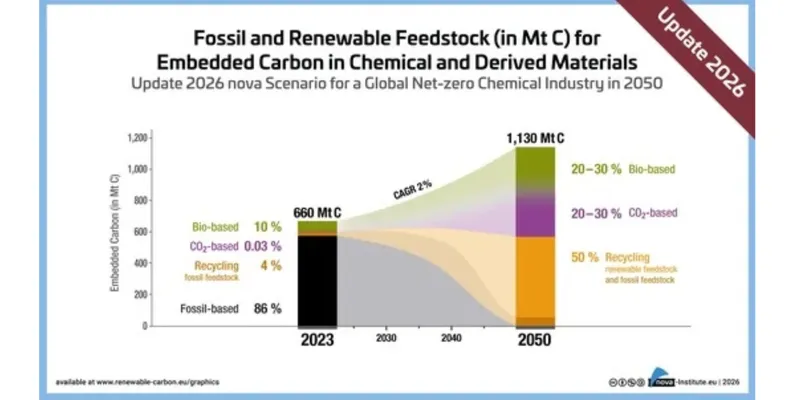
The 2026 report introduces an improved carbon-tracking methodology, examines global and European feedstock demand, and outlines a scenario for achieving a net-zero chemical industry by 2050.
The Renewable Carbon Initiative (RCI) has released the 2026 update of its Carbon Flow Report, providing updated data on fossil and renewable carbon supply and demand in the chemicals and derived materials sectors at global and European levels. Commissioned by RCI and developed by experts from nova-Institute, the report introduces a system-based methodology designed to track carbon flows across chemical value chains while avoiding double counting.
Understanding Carbon Flows and Defossilisation
Carbon serves two distinct purposes: it can act as an energy carrier, releasing energy through the combustion of hydrocarbon molecules, or remain embedded in products as a structural component. Embedded carbon is found in food and feed, as well as in materials and chemicals used to produce products such as plastics, wood-based construction materials, paper and cotton textiles.
The Carbon Flow Report 2026 focuses primarily on fossil and renewable carbon used in chemicals and plastics. It provides an analytical basis for evaluating defossilisation strategies, renewable carbon supply options and cross-sectoral carbon management. The updated data are particularly relevant to ongoing European Union policy discussions on bio-based and renewable carbon content targets.
What Is Defossilisation?
While renewable energy, electrification and hydrogen can support decarbonisation in the energy and transport sectors, carbon remains an essential component of chemicals and plastics. Defossilisation refers to replacing fossil carbon with renewable sources, including biomass, CO₂ and recycled materials.
RCI introduced this strategy at the European policy level in 2020. Since then, the concepts of embedded carbon, renewable carbon and defossilisation in the chemical and plastics industries have gained greater recognition and political interest.
However, reliable data remain necessary to guide this transition. According to the report, databases have not always provided sufficient quantities or quality of information for the chemical sector.
Background to the Original Carbon Flow Report
The first edition of the RCI-commissioned Carbon Flow Report was published in 2023 using 2020 as its reference year. It presented carbon flows across food, feed, energy, fuels, materials and chemicals, providing a common dataset for policymakers, non-governmental organisations and industry stakeholders.
The report also established an analytical foundation for evaluating defossilisation pathways, renewable carbon supply options and carbon management across sectors.
The importance of this transition was also highlighted in an editorial published in the scientific journal Nature on 6 January 2026, which mentioned the Carbon Flow Report:
“Worldwide, demand for ‘embedded’ carbon — that found in chemicals — is expected to double by 2050, according to the nova-Institute, a green-energy research institute in Hürth, Germany. But this carbon cannot come from the usual sources, such as coal, natural gas and oil. These must remain in the ground, and this is where defossilization comes in. Defossilization means finding sustainable ways to make carbon-based chemicals. Alternative sources of carbon include the atmosphere and plants, as well as carbon in existing biological or industrial waste, such as used plastics or agricultural residue.”
2026 Update Introduces a New System Approach
Three years after the original publication, RCI identified the need to update the report as more detailed datasets became available, including information from several RCI projects that had addressed data gaps and improved data quality.
The update also addressed limitations in the earlier methodology. Although official datasets such as PRODCOM offered a convenient starting point, they lacked the detail and precision required to calculate embedded carbon in chemicals and plastics reliably. The previous approach also could not rule out double counting.
To address these issues, nova-Institute developed a system approach that traces carbon flows from feedstocks through successive stages of chemical production, including intermediates, building blocks, monomers and polymers.
The method combines material flow analyses and energy balances to provide a platform-flow and carbon-balance perspective across chemical value chains. It integrates updated global and European datasets and covers more than 40 chemical value chains, representing almost the entire market.
Applied for the first time in this report, the methodology is designed to provide a more comprehensive and reliable picture of embedded carbon flows while systematically excluding double counting.
The updated dataset draws on CEFIC petrochemical data for Europe, International Energy Agency (IEA) data at the global level, and nova/RCI bio-based data for Europe and the world. It uses 2023 as its reference year and incorporates the most recent available global-level data. As a result, the updated figures differ significantly from those in the first edition.
Global Carbon Feedstock Demand Remains Dominated by Fossil Sources
In 2023, global demand for carbon feedstock in chemicals and derived materials reached 660 million tonnes per year, with polymers accounting for 78%.
Fossil resources supplied 86% of this feedstock, comprising 61% from crude oil, 21% from natural gas and 4% from coal. Biomass contributed 10%, while recycling accounted for 4%. CO₂-based carbon remained negligible.
When the assessment is expanded to include other carbon-based materials, such as the heavy oil fraction, wood used in construction, pulp and paper, cotton and other bio-based fibres, total carbon feedstock demand reached 1,400 million tonnes of carbon per year in 2023. Biomass and recycled biomass together contributed 640 million tonnes of carbon per year, representing 46% of this broader total.
The updated report places demand for carbon feedstock in the chemicals sector at 660 million tonnes per year in 2023, compared with 550 million tonnes per year in the original report for 2020.
Global demand grew at a compound annual growth rate (CAGR) of 2–3% between 2020 and 2023. Growth at this rate would have raised demand to approximately 600 million tonnes per year. The remaining increase reflects the improved methodology, stricter accounting of carbon feedstock and the inclusion of additional databases covering fossil, bio-based and recycling value chains.
Biomass Use in the Chemical Industry
The updated analysis also provides a detailed breakdown of biomass use by the global and European chemical industries in 2023/24.
Globally, the chemical industry used 118 million tonnes of dry biomass containing 64 million tonnes of carbon. In Europe, the corresponding figures were 13 million tonnes of dry biomass containing 7 million tonnes of carbon.
A Scenario for a Global Net-Zero Chemical Industry by 2050
The 2026 update includes an exploratory scenario for the global chemical industry’s transition towards net zero by 2050. The scenario is based on plausible assumptions rather than a prediction, and its realisation depends largely on political frameworks and related investments.
Compared with the net-zero scenario presented in 2023, the updated scenario incorporates three main changes:
- A lower compound annual growth rate of 2%, compared with 2.5% previously.
- A slightly lower recycling share of 50% in 2050, compared with 55% in the earlier scenario.
- A slightly higher biomass contribution of 20–30%, compared with 20% previously.
The scenario also uses the revised 2023 carbon-flow volumes and shares as its starting point.
European Carbon Feedstock Demand and Recycling Trends
In 2023, the EU-27 required 85 million tonnes of carbon feedstock per year for chemicals and derived materials, equivalent to 13% of global demand. Polymers accounted for 76% of this demand, while organic chemicals represented 24%.
The revised figure is substantially lower than the 110 million tonnes of carbon per year calculated for the EU-27 in the original report for 2020. The report identifies two main reasons for the difference.
First, chemical production in Europe declined by around 10–15% between 2020 and 2023. Second, the updated methodology more strictly avoids double counting of fossil fuels. The first edition relied on PRODCOM data, which were susceptible to double counting, while the 2026 update uses the CEFIC petrochemical database as its basis.
Recycling Accounts for a Larger Share of European Feedstock
The EU-27's feedstock mix differs from the global average. In 2023, bio-based carbon accounted for 8% and recycled carbon for 9% of European carbon feedstock demand.
Although the bio-based share was lower than the global figure, the recycling share was significantly higher. According to the report, this partly reflects the more realistic, lower estimate of fossil feedstock volumes in the updated baseline, which increases the relative shares of bio-based and recycled carbon.
The volume of recycled carbon increased by 14% between 2020 and 2023. However, compared with 2022, the recycled volume in 2023 declined by 6%, indicating difficulties in the European recycling sector.
The updated baseline is intended to provide a more reliable basis for establishing realistic renewable carbon content targets in Europe.
Report Scope and Future Updates
The full 2026 Carbon Flow Report spans 80 pages and includes more than 30 graphics and tables. It provides detailed information on feedstock composition, major chemical building blocks and intermediates, application-sector breakdowns, methodology, data sources and literature.
The analysis draws on scientific literature, statistical databases and industry data, supported by expert consultations. Experts from nova-Institute applied a consistent material-flow approach to compile an inventory of carbon stocks and flows.
The report focuses on the chemicals and derived materials sector, assessing current carbon demand and exploring scenarios for full defossilisation by 2050.
RCI describes the report as a living document that will be updated periodically to reflect changes in data availability, policy developments and market conditions. Continued refinement of its database, methodology and visualisations is intended to provide policymakers, industry stakeholders and researchers with current, transparent evidence to support the transition from fossil to renewable carbon.