“Reliance Chemotex Industries Financial Analysis Report”
1. Introduction
Founded in 1977 within Rajasthan's industrial landscape, Reliance Chemotex Industries Ltd (RCIL) creates synthetic yarns suited for clothing, household fabrics, and industrial applications. Though publicly listed on the BSE with ticker 503162, its presence remains quietly consistent across five decades. Despite operating without fanfare, the company sustains production of both artificial and mixed fibre varieties. Nearly half a century passes, yet visibility stays minimal - deliberately or by nature of trade.
Despite soft local appetite in clothing and household goods, overseas shipments help balance out the firm's results, which swing heavily with movements in crude markets.
2. Company Overview
Starting strong with synthetic fibers, RCIL produces artificial silk alongside polyester variants meant for car interiors. Not limited to one niche, the company also supplies yarns designed for floor coverings. Moving into living spaces, its offerings extend to textiles used in household decor. Combining materials carefully, it develops hybrid versions too. Wider in scope compared to local competitors, this variety opens doors across different markets. Reaching varied customers becomes easier when options multiply under one roof.
Despite installing solar panels and upgrading dyeing units lately, the firm faces scrutiny after its credit score dropped to IND BBB- early this year. A closer look reveals India Ratings flagged concerns about short-term strain, tied to borrowing worth Rs.206.6 Cr. Progress on green tech contrasts with tightening financial pressure evident in the reassessment.
- Products: Synthetic & blended yarn (polyester, viscose, nylon, blended varieties)
- End Markets: Home furnishing, automotive textiles, apparel, industrial
- Installed Capacity: Large spinning facility in Rajasthan
- Promoter Holding: 67.69% (stable across 3 years)
3. Promoter & Founder
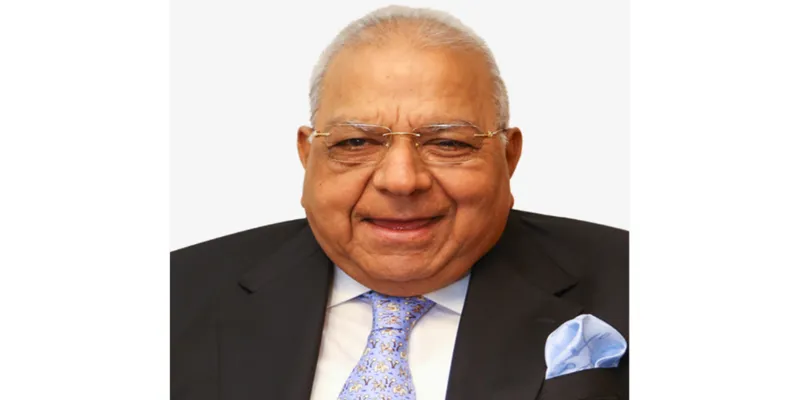
The company was founded by Shanker Lal Shroff — described by the company as a first-generation entrepreneur and 'true visionary' who built RCIL from the ground up. His founding philosophy centred on quality and technical excellence in synthetic yarn manufacturing. The current promoter group — including the Shroff family and associates — holds 67.69%, a stable majority that has not changed in over three years.
In early 2026, leadership saw a shift when Brahm Sworoop Sharma took office as President, reflecting adjustments within executive functions. While the title changed hands, internal workflows began adapting under fresh oversight during that period.
4. Financial Statement Analysis
Income Statement
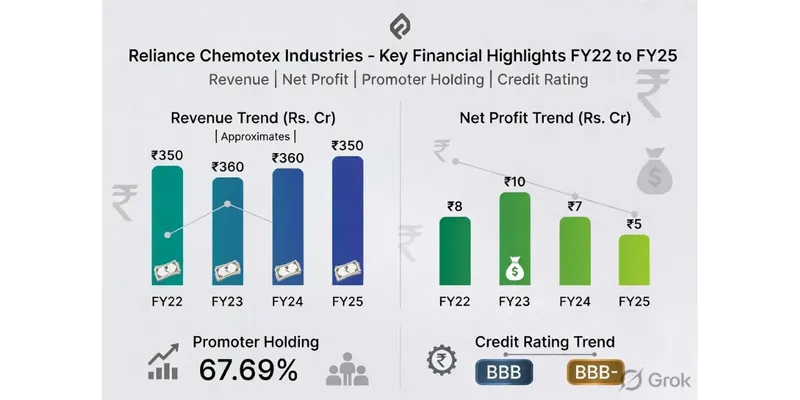
RCIL's revenue has stayed in a tight band around Rs.350–360 Cr over the past four fiscal years, with no meaningful growth or sharp decline. Q3 FY26 revenue came in at Rs.81.94 Cr, and 9-month FY26 net profit was Rs.3.52 Cr — thin but positive. The credit downgrade to BBB- in Feb 2026 suggests margin pressure is intensifying.
Metric | FY22 | FY23 | FY24 | FY25 |
|---|---|---|---|---|
Revenue (Rs. Cr) | ~350 | ~360 | ~360 | ~350 |
Net Profit (Rs. Cr) | ~8 | ~10 | ~7 | ~5 |
Promoter Holding (%) | 67.69% | 67.69% | 67.69% | 67.69% |
Credit Rating | — | — | BBB | BBB- |
Balance Sheet
Based on public filings, RCIL's balance sheet carries moderate leverage with bank facilities totalling Rs.206.6 Cr (as rated by India Ratings in Feb 2026). The asset base includes spinning facilities, solar power installations, and fibre dyeing capacity.
Metric | FY24 | FY25 (est.) |
|---|---|---|
Bank Facilities (rated) | Rs.200 Cr | Rs.206.6 Cr |
Promoter Holding | 67.69% | 67.69% |
5. Key Insights & Interpretation
Strengths
- High promoter holding (67.69%) — long-term management commitment
- Diversified product range across multiple end-user segments
- Solar power and fibre dyeing investments show forward-looking capex
- Established brand and relationships after nearly 50 years in operation
Weaknesses
- Revenue growth has stagnated — no topline expansion over 3 years
- Credit downgrade to BBB- signals increasing financial stress
- Thin net margins leave little buffer for input cost shocks
- Detailed financial data restricted on public platforms — transparency concern
Risk Factors
- Petrochemical-linked input costs (polyester, viscose) remain volatile
- Credit downgrade could increase borrowing costs going forward
- Reclassification of a promoter (Nand Gopal Khaitan) to public category — governance signal
Future Outlook
Looking ahead, RCIL remains on careful footing. With a BBB- rating in place, alongside steady but unchanging revenues, progress now hinges less on expansion and more on operational efficiency or fresh growth triggers. A shift may emerge after the president change in February 2026 - this move might reflect deeper changes beneath the surface. Yet real impact depends entirely on follow-through, not announcements. Confidence returns only when results do.
6. Conclusion
Stagnation defines Reliance Chemotex today, despite decades in India’s synthetic yarn sector. Revenue shows little movement; profit margins barely sustain. A recent credit rating cut adds pressure, while sparse public financial data raises questions. Ownership remains heavily promoter-driven - a factor that brings stability. Diversification across products offers another layer of resilience. Yet clarity on earnings trends and signs of margin improvement remain absent - enough reason to hold back for now.
Data Sources