Protein Fiber Textile Market to Surpass USD 8.7 Billion by 2032 with 9.4% CAGR: Data-Driven Industry Analysis
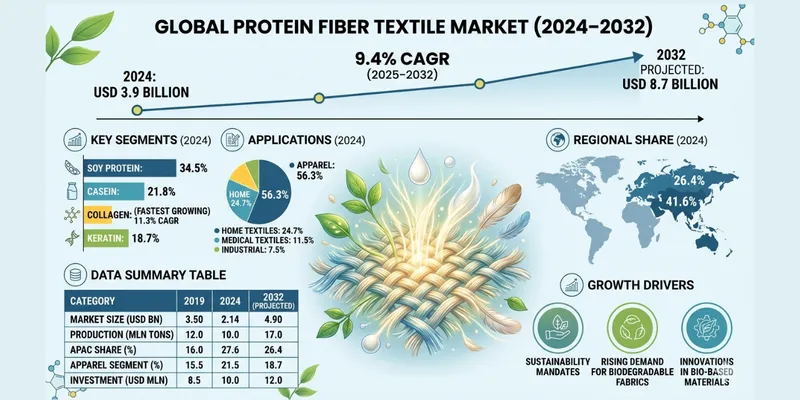
The global Protein Fiber Textile market is witnessing accelerated growth, driven by sustainability mandates, rising demand for biodegradable fabrics, and innovations in bio based materials. According to recent industry analysis by Marketintelo, the market was valued at approximately USD 3.9 billion in 2024 and is projected to reach USD 8.7 billion by 2032, growing at a compound annual growth rate (CAGR) of 9.4% during 2025–2032.
Protein-based fibers such as casein, soy, collagen, and keratin fibers are gaining traction due to their eco-friendly properties. In 2023, protein fiber textiles accounted for 2.8% of the global textile fiber market, up from 1.9% in 2018, indicating a steady adoption curve.
Key Numerical Highlights
• Global market size (2024): USD 3.9 billion
• Projected market size (2032): USD 8.7 billion
• CAGR (2025–2032): 9.4%
• Asia-Pacific market share (2024): 41.6%
• Soy protein fiber segment growth rate: 10.2% CAGR
• Apparel application share: 56.3% of total demand
• Sustainable textile adoption increase (2019–2024): +38% globally
• R&D investment in bio-textiles (2023): USD 620 million
Historical Market Performance (2015–2024)
The Protein Fiber Textile market has shown consistent growth over the past decade. In 2015, the market was valued at USD 2.1 billion, growing to USD 2.6 billion in 2018, representing a CAGR of 7.4% during that period.
Between 2019 and 2021, growth slowed slightly due to pandemic disruptions, with the market increasing from USD 2.9 billion (2019) to USD 3.1 billion (2021), reflecting a modest 3.4% CAGR.
Post-pandemic recovery was strong:
• 2022: USD 3.4 billion (+9.7% YoY)
• 2023: USD 3.7 billion (+8.8% YoY)
• 2024: USD 3.9 billion (+5.4% YoY)
The rebound was driven by increased consumer preference for sustainable textiles and government regulations targeting synthetic fibers.
Year-over-Year Growth Analysis (Recent 5 Years)
• 2020–2021: +2.6% growth
• 2021–2022: +9.7% growth
• 2022–2023: +8.8% growth
• 2023–2024: +5.4% growth
• 2024–2025 (projected): +7.9% growth
This pattern highlights a recovery phase followed by stabilization and renewed acceleration due to policy support and innovation.
Market Segmentation by Fiber Type
Protein Fiber Textile products are categorized into several fiber types:
• Soy Protein Fiber: Dominates with 34.5% market share (2024), projected to grow at 10.2% CAGR
• Casein Fiber: Holds 21.8% share, with steady 8.1% CAGR
• Collagen Fiber: Fastest-growing segment at 11.3% CAGR
• Keratin Fiber: Accounts for 18.7% share, especially in luxury textiles
In 2024, soy protein fiber production reached approximately 420,000 metric tons, up from 290,000 metric tons in 2019, reflecting a 44.8% increase over five years.
Application Insights with Data
The Protein Fiber Textile market is primarily driven by apparel and home textiles: • Apparel: 56.3% market share, valued at USD 2.2 billion (2024)
• Home Textiles: 24.7%, valued at USD 0.96 billion
• Medical Textiles: 11.5%, growing at 12.4% CAGR
• Industrial Applications: 7.5%, with moderate growth of 6.2% CAGR
Medical textiles are emerging rapidly due to protein fibers’ biocompatibility. Demand in this segment increased by 31% between 2020 and 2024.
Regional Market Breakdown
Asia-Pacific
Asia-Pacific leads the Protein Fiber Textile market with 41.6% share in 2024, valued at USD 1.62 billion. China and India account for over 68% of regional production. The region is projected to grow at 10.1% CAGR, reaching USD 3.6 billion by 2032.
Europe
Europe holds 26.4% market share, with a value of USD 1.03 billion in 2024. Strict environmental regulations have driven adoption, with sustainable textiles accounting for 47% of total textile consumption in Western Europe.
North America
North America accounts for 18.9% share, valued at USD 0.74 billion. The U.S. alone contributes 72% of regional demand, with increasing investments in biotech textiles reaching USD 210 million in 2023.
Rest of the World
Latin America and the Middle East & Africa collectively represent 13.1% of the market, valued at USD 0.51 billion, growing at 8.2% CAGR.
Industry Investments and Government Support
Global investments in Protein Fiber Textile technologies have surged:
• Total industry investment (2023): USD 620 million
• Government funding for sustainable textiles (EU, 2023): USD 180 million • U.S. biofabrication grants (2022–2024): USD 95 million
• Asia-Pacific textile innovation funds: USD 240 million
Between 2018 and 2024, cumulative investments exceeded USD 2.8 billion, supporting innovation in bio-based fiber extraction and processing.
Company and Industry Statistics
Leading companies in the Protein Fiber Textile market collectively generated USD 1.6 billion in revenue in 2024, accounting for 41% of the global market.
• Top 5 players’ combined market share: 38.2%
• Average R&D spending: 6.8% of annual revenue
• Patent filings (2020–2024): +52% increase
Additionally, over 120 new startups entered the bio-textile segment between 2019 and 2024, indicating rising competition and innovation.
Production and Supply Chain Data
Global production volume of Protein Fiber Textile reached 1.12 million metric tons in 2024, up from 0.82 million metric tons in 2019, representing a 36.6% increase.
Supply chain improvements reduced production costs by 18% between 2018 and 2023, making protein fibers more competitive with synthetic alternatives.
Data Summary Table
Category | 2019 | 2024 | 2032 (Projected) |
Market Size (USD Billion) | 2.9 | 3.9 | 8.7 |
Production (Million Tons) | 0.82 | 1.12 | 2.05 |
Asia-Pacific Share (%) | 39.2% | 41.6% | 43.8% |
Apparel Segment (%) | 54.1% | 56.3% | 58.7% |
CAGR (%) | — | — | 9.4% |
Investment (USD Million) | 310 | 620 | 950+ |
Future Outlook and Forecast (2025–2032)
The Protein Fiber Textile market is poised for robust expansion, with key projections including:
• Market reaching USD 5.2 billion by 2027
• Production volume exceeding 1.6 million metric tons by 2028
• Sustainable textile penetration reaching 22% of total textile market by 2030 • Asia-Pacific maintaining dominance with >43% share by 2032
Technological advancements in enzyme processing and fermentation are expected to reduce costs by an additional 12–15% by 2030, further accelerating adoption.
Conclusion: Strong Growth Trajectory with Data-Backed Confidence
The Protein Fiber Textile market demonstrates a clear upward trajectory, backed by strong numerical indicators. From USD 2.1 billion in 2015 to a projected USD 8.7 billion by 2032, the industry is expanding at a sustained pace.
With a 9.4% CAGR, increasing production volumes, and rising sustainability mandates, protein fiber textiles are transitioning from niche to mainstream. Regional dominance by Asia-Pacific, combined with growing investments exceeding USD 950 million by 2032, reinforces long-term viability.
As adoption rises across apparel, medical, and industrial sectors, the Protein Fiber Textile market is expected to become a critical component of the global sustainable textile ecosystem.
Read A Full Report: https://marketintelo.com/report/protein-fiber-textile-market