Production Process of Seamless Knits: How Modern Machines Make Clothes Without Seams
Tanvi Munjal
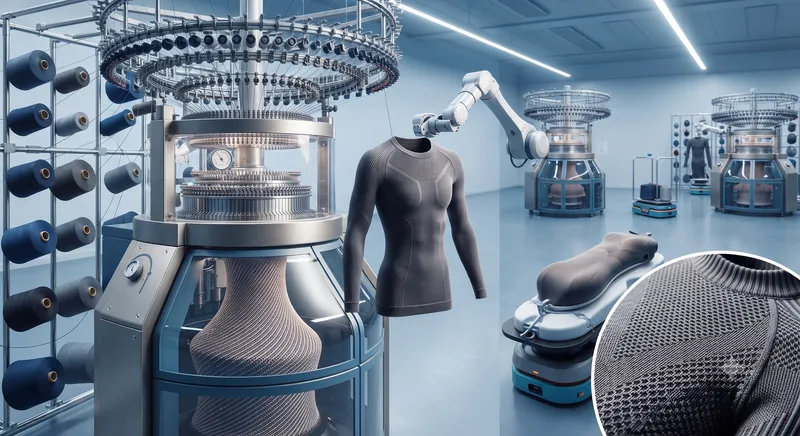
Seamless knitting produces tubular garment components or shaped knitted structures, reducing the need for conventional cutting and sewing. Depending on the technology, machines are used for items such as activewear, lingerie and compression garments, while whole-garment flat knitting can create complete garments in three dimensions with little or no sewing. Rib, mesh, support and design features can be incorporated into the knitted structure, subject to the machine’s capabilities and programming.
What Makes “Seamless” Different?
Traditional cut-and-sew knitwear is made by knitting fabric, cutting it into panels and stitching them together. Seamless knitting reduces the need for these steps, helping manufacturers create garments with fewer seams and integrate features such as stretch zones, mesh panels and support areas into the knitted structure.
The result can be fewer seams, less cutting waste and reduced assembly work. These characteristics are particularly relevant in activewear, lingerie, shapewear and medical compression garments, although the actual benefits depend on garment design and production method.
Step-by-Step: From Yarn to Finished Seamless Garment
1. Yarn Selection and Preparation
Yarn selection is the first step in the process. Many seamless performance garments use synthetic yarns such as nylon (polyamide) and polyester for properties including durability, with elastane (spandex) added for stretch and recovery. Moisture-management performance depends on factors such as yarn construction, fabric structure and finishing, rather than fibre type alone. Cotton, modal and viscose may also be used in softer everyday garments.
Yarn may be dyed before knitting, or the garment may be dyed after knitting. The choice depends on the fibre, required colour, production method and end-use specifications.
2. Digital Design and Machine Programming
Seamless garments are developed using digital knitting programs rather than conventional fabric patterns alone. Designers and technicians translate garment measurements and stitch designs into machine instructions. A sample is knitted and checked for size, fit and fabric quality before production begins.
This stage is where body-mapping is planned: different areas of the same garment can have different stitch densities and yarns, enabling compression, ventilation or aesthetic patterns without extra sewing.
3. Knitting on Specialised Machines
Seamless and whole-garment production uses two main types of knitting technology:
- Computerised circular seamless machines: These machines produce tubular knitted structures for garments such as activewear and lingerie. Santoni, based in Brescia, Italy, is part of the Lonati Group. According to the Lonati Group, Santoni meets approximately 97% of worldwide demand for seamlesswear machines; this is a company-reported claim [1]. Santoni’s SM8-TOP2V is an electronic circular knitting machine with eight feeds, and terry production is available on request [2]. The SM8-TOP2ST supports selective terry knitting alongside standard seamless structures [3].
- Computerised flat-bed whole-garment machines: These can knit complete garments in three dimensions, reducing or eliminating the need for garment assembly by sewing. Japan-based SHIMA SEIKI offers its WHOLEGARMENT range, including the MACH2XS [4]. In June 2026, KARL MAYER announced an agreement to transfer selected assets from its discontinued STOLL-branded flat-knitting machine business, including the STOLL brand and certain technological assets, to CIXING Group. The announcement stated that completion of the transaction was still pending at that time [5].
Other notable circular knitting machine makers include Italy-based Sangiacomo, which manufactures machines for producing men’s and children’s socks [1]. Germany-based Merz Maschinenfabrik specialises in circular knitting machines for medical compression stockings and related products. It also developed the Merz Body Seamless machine in cooperation with Mayer & Cie [6].
During knitting, the machine forms a tubular or shaped knitted structure. Depending on the design and machine technology, some cutting or assembly may still be needed, but much of the shaping is completed during knitting.
4. Dyeing, Finishing and Heat‑setting
After knitting, garments may undergo dyeing and finishing, depending on the material and product requirements. Finishing can include softening or functional treatments, while heat-setting or other dimensional stabilisation may be used when suitable for the fibre and garment construction.
5. Minimal Assembly and Quality Control
Because the garment is already shaped, assembly may include adding components such as straps, bra pads, gussets, labels or heat-transfer branding, depending on the design. Any remaining joins or finishing operations depend on the garment design and the machine technology used.
Final quality-control checks cover dimensions, knitting faults, stretch and recovery, and shade consistency. Additional tests, such as colour fastness, pilling and wash durability, are conducted when required by the product specification or buyer’s quality plan.
Machines and Leading Brands at a Glance
Process Step | Typical Machines | Examples of Manufacturers and Technologies |
Circular seamless knitting | Electronic circular knitting machines | Santoni; Sangiacomo; Merz for compression-hosiery applications |
Flat-bed whole-garment knitting | Computerised flat-bed knitting machines | SHIMA SEIKI WHOLEGARMENT |
Dyeing and finishing | Dyeing and finishing equipment | Depends on the factory and process |
Garment assembly | Linking and sewing machines, where required | Depends on the garment design |
Seamless Knitting Technology: Global Suppliers and India’s Manufacturing Base
Globally, specialised manufacturers produce seamless activewear and intimate apparel for a range of markets. India has established garment manufacturing hubs, including Tirupur, Delhi NCR and Bengaluru. However, the presence of garment manufacturers in these regions does not, by itself, establish them as specialised seamless-knitting clusters. Buyers should verify whether suppliers operate seamless knitting machinery in-house or outsource the knitting process. Listings for yoga wear, sports bras and leggings should not be treated as proof of in-house seamless production.
Italy is home to established circular knitting machinery manufacturers, including Santoni and Sangiacomo, while Japan-based SHIMA SEIKI is known for its WHOLEGARMENT flat-knitting technology. STOLL is a historically significant flat-knitting brand, but its manufacturing and asset-transfer status should be taken into account when evaluating current suppliers.
SWOT Snapshot: Seamless Knits Industry
Strengths
- Reduced cutting waste and sewing labour; potentially faster product development for complex designs.
- Fewer seams and zoned construction can improve comfort and fit, depending on yarn, stitch structure, compression, sizing and finishing.
Weaknesses
- High capital cost for advanced machines (particularly advanced whole-garment systems).
- Dependence on skilled programmers and technicians to convert designs into knitting programs.
Opportunities
- Applications in medical compression, orthopaedic supports and smart textiles.
- Potential to reduce cutting waste compared with conventional cut-and-sew, depending on garment design and production method.
- Opportunities for Indian brands to explore seamless activewear and intimate apparel.
Threats
- Intense price competition from low-cost manufacturing regions.
- Supply-chain volatility for synthetic yarns (nylon, elastane).
Why This Matters for Readers and Brands
For buyers, seamless construction can reduce seam-related irritation and support different performance features, depending on garment design and fit. For brands and manufacturers, it offers another way to combine garment shaping and functional features while potentially reducing cutting and assembly work.
If you’re evaluating suppliers, ask which circular seamless or flat-bed whole-garment machines they operate, what gauges and garment dimensions they can accommodate, and how they manage programming, sampling, dyeing, finishing and quality testing. These details help distinguish specialist seamless manufacturers from general knitwear contractors.
References
[1] Lonati Group. https://www.lonatigroup.com/en/areas-of-competence/textile
[2] Santoni. SM8-TOP2V: Electronic Circular Knitting Machine.
https://www.santoni.com/en/products/seamless/sm8-top2v
[3] Santoni. SM8-TOP2ST: Electronic Circular Knitting Machine.
https://www.santoni.com/en/products/seamless/sm8-top2st
[4] SHIMA SEIKI. MACH2XS WHOLEGARMENT Knitting Machine.
https://www.shimaseiki.com/product/knit/mach2xs/
[5] KARL MAYER. Agreement Signed for the Divestiture of Selected Assets. 18 June 2026.
[6] Merz Maschinenfabrik. Company Information and History.
https://www.merz-mf.de/en/company