Printing the Floor Beneath Your Feet: Colorjet Makes Its Mark at ITM ISTANBUL 2026
-2-800x400.webp?2026-06-16T06:25:38.825Z)
Arun Varshney, Vice President & Business Head, ColorJet, on the 5.2-metre CarpetJet, India's digital printing ambitions, and why the time for analogue-to-digital transition is now
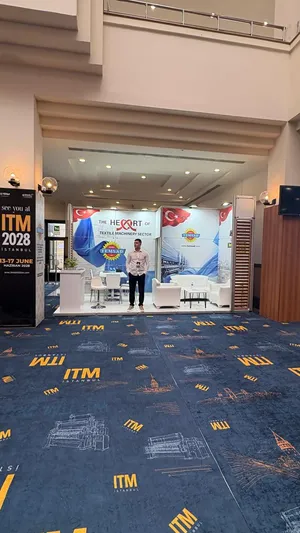
There are product introductions, and then there are statements. At ITM Istanbul 2026, one of the world's foremost textile technology exhibitions, ColorJet chose to make both simultaneously. The carpets beneath visitors' feet as they walk the exhibition halls and connecting pathways have been produced on ColorJet's CarpetJet printers, installed at a customer facility in Türkiye. Before a single conversation has taken place on the show floor, the Indian digital printing manufacturer has already demonstrated what its technology can do at scale.
Speaking at the ColorJet booth, ColorJet's Vice President and Business Head reflected on what the moment means. "It is a proud privilege that one of our customers got the ITM walkways printed on a ColorJet machine. It is a very proud feeling — representing India on an international platform and exhibiting our quality and product."
Introducing the 5.2-Metre CarpetJet
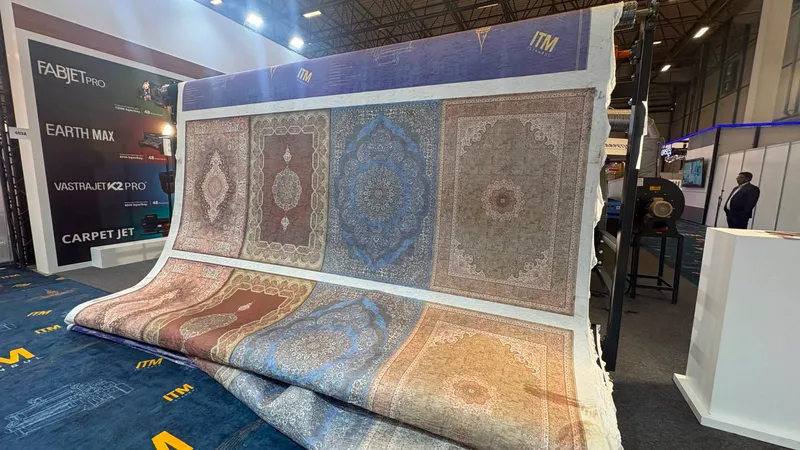
The centrepiece of ColorJet's ITM presence is the introduction of India's first 5.2-metre CarpetJet machine — a direct-disperse digital printing solution purpose-built for the carpet and floor-covering industry. The significance of the width specification is not incidental. "Up till now, 4-metre solutions have been available in the market. This particular machine addresses the need for wider width, super wider width, and extra wider width requirements." At 5.2 metres, it covers wall-to-wall carpet printing requirements that existing solutions in the market simply could not accommodate.
The machine runs live on the show floor at ITM — not merely on display, but in active production. It prints on direct disperse, suited specifically to polyester-based carpets, delivering what Varshney characterises as a quick, sustainable, and highly customisable solution. "It can be customised as per the design, as per the market requirement, and it fits into the right set of customer expectations."
The broader CarpetJet platform, as detailed in ColorJet's specifications, delivers print speeds of up to 380 sqm/hour with industrial-grade print heads and eco-friendly water-based disperse inks — engineered for high-volume production without compromising on consistency or print quality.
A Market Tailor-Made for This Product
Türkiye is not an accidental choice for showcasing this innovation. "Traditionally, Turkey has been a good floor-covering and carpet market," he noted. ColorJet has already supplied multiple solutions to the Turkish market and to neighbouring regions, including Armenia and other CIS countries. The 5.2-metre machine has been specifically customised and tailored to answer the demands of this geography. "We are very confident that this particular product will cater to the needs of the carpet industry and will give a complete quality solution for customers here in Türkiye as well as the CIS and adjoining countries."
The exhibition response has reinforced that confidence. Strong enquiries have come in from Gaziantep and Batman — two of Türkiye's principal carpet manufacturing hubs — as well as from across the broader Balkan region and neighbouring countries, including Syria and Armenia. Crucially, these are not distributors or intermediaries. "We have direct manufacturers who are actually doing the digital printing work, who want to adopt digital workflows," Varshney clarified. Many are grappling with real operational constraints — time-to-market pressures, colour range limitations, and substrate restrictions — and are actively exploring digital solutions as the answer.
A Full Ink Portfolio — and Why Pigment Is the Future
Asked about ColorJet's position in the ink segment — an area where several competitors have been making moves — he made clear that this is not new territory for the company. ColorJet already offers a comprehensive ink portfolio spanning reactive, pigment, disperse, and acid solutions, available across its machine range at what he described as a value-for-money platform. "The consistency on print quality, the jettability, and the quality should be uniform across the entire production, and the unique solution available with ColorJet represents a large gamut of ink solutions in the market."
On the question of which ink technology holds the most promise going forward, the answer was immediate. Pigment, he argued, is the technology of the future — and the reasoning is structural. Reactive inks are confined to cellulosic substrates and require steaming and washing processes that generate effluent discharge. Disperse is limited to 100% polyester. Pigment, by contrast, is substrate-independent — it works across fibres and eliminates the water-intensive post-processing steps that reactive printing demands. "Globally, when we are talking about sustainability, pigment solution is the next big thing — the future, actually." ColorJet currently holds the largest installation base of pigment machines in India, with a growing global footprint to match.
Digital vs Analogue: The Tipping Point Has Arrived
One of the more pointed exchanges in the conversation addressed the broader competitive dynamic between digital and conventional printing — rotary and table (screen) printing — which still accounts for the dominant share of textile print volumes globally.
Varshney acknowledged the historical perception head-on: that digital printing carries a higher cost per metre than analogue. He pushed back firmly. The calculation, he argued, has shifted fundamentally when the full picture is considered — workflow savings, reduced wastage, faster time-to-market, and the ability to serve both high-volume and print-on-demand requirements from a single platform. "The analogue printing has to adopt the digital market, the digital printing solutions. Probably this is the right time."
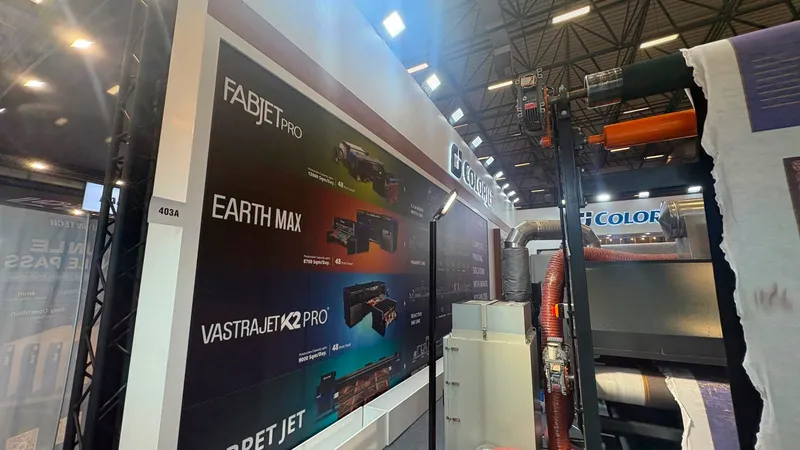
ColorJet's current portfolio positions the company to make that case comprehensively. The recently introduced Falcon 64 — a 1.9-metre machine with 64 print heads, described as the fastest Indian digital printing machine currently available for commercial production — anchors the high-speed apparel and fabric segment. The Earth series covers sustainable pigment printing. And now, the 5.2-metre CarpetJet completes the offering for the floor-covering market. "With a complete basket of solutions from ColorJet — the latest Falcon 64 printhead, the Earth series on pigment, and now the carpet solution — it is the right time for analogue printing to adopt digital on a faster level."
-800x243.webp?2026-06-16T06:28:06.977Z)
India's Engineering, on a Global Stage
Underlying the entire ITM presence is a theme that Varshney returned to more than once — the significance of Indian-engineered technology performing at this level on a global platform. That the carpets of one of the world's leading textile machinery exhibitions were produced on an Indian-made machine is not a footnote; for Varshney, it is the headline.
"It is a proud privilege representing India on an international platform and exhibiting our quality and product. It is a very nice experience for us at ColorJet."
His invitation to anyone who has yet to visit the booth was characteristically direct: "We want to invite everyone to witness 5.2-metre live carpet printing in action at ColorJet's booth at ITM Türkiye. Witness the transformation — the colours, the vibrancy, the ease of printing — live in action."