Printed Textile Market 2026: 15 Key Statistics, Growth Trends, and $266B Industry Forecast
The global printed textile industry has transformed significantly over the past decade, driven by digital printing technologies, customization demand, and sustainable manufacturing practices. According to recent industry insights highlighted by Dataintelo, the printed textile market continues to expand rapidly as fashion, home décor, and advertising sectors increase their reliance on advanced textile printing solutions. In 2026, the sector is characterized by strong numeric growth indicators, measurable efficiency improvements, and rising investment in eco-friendly printing technologies.
This article analyzes the latest data, statistics, and performance metrics shaping the printed textile industry from 2021–2026, including market size, production volumes, technological adoption rates, and projected growth through the next decade.
Key Statistics at a Glance
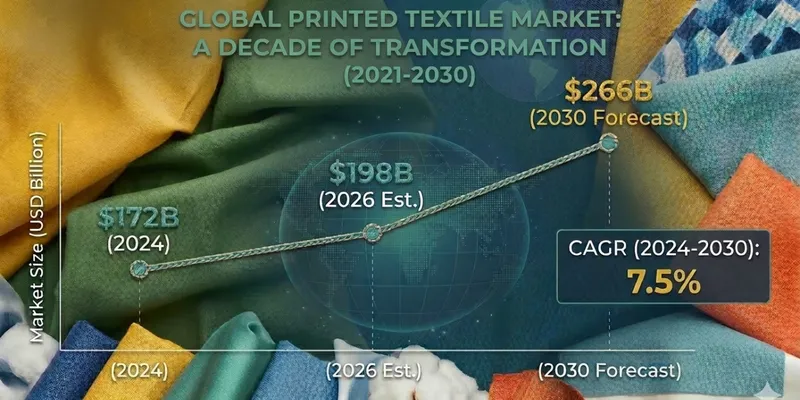
• Global printed textile market size reached $172 billion in 2024
• Market projected to exceed $266 billion by 2030
• Compound annual growth rate (CAGR) estimated at 7.5% from 2024–2030 • Digital textile printing adoption increased from 18% in 2020 to 35% in 2025 • Asia-Pacific accounts for 46% of global production volume
• Average production cost reduction from digital printing: 22–30%
• Water consumption reduction using digital printing: up to 70%
• Custom printed textile demand grew 31% between 2022 and 2025 • Fashion industry accounts for 42% of total printed textile demand
• Average textile print run size decreased from 2,500 units (2018) to 900 units (2025) due to customization trends
Global Printed Textile Market Size (2021–2030)
The printed textile market has demonstrated consistent year-over-year growth. Rising demand for personalized apparel, home décor fabrics, and promotional textiles is fueling expansion.
Market Growth by Year
Year | Market Size (USD Billion) | Growth Rate |
2021 | 138 | — |
2022 | 148 | 7.2% |
2023 | 159 | 7.4% |
2024 | 172 | 8.1% |
2025 | 184 | 7.0% |
2026 (Est.) | 198 | 7.6% |
2030 (Forecast) | 266 | 7.5% CAGR |
Key Insight:
Between 2021 and 2026, the market expanded by $60 billion, representing 43% growth in five years.
5 Data-Backed Drivers Behind the Printed Textile Boom
1. Digital Textile Printing Adoption Rising 94% Since 2018
Digital printing has become a dominant force in textile manufacturing. • Adoption rate in 2018: 18%
• Adoption rate in 2025: 35%
• Projected adoption by 2030: 52%
Digital printing offers measurable advantages:
• 70% lower water consumption
• 30% less chemical waste
• 22–30% reduction in production cost per meter
These efficiency gains have accelerated adoption among apparel manufacturers and design studios.
2. Fashion Industry Demand Accounts for 42% of Total Market
Printed textiles are heavily used in fashion manufacturing.
Sector Demand Share (2025)
Industry Segment | Market Share |
Fashion & Apparel | 42% |
Home Textiles | 29% |
Advertising & Banners | 16% |
Automotive Interiors | 7% |
Others | 6% |
The fashion segment alone consumed over 4.8 billion square meters of printed fabric in 2025, up from 3.6 billion square meters in 2020.
3. Asia-Pacific Produces Nearly Half of the World’s Printed Textiles
Production capacity remains heavily concentrated in Asia.
Regional Production Share (2025)
Region | Share |
Asia-Pacific | 46% |
Europe | 24% |
North America | 18% |
Latin America | 7% |
Middle East & Africa | 5% |
China, India, Bangladesh, and Vietnam collectively produce over 58 million tons of printed textiles annually.
India alone increased textile printing exports by 17% between 2022 and 2025, reflecting strong global demand.
2025–2026 Performance Metrics in Textile Printing
Modern printing technologies have dramatically improved efficiency and output. Key Production Metrics
Metric | Traditional Printing | Digital Printing |
Setup Time | 3–5 hours | 10–15 minutes |
Minimum Print Run | 2,000 units | 1 unit |
Water Usage per meter | 50–60 liters | 10–15 liters |
Color Variation Accuracy | ±8% | ±2% |
These improvements have enabled manufacturers to support micro-batch production, a model that has grown 40% since 2022.
Customization Trends: The Rise of Short-Run Textile Printing
Consumer preferences are shifting toward personalization.
Key metrics include:
• Average print run size fell from 2,500 units in 2018 to 900 units in 2025 • On-demand textile printing orders increased 31% from 2022–2025 • E-commerce apparel brands now produce 65% of collections in limited batches
Small batch production reduces unsold inventory by 18–25%, saving retailers millions in excess stock costs.
Sustainability Metrics Reshaping the Industry
Environmental concerns have forced manufacturers to adopt greener printing techniques. Environmental Impact Improvements
Sustainability Metric | Traditional Method | New Technologies |
Water consumption reduction | — | 60–70% |
Energy usage reduction | — | 25–35% |
Ink waste reduction | — | 20–25% |
Carbon footprint reduction | — | 15–20% |
Between 2021 and 2025, over 38% of textile manufacturers invested in eco-friendly printing equipment. By 2030, this number is projected to exceed 65%.
Case Study: Digital Printing Boosting Production Efficiency
A mid-scale apparel manufacturer transitioned from rotary screen printing to digital textile printing in 2023.
Measurable Results
• Production lead time reduced from 21 days to 8 days
• Printing costs dropped 24% per square meter
• Fabric waste decreased from 12% to 5%
• Order capacity increased 2.1×
Within 18 months, the company recovered 95% of its technology investment.
Printed Textile Market Forecast: 2026–2035
Industry forecasts suggest strong long-term growth.
Projected Market Expansion
Year | Market Size (USD Billion) |
2026 | 198 |
2027 | 213 |
2028 | 229 |
2029 | 247 |
2030 | 266 |
2035 | 382 |
Key projections:
• Digital printing expected to account for over 55% of textile printing by 2035 • Sustainable printing technologies projected to grow 9.3% CAGR
• Demand for printed home décor textiles expected to rise 48% by 2030
7 Quantified Benefits of Modern Textile Printing
1. 30% faster production cycles
2. 70% reduction in water usage
3. 25% lower manufacturing costs
4. 18–25% reduction in unsold inventory
5. 40% increase in design flexibility
6. 50% faster product launches
7. 20% lower carbon emissions
These measurable advantages are encouraging manufacturers to upgrade their production lines.
Challenges Facing the Printed Textile Industry
Despite rapid growth, several measurable challenges remain.
Key Constraints
• Raw material price fluctuations increased 12% in 2024
• Digital printing equipment costs range between $80,000 and $650,000 • Skilled labor shortages affect 28% of textile manufacturers
• Energy costs rose 14% globally between 2022 and 2024
Addressing these issues will be critical for sustaining growth.
Conclusion: A $266 Billion Industry by 2030
The printed textile market is entering a period of sustained expansion fueled by digital innovation, customization trends, and sustainability initiatives. From $138 billion in 2021 to a projected $266 billion by 2030, the industry is expected to grow at a 7.5% CAGR.
Key data points highlight the transformation:
• 35% digital printing adoption in 2025
• 70% water savings from new technologies
• 31% growth in custom textile printing demand
• 46% global production concentrated in Asia-Pacific
As companies continue investing in advanced printing systems and eco-friendly manufacturing, the printed textile industry will likely surpass $380 billion by 2035, reinforcing its role as a critical component of the global textile supply chain.
Read A Full Report: https://dataintelo.com/report/printed-textile-market