Premier Synthetics Limited

1. Introduction
The Indian textile industry is currently beset by a harsh cycle of variable input costs and a structural shift toward global supply chain diversification. For a legacy entity like Premier Synthetics Limited (PSL), the 2024-2025 fiscal year marks a departure from traditional industrial survival toward a radical corporate metamorphosis. This analysis examines PSL’s attempt to navigate a "V-shaped" recovery, though the underlying data suggests that this rebound is less about manufacturing prowess and more about aggressive asset management and a calculated retreat from a capital-intensive past. As we dissect the numbers, it becomes clear that PSL’s historical footprint is being actively leveraged to fund a future that looks nothing like its five-decade manufacturing heritage.
2. Company Overview
Incorporated in 1970, PSL is a fixture of the Ahmedabad industrial landscape. For decades, the company’s identity was inextricably linked to Blue Blends (India) Limited, for whom it performed exclusive job-work. However, the modern PSL has attempted to break this dependency, pivoting toward independent market players in the cotton yarn segment. Operating as a small-cap specialist, it primarily supplies the denim manufacturing sector. Yet, the current operational model is best described as a business in a state of controlled liquidation, as management seeks to optimize its balance sheet by moving away from the thin-margin realities of pure-play manufacturing.
3. Promoter / Founder Introduction
Leadership at PSL is anchored by Sanjaykumar Vinodbhai Majethia and Gautamchand Surana. Mr. Majethia, with over 15 years in trading and industry, has the unenviable task of steering the ship through a period of severe revenue contraction. Perhaps the most telling indicator of the company’s future is the proposed appointment of Ms. Savita Gupta as an Independent Director. Her 20-year career in finance and insurance is not a random addition; it is a tactical prerequisite for the company’s planned expansion into management and finance consultancy. This infusion of financial services expertise suggests the board is preparing for a future where spreadsheets and advisory fees replace spindles and yarn.
4. Financial Statements
The 2023-2025 period reveals a company desperately trying to find its footing. While the surface-level metrics suggest a rebound, a deeper dive into the "quality" of earnings tells a more complex story of operational struggle offset by non-operating gains.
Metric (Rs. Cr.) | FY 2025 | FY 2024 | FY 2023 |
Sales/Revenue | 14.80 | 7.99 | 52.68 |
Operating Profit | -1.11 | 0.33 | 0.72 |
Net Profit | 1.49 | -2.21 | 0.02 |
Total Assets | 35.76 | 35.00 | 42.14 |
Total Borrowings | 8.14 | 6.57 | 10.48 |
Debtor Days | 53.02 | 136.13 | 55.01 |
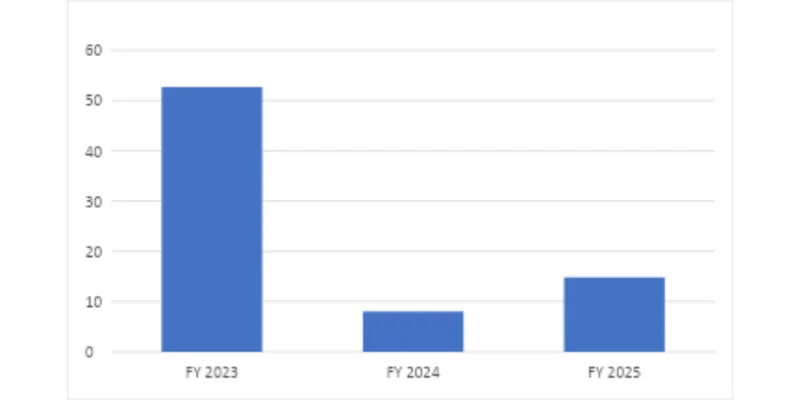
The income statement shows revenue recovering to ₹14.80 Cr from the ₹7.99 Cr abyss of 2024, but this is cold comfort. The core manufacturing "engine" is effectively stalled, evidenced by a negative Operating Profit of ₹-1.11 Cr. The reported Net Profit of ₹1.49 Cr—a sharp contrast to the ₹2.21 Cr loss in 2024—is almost entirely fueled by "Other Income," which surged to ₹2.98 Cr. Essentially, the ship is being kept afloat by asset-related gains rather than yarn sales.
On the balance sheet, equity capital remains steady at ₹4.59 Cr, but the debt-to-equity narrative requires monitoring as borrowings ticked up to ₹8.14 Cr. The headline-grabbing reduction in debtor days from 136 to 53 is less an unprecedented efficiency gain and more a return to the historical mean after a period of near-total collection paralysis in FY24.
5. Insights
Management is effectively cannibalizing its asset base to fund a strategic exit from a volatile industry.
- Strengths: The current Price-to-Book ratio of 0.24 is a screaming signal that the market has priced in a total manufacturing exit, valuing the company at a fraction of its liquidation potential.
- Weaknesses: A low interest coverage ratio and a five-year sales growth decline of -19.2% confirm that the legacy yarn business is no longer a viable long-term engine for shareholder value.
- Risk Factors: Governance is a critical watchpoint. Authorizing Related Party Transactions (RPTs) up to ₹80 Cr—a figure nearly six times current revenue—raises eyebrows. These limits are specific to Premier Spintex (₹50 Cr), Sun Insulators (₹25 Cr), and Vijay Stationeries (₹5 Cr), suggesting a highly interconnected web of group dependencies.
- Future Outlook: The proposed sale of 18,284 sq. mtrs of land at Rakanpur (Survey numbers 708, 709, and 710) for a minimum of ₹6.00 Cr provides the necessary seed capital for Item No. 7: the pivot into "Management and Finance Consultancy." This is a classic asset-light strategy—liquidating underperforming physical assets to enter a high-margin service domain.
6. Conclusion
Premier Synthetics Limited is a legacy player in the middle of a high-stakes divorce from its industrial roots. The 2025 financial recovery is a triumph of accounting and asset management over manufacturing excellence. By liquidating the Rakanpur land and appointing finance-heavy board members like Savita Gupta, management is making a savvy, albeit aggressive, move to de-risk.
This is a practical recognition that PSL's textile era is over rather than a sign of desperation. With the goal of becoming a leaner, service-focused consultancy, the company is effectively shedding its industrial skin.
Data Source Note: 55th Annual Report (2024-25) and BSE Public Disclosures.