PRAG BOSIMI
- INTRODUCTION
- Introduction of the company
- Prag Bosimi Synthetics Ltd (PBSL), incorporated in 1987, is a joint sector initiative between the Assam Industrial Development Corporation (AIDC) and the Hemant Vyas Group. It is the only major industrial venture of its kind in North East India, primarily focused on the textile value chain.
- Industry Overview
- A chunk of India’s economy ties back to textiles and clothing – which is about 2.3% of GDP, alongside nearly one out of every eight export dollars. Inside this space, synthetic fibres take centre stage, especially for companies like PBSL. This corner of the sector has caught government attention through the PLI initiative, which pushes to grow India’s global footprint in man-made fibres beyond today’s 6.5-billion-dollar mark.
- Purpose of the Analysis
- Looking at how PBSL is doing financially forms the core of this review. While operations have hit a pause due to halted production, that setback isn’t ignored here. Instead of guessing outcomes, the focus stays on what’s happening now. A clearer picture emerges when both risks and recovery signs are weighed together. This analysis helps you with the numbers of this Company for a clear judgement.
2. COMPANY OVERVIEW
- Background and History
From its headquarters in Guwahati, Assam, PBSL began as a move toward boosting local economies across the Northeast. Switzerland’s EMS Inventa became a partner through shared know-how, helping launch premium polyester yarn production.
- Business Model
- The company operates an integrated manufacturing model for Polyester Filament Yarn (PFY) and Partially Oriented Yarn (POY).
- It also maintains a backward integration unit for packaging materials like corrugated cartons and paper tubes.
- Key Products / Services
The key products offered by the company are as follows-
- Polyester Filament Yarn (PFY) - Textured, dyed & dope dyed.
- Partially Oriented Yarn (POY).
- Apparel under the brand name “Bosimi”.
- Market Position
PBSL holds the position as a pioneer of polyester manufacturing in North East India. However, it faces stiff competition from pan-India giants like Reliance Industries and Alok Industries, which benefit from larger economies of scale and superior logistical connectivity compared to PBSL's Guwahati-based operations
3.PROMOTER /FOUNDER INFORMATION
Name of Promoter | Professional Background | Role in Company Growth |
|---|---|---|
Hemant B. Vyas (Founder/Late MD) | Extensive experience in textile manufacturing and strategic management. | Instrumental in the initial JV with the Govt. of Assam and technical tie-up with Switzerland. |
AIDC (Govt. of Assam) | State-level industrial development body. | Provides crucial regulatory support, land, and institutional backing for the project. |
Devang H. Vyas (Director) | B. Chem Engineering (Mumbai), MBA (Stanford), Ex-McKinsey Consultant. | Currently steers strategic financial decisions and administrative functions for the group. |
4. FINANCIAL STATEMENT ANALYSIS
- Income Statement Analysis
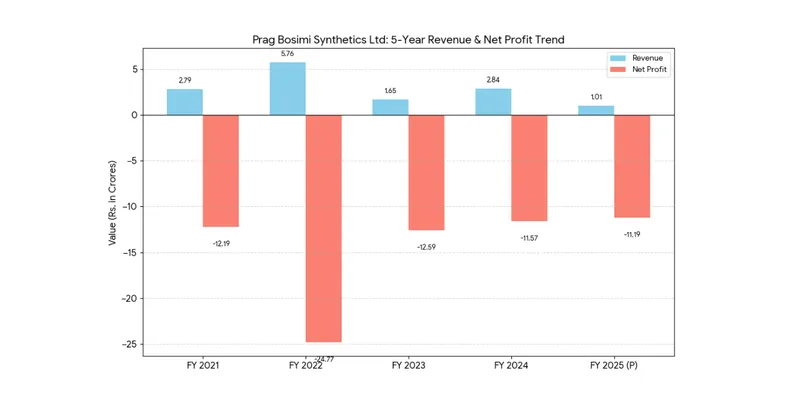
Particulars | FY 2023 | FY 2024 | FY 2025 (Est/Prov.) |
|---|---|---|---|
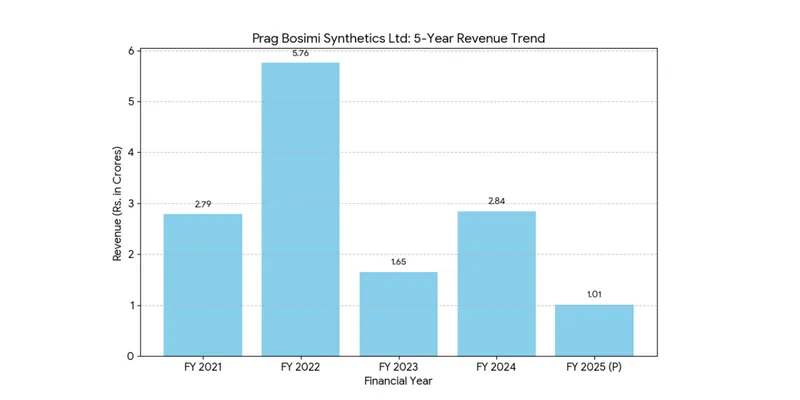
Revenue | 1.65 | 2.84 | 1.01 |
Net Profit (Loss) | (12.59) | (11.57) | (11.19) |
Key Observations of Income Statement:
The company has seen a significant decline in operations, with production frequently suspended
- Revenue & Net Profit Chart
- Balance Sheet Analysis:
Component | FY 2025 | Interpretation |
|---|---|---|
Total Assets | 196.93 | Primarily consists of fixed assets (machinery) which are currently underutilized. |
Total Liabilities | 203.44 | Liabilities exceed assets, indicating a state of technical insolvency. |
Total Equity | (6.51) | Negative equity due to accumulated losses over the years. |
As of FY25:
- The negative net worth of Rs. 9.33 Cr (as of Sept 2025) indicates severe financial distress.
- Most assets are “Gross Block” (Machinery), which requires immediate power restoration to become productive
- Cash Flow Statement Analysis (Rs. In crore)
Year | Net Cash Flow (Rs. Cr) |
|---|---|
FY 2023 | (0.49) |
FY 2024 | (0.07) |
FY 2025 | (0.13) |
Interpretation:
- Cash flow from operations is negative as revenue is insufficient to cover fixed costs.
- Survival is currently dependent on internal accruals or promoter support rather than operational cycles.
- Immediate cash infusion is required to settle power bills (APDCL) and restart units.
- Key Financial Ratios
Ratio Category | Ratio Name | Value | Interpretation |
|---|---|---|---|
Profitability | Net Profit Margin | 0.00% | Negative/Nil due to ongoing operational losses. |
Liquidity | Current Ratio | 0.14x | Critically low; unable to meet short-term obligations. |
Leverage | Debt-to-Equity | -24.55 | Meaningless due to negative equity; indicates extreme risk. |
Efficiency | Asset Turnover | 0.00 | Assets are not generating revenue due to production halt. |
- Year-on-Year Comparison (3 years)
Particulars | FY 2023 | FY 2024 | FY 2025 (P) | YoY Interpretation |
|---|---|---|---|---|
Total Revenue | 1.65 | 2.84 | 1.01 | Declining: After a brief spike in FY24, revenue fell by ~64% due to production halts. |
Operating Profit | (1.93) | (4.21) | (2.72) | Negative: Consistent operational losses; expenses (power/maintenance) far exceed output. |
Net Profit (Loss) | (12.59) | (11.57) | (11.19) | Stagnant Losses: Large losses persist, primarily driven by high interest and depreciation. |
Total Debt | 158.45 | 157.92 | 159.84 | High Leverage: Debt remains static and unserviced, leading to a mounting interest burden. |
Net Worth | 0.49 | (11.09) | (6.51) | Eroding: The net worth turned negative in FY24, signaling technical insolvency. |
- Strengths
- Backed firmly by the Assam Government through AIDC. The name BOSIMI already holds recognition in the market.
- Working alongside Swiss partners brings advanced know-how into play.
- Weaknesses
- Power shut off means factory stands still.
- Cash flow barely exists.
- Company owes more than it owns. Bills pile up without income.
- Risk Factors
- High contingent liabilities - approx. Rs. 30.2 Cr.
- Dependency on a single manufacturing site in a geographically sensitive zone.
- Future Outlook
The company is pursuing a Rs. 90 Crore subsidy claim from the State Level Committee (SLC). If released, this could clear debts and facilitate a phased restart of production.
6. CONCLUSION
Final Evaluation of Financial Health
Losing money fast, the business can’t cover its debts anymore. Operations stopped months ago due to mounting pressure. Its balance sheet shows more owed than owned. Considered beyond normal recovery now – it is technically a “stressed asset” now.
Investment / Performance Perspective
From an investment standpoint, the stock is highly speculative. Any recovery is purely contingent on the successful release of government subsidies and the restoration of power to the Guwahati plant. Unless operations resume, the financial health will continue to deteriorate.
Data Sources