polyols market projected to reach $21.59 billion by 2030
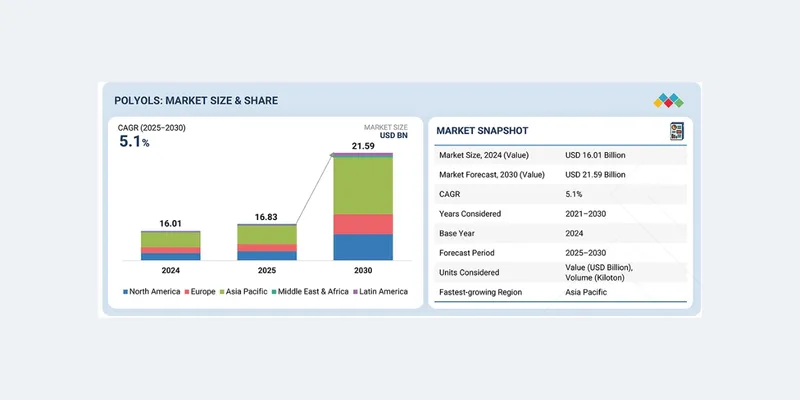
Polyols market is projected to grow steadily through the end of the decade, according to a recent market report. The study outlines key segments, growth drivers, and regional trends influencing demand across industries.
The report titled “Polyols Market by Type (Polyether Polyols, Polyester Polyols), Application (Flexible Polyurethane Foam, Rigid Polyurethane Foam, CASE), End-use Industry (Building & Construction, Furnishing, Automotive, Electronics), and Region - Global Forecast to 2030” states that the market was valued at USD 16.01 billion in 2024 and is expected to reach USD 21.59 billion by 2030, registering a CAGR of 5.1% during the forecast period.
Polyols are organic molecules containing multiple hydroxyl (–OH) groups and are widely used as key raw materials in the production of polyurethanes. These materials react with isocyanates to form a range of end-use products, including foams, elastomers, coatings, adhesives, and sealants. Based on their chemical structure and application, polyols are primarily categorized into polyether polyols and polyester polyols, each suited to different industrial uses.
Key market participants identified in the report include DOW, Covestro AG, BASF SE, Huntsman International LLC, Shell, and Stepan Company, among others.
The report outlines several factors influencing market dynamics. The automotive industry’s focus on lightweight materials is identified as a key driver. At the same time, the complexity associated with recycling polyurethane products is noted as a restraint. The increasing use of bio-based polyols presents a growth opportunity, while cross-border compliance challenges related to CASE (coatings, adhesives, sealants, elastomers) polyols remain a key challenge.
Regionally, the Asia Pacific market accounted for the largest share in 2024. This growth is attributed to industrial expansion and demand from end-use industries such as construction, automotive, furniture, and packaging. Countries including China, India, South Korea, and Southeast Asian nations have seen increased activity in these sectors.
The report notes that growth in construction driven by urbanization, infrastructure development, and housing demand has supported the use of rigid polyurethane formulations for insulation and structural purposes. At the same time, rising disposable incomes and living standards have contributed to increased demand for flexible polyurethane foam in applications such as furniture, bedding, and automotive interiors.
Source: MarketsandMarkets