Policy Impact Assessment of Government Initiatives in the Indian Textile Industry: Performance of Industrial Development and Export Promotion Schemes
Dr Iti Dubey
Assistant Professor
Abstract
The Indian textile and apparel industry plays a pivotal role in the country's industrial growth, employment generation, rural development, and export earnings. India's textile sector is supported by government policies that focus on upgrading production technology, improving industrial infrastructure, developing workforce skills, and helping domestic manufacturers compete in international markets. This chapter critically examines the performance of major government initiatives, including the Production Linked Incentive (PLI) Scheme, PM MITRA Parks, Amended Technology Upgradation Fund Scheme (ATUFS), National Technical Textiles Mission (NTTM), Skill India (SAMARTH), Startup India, and export promotion schemes. Drawing on the information presented in the source document, the chapter evaluates the objectives, implementation, achievements, and challenges associated with these initiatives. The analysis indicates that while these policies have accelerated investment, promoted technology adoption, strengthened technical textile manufacturing, and improved export competitiveness, implementation bottlenecks, infrastructure gaps, and limited participation of micro and small enterprises continue to constrain their full impact. The chapter concludes with policy recommendations aimed at enhancing the efficiency and sustainability of India's textile sector.
Keywords: Textile Industry, Government Policy, Export Promotion, Technical Textiles, ATUFS, PM MITRA, PLI, Textile Development.
1. Introduction
The Indian textile industry represents one of the country's oldest and most strategically important manufacturing sectors. From fibre production and yarn processing to fabric making and finished garments, India's textile industry covers several interconnected activities. It also includes technical textiles, handloom products, handicrafts, and the export of textile goods. The sector has traditionally contributed to industrial production, foreign exchange earnings, employment generation, and rural livelihoods.
Recognising the sector's strategic importance, the Government of India has introduced a series of policy interventions designed to modernise production systems, strengthen infrastructure, improve technological capabilities, and increase export competitiveness. Unlike earlier policies that primarily focused on subsidies and traditional manufacturing, recent initiatives emphasise integrated industrial development, innovation, sustainability, digitalisation, and value-chain integration. These reforms aim to position India as a globally competitive textile manufacturing hub while simultaneously supporting employment and regional economic development.
2. Evolution of Government Policy in the Textile Sector
India's textile policy has undergone a significant transformation over the past two decades. Earlier interventions concentrated on supporting traditional textile sectors through cluster development, technology upgradation, and export incentives. More recent policy initiatives adopt a comprehensive industrial approach by integrating investment promotion, infrastructure development, technical textile manufacturing, research and innovation, entrepreneurship, and workforce development.
This policy transition reflects the changing dynamics of international textile trade, increasing competition from countries such as Bangladesh, Vietnam, and China, and the growing demand for sustainable, high-value, and technology-intensive textile products.
3. Major Government Initiatives
3.1 Production Linked Incentive (PLI) Scheme
The Production Linked Incentive (PLI) Scheme was introduced to encourage large-scale investment in man-made fibre (MMF) apparel and technical textile manufacturing. The scheme seeks to strengthen domestic manufacturing, improve economies of scale, and increase India's participation in global value chains.
The policy has stimulated private investment proposals and encouraged capacity expansion in high-value textile manufacturing. However, the high investment threshold has limited the participation of micro, small, and medium enterprises (MSMEs), reducing the inclusiveness of the scheme.
3.2 PM MITRA Mega Textile Parks
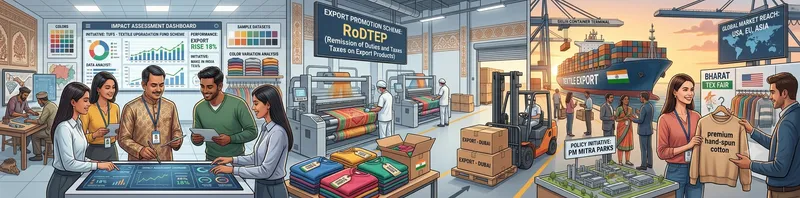
PM MITRA Parks represent an integrated infrastructure development initiative aimed at establishing world-class textile manufacturing ecosystems. The concept follows a "Farm-to-Fibre-to-Fabric-to-Fashion-to-Foreign Market" approach by integrating all stages of textile production within a single industrial cluster.
These parks are expected to reduce logistics costs, improve supply-chain efficiency, attract domestic and foreign investment, and generate large-scale employment. Although implementation has progressed through land allocation and state participation, commercial operations are still evolving.
3.3 Amended Technology Upgradation Fund Scheme (ATUFS)
Technology modernisation remains a critical determinant of industrial competitiveness. The Amended Technology Upgradation Fund Scheme (ATUFS) provides capital subsidies to textile enterprises for adopting modern machinery and advanced manufacturing technologies.
The scheme has facilitated automation, improved product quality, enhanced productivity, and encouraged modernization across various textile segments. Nevertheless, delays in subsidy disbursement, complex documentation requirements, and limited accessibility for smaller enterprises remain significant implementation challenges.
3.4 National Technical Textiles Mission
The National Technical Textiles Mission promotes the development of high-value technical textiles used in healthcare, defence, agriculture, transportation, infrastructure, and industrial applications. The initiative supports research and development, standardization, testing infrastructure, market development, and industry-academia collaboration.
The mission has contributed to expanding India's technical textile ecosystem and diversified textile manufacturing beyond conventional apparel production.
3.5 Skill India (SAMARTH)
A skilled workforce plays an important role in helping textile manufacturers improve productivity and maintain product quality. Under the SAMARTH programme, training is provided across multiple segments of the textile value chain, including garment manufacturing, handloom, apparel production, and textile processing.
The initiative has enhanced workforce availability, promoted women's participation, and supported employment generation in rural and semi-urban regions. However, the absence of systematic post-training employment tracking and regional disparities in training infrastructure continue to affect programme outcomes.
3.6 Startup India and Textile Innovation
Startup India has encouraged innovation in sustainable fibres, recycling technologies, smart textiles, digital manufacturing, and artificial intelligence applications within the textile sector. The initiative has strengthened entrepreneurial activity and promoted collaboration between academia and industry.
Despite these achievements, commercialization of innovative technologies remains limited due to financing constraints, technology adoption barriers, and market uncertainties.
3.7 Export Promotion Schemes
Export competitiveness has been supported through various initiatives, including Duty Drawback, Market Access Initiative (MAI), Market Development Assistance (MDA), Interest Equalization Scheme, Merchandise Exports from India Scheme (MEIS), and more recent export incentive mechanisms discussed in the source material.
These policies aim to reduce production costs, improve market access, encourage product diversification, and strengthen India's global export position. Although export incentives have improved competitiveness, exporters continue to face challenges arising from global market volatility, logistics costs, and increasing international competition.
4. Policy Impact Assessment
The collective impact of these government initiatives demonstrates a gradual transformation of India's textile industry from a labour-intensive traditional sector into a more technology-driven manufacturing ecosystem.
Investment-oriented policies have encouraged modernisation and capacity expansion, while infrastructure initiatives have improved industrial clustering and supply-chain integration. Technology upgradation has increased productivity and product quality, enabling firms to compete in international markets.
Similarly, technical textile policies have diversified industrial production into high-value applications, creating new opportunities for research, innovation, and export growth. Skill development programmes have strengthened workforce capabilities and enhanced employment opportunities, particularly for women and rural populations.
However, implementation effectiveness varies considerably across schemes. Administrative delays, limited MSME participation, inadequate infrastructure in certain regions, and financing constraints continue to reduce policy effectiveness. These challenges highlight the need for greater institutional coordination and simplified implementation mechanisms.
5. Emerging Challenges
Despite significant policy support, several structural challenges continue to affect the competitiveness of the Indian textile industry.
Major constraints include fragmented manufacturing structures, dependence on conventional production technologies among small enterprises, rising logistics costs, insufficient research investment, environmental compliance requirements, and increasing competition from emerging textile-exporting nations.
Furthermore, the transition toward sustainable manufacturing and circular economy practices requires greater investment in cleaner technologies, resource-efficient production systems, and environmentally responsible supply chains.
6. Policy Recommendations
Future government measures should make existing schemes easier to implement and ensure that their benefits reach a greater number of textile businesses, including small and medium-sized enterprises. Simplifying administrative procedures under investment and technology schemes would enable greater participation by MSMEs. Accelerating the operationalisation of integrated textile parks can improve industrial productivity and reduce logistics costs.
Greater emphasis should also be placed on strengthening industry-academia collaboration, promoting innovation in technical textiles, expanding digital manufacturing capabilities, and supporting sustainable production practices. Enhanced monitoring and evaluation mechanisms should be introduced to assess employment generation, productivity improvements, and export performance under various government schemes.
7. Conclusion
Government initiatives have significantly reshaped India's textile policy landscape by shifting the emphasis from traditional production support toward investment-driven industrial development, technological modernisation, infrastructure creation, skill enhancement, and export competitiveness. Schemes promoting integrated manufacturing, technology adoption, technical textiles, entrepreneurship, and export incentives have collectively strengthened the industry's long-term growth potential.
Nevertheless, sustained improvements in implementation efficiency, MSME participation, innovation ecosystems, infrastructure development, and policy coordination remain essential for realising the full benefits of these initiatives. A balanced approach combining technological advancement, sustainability, inclusive industrial growth, and global market integration will be critical for positioning India as a leading textile manufacturing and export hub in the coming decades.