PM Modi Urges Indian Industry to Boost Manufacturing, Value Addition and Exports
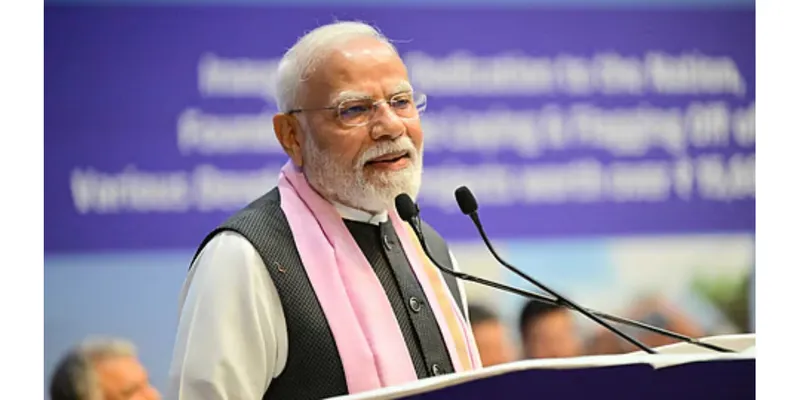
Addressing FICCI’s 100th annual general meeting, the Prime Minister calls on businesses to reduce import dependence, leverage trade agreements and strengthen India's global manufacturing competitiveness.
PM Calls for Greater Manufacturing and Export Ambitions
Prime Minister Narendra Modi has called on Indian industry to strengthen manufacturing capabilities and use the country's growing trade partnerships to expand its presence in international markets.
Speaking at FICCI's annual general meeting, as the industry association marked its 100th year, Modi highlighted the government's tax and business reforms and invited industry representatives to submit written recommendations for further improvements.
“This is not the old government. This is a government that is your friend,” he said, encouraging businesses to communicate their concerns and suggestions without hesitation.
He urged companies to use the next two decades to strengthen domestic capabilities, reduce dependence on imports and prepare for changing demand in India and overseas markets.
“Our domestic market should not be our comfort zone. It should give us the confidence to compete in global markets,” he told industry leaders. “In every long-term investment decision of yours for the next 20 years, make India First your foundation.”
According to Modi, strengthening domestic production and value addition would support self-reliance while creating new opportunities for businesses.
Pharmaceuticals: Focus on Domestic Production of APIs
Highlighting opportunities in the pharmaceutical sector, Modi noted that although India has established strengths in finished medicines and is recognised as the “pharmacy of the world”, it continues to import billions of dollars' worth of active pharmaceutical ingredients (APIs), bulk drugs and drug intermediates.
He urged pharmaceutical manufacturers to identify ingredients that could be produced domestically and invest in advanced technologies and large-scale manufacturing facilities to improve global competitiveness.
“In finished medicines, we have strength. Now we will have to build our capabilities in ingredients as well,” Modi said.
Steel and Aluminium Industries: Reducing Import Dependence
The Prime Minister also pointed to gaps in India's steel and aluminium industries.
He noted that India exports iron ore while importing finished steel products. Similarly, despite having substantial bauxite reserves, the country continues to depend on imports for specialised aluminium alloys and other products.
Modi called on manufacturers to identify the specific grades of steel being imported and develop the technology required to produce them domestically. He also emphasised the importance of building expertise across mineral value chains to increase domestic value addition.
Agriculture and Food Processing Offer Export Opportunities
Modi urged the corporate sector to increase investment in agriculture and food processing, highlighting the gap between India's agricultural production capacity and its share of international exports.
Despite the country's size, India's contribution to global agricultural exports remains at just 2-2.5%, he said.
“What kind of a country is this, and what kind of industrialists are we, if we export wheat and import bread?” Modi asked, encouraging businesses to examine why raw materials continue to be exported while finished products are imported.
He also highlighted the growing contribution of processed food to India's agri-food exports. Over the past 12 years, the share of processed food in these exports has increased from 13% to more than 20%.
The Prime Minister called for a coordinated approach to developing products for international markets, supported by reliable procurement networks and an understanding of the requirements of overseas customers.
Engineering and Machinery Manufacturing Need Greater Attention
The Prime Minister identified hand tools, power tools and machinery manufacturing as sectors with considerable export potential.
He encouraged large companies to support smaller enterprises in developing manufacturing capabilities that meet international quality and production scale requirements.
Modi also highlighted opportunities to manufacture machinery for developing economies, particularly countries in the Global South. Packaging equipment, irrigation systems and factory-related machinery were among the areas he identified for potential expansion.
Trade Agreements Provide Access to International Markets
Modi urged Indian businesses to make greater use of the trade agreements signed with several countries, noting that improved access to major international markets presents opportunities for domestic manufacturers.
He questioned whether companies had adequately prepared to benefit from these agreements and called for greater investment in overseas market research, consumer preference analysis and distribution networks.
He stressed that India's domestic market of 1.4 billion people should not lead businesses to assume that all their production would automatically find buyers within the country.
Instead, manufacturers must improve product quality and ensure that their offerings meet international standards.
PM Emphasises Quality for Domestic and International Consumers
Modi also raised concerns over companies marketing certain products as “export quality” for Indian consumers, stating that domestic buyers should receive the same standard of quality.
“My countrymen deserve quality,” he said.
He encouraged businesses to understand consumer preferences across different regions and develop products suited to their requirements.
The Prime Minister further emphasised the need for investment in international market research, product development and distribution infrastructure to strengthen the global presence of Indian products.
Industry Urged to Contribute to Developed India Vision
Concluding his address, Modi called on businesses to focus on their contribution to India's development over the coming years rather than waiting for another century to bring significant changes.
“Do not wait another 100 years. Think about what you can give the country in the next 10 years,” he said.
“Developed India is not a slogan; it is a commitment,” Modi added, urging industry and citizens to contribute towards the country's goal of becoming a developed nation.