PLI Scheme Shows Mixed Progress, Says CareEdge Ratings
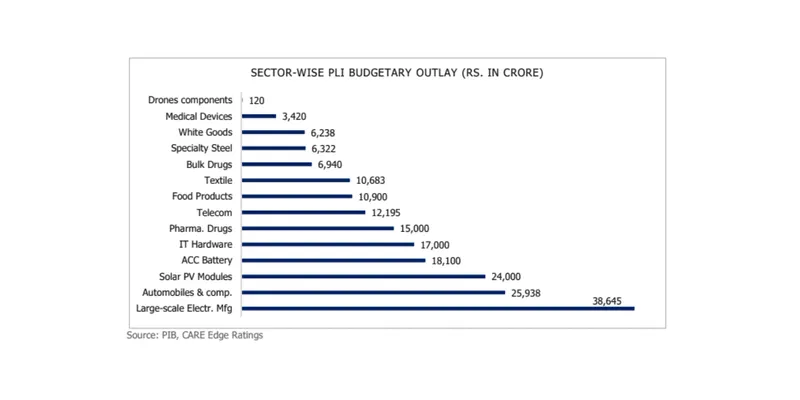
India’s Production Linked Incentive (PLI) scheme has delivered uneven results across sectors, with incentive disbursements reaching only 12 percent of the total approved outlay so far, even as investments, production and job creation show encouraging momentum, according to an analysis released by CareEdge Ratings.
Launched in 2020 under the Government of India’s Atmanirbhar Bharat and Make in India initiatives, the PLI framework was initially approved for 10 sectors with a budgetary outlay of Rs 1.46 lakh crore. The scope was later expanded to 14 sectors, taking the total approved outlay to Rs 1.97 lakh crore. However, cumulative incentive disbursements up to September 2025 stood at Rs 23,946 crore.
Despite the slow pace of payouts, CareEdge Ratings noted that the scheme has facilitated actual investments of about Rs 2 lakh crore and supported incremental production and sales of over Rs 18.7 lakh crore as of September 2025. More than 12.6 lakh direct and indirect jobs have also been generated across participating sectors, although several industries remain in the investment or scale-up phase of their five-year targets.
Electronics manufacturing has emerged as the strongest performer under the PLI framework. Total production in the sector rose 146 percent, from Rs 2.13 lakh crore in FY21 to Rs 5.45 lakh crore in FY25. Foreign direct investment inflows exceeded USD 4 billion during this period, with nearly 70 percent directed toward PLI beneficiaries. Mobile phone exports surged sharply, rising from Rs 22,870 crore in FY21 to approximately Rs 2 lakh crore in FY25.
The pharmaceuticals segment, particularly key starting materials (KSMs), active pharmaceutical ingredients (APIs) and bulk drugs, also recorded strong gains. Cumulative sales during FY22–FY25 reached Rs 2.66 lakh crore, including exports of Rs 1.70 lakh crore. India transitioned from being a net importer of certain bulk drugs in FY22 to a net exporter by FY25, reflecting improved domestic value addition and supply-chain resilience.
Medical devices manufacturing has shown rapid scale-up, with 21 projects producing 54 high-end products, including MRI systems, CT scanners, heart valves and linear accelerators. These developments have helped reduce import dependence and expand exports in a sector historically reliant on overseas suppliers.
Other sectors, including automobiles and auto components, have mobilised investments of Rs 35,657 crore and generated incremental sales of Rs 32,879 crore, with incentive disbursements amounting to Rs 1,350.83 crore as of November 2025. However, capital-intensive segments such as Advanced Chemistry Cell (ACC) batteries and solar photovoltaic modules are progressing more slowly due to longer gestation periods. Under the ACC scheme, 40 GWh of capacity has been allocated, but only 1 GWh has been commissioned as of October 31, 2025.
CareEdge Ratings observed that the government has adopted a flexible implementation approach to support slower-moving sectors, including timeline extensions, phased tranches and relaxed conditions. Adjustments under the textile PLI scheme were cited as an example of this adaptive strategy aimed at improving participation and strengthening domestic value chains.
Commenting on the overall performance, Arti Roy, Associate Director, CareEdge Ratings, said:
“As against total PLI outlay, though disbursement stood low at 12%, it has been largely successful in achieving the desired results in terms of investment, incremental production/sales and job creation. As against the initial expectations of investments of Rs 3.48 lakh crore, incremental production/sales of Rs 29 lakh crore, and creation of around 39 lakh additional jobs, the scheme has facilitated actual investments of about Rs 2 lakh crore, supported incremental production/sales of over Rs 18.7 lakh crore and generated more than 12.6 lakh direct and indirect jobs across these sectors by September 2025.”
Looking ahead, Hardik Shah, Director, CareEdge Ratings, noted that incentive payouts are expected to accelerate as companies approach production milestones:
“With several companies approaching or completing their milestones, incentive disbursements under the PLI scheme are expected to accelerate, as reflected from the Government’s upward revision of the FY26 outlay to Rs 19,742 crore. Going forward, the PLI framework is poised to deliver stronger outcomes by driving scale, fostering greater technology adoption, and deepening domestic value chains.”
Ranjan Sharma, Senior Director, CareEdge Ratings, highlighted export momentum in PLI-supported sectors:
“CareEdge Ratings believes that the PLI scheme has been a well-structured initiative that has laid the foundation for India’s manufacturing transformation… Exports from PLI-supported sectors have crossed Rs 7.5 lakh crore, accounting for nearly 6–7% of India’s total merchandise exports, led by electronics and pharmaceuticals.”
However, CareEdge Ratings cautioned that counterparty risks remain, particularly in segments such as electric buses, where private-sector participation has been limited due to inadequate incentives. Addressing these gaps will be critical for sustaining long-term growth under the PLI framework.