Plastics Recycling Industry Faces Market Pressures Amid Calls for Fair Competition and Clear Regulations
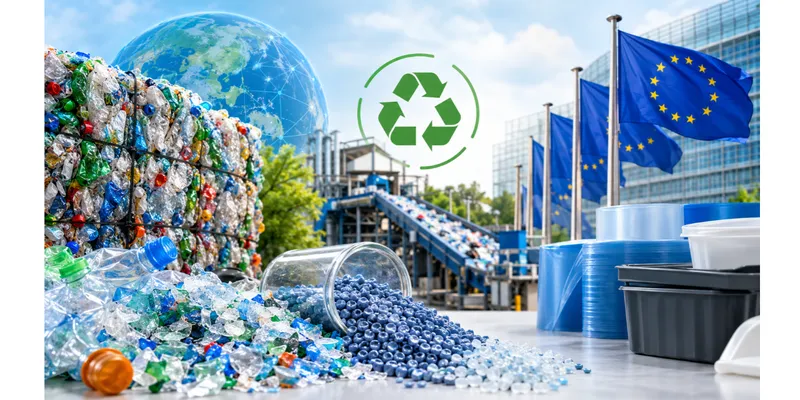
BIR Convention highlights weak demand, high operating costs, recycled-content targets and regulatory developments affecting global plastics recycling
The global plastics recycling industry is facing continued pressure from weak demand, high costs and reduced profitability, according to discussions at the Bureau of International Recycling (BIR) World Recycling Convention in Malaga, Spain. Industry representatives called for fair competition and practical regulations, while highlighting opportunities arising from mandatory recycled-content requirements and ongoing policy developments.
BIR Calls for Fair Competition and a Level Playing Field
Addressing the Convention on October 27, outgoing BIR Plastics Division President Henk Alssema, CEO of Inviplast (Netherlands), said the industry must continue communicating the need for “fair competition, practical rules and a level playing field” to governments and policymakers.
He noted that market conditions vary across regions, but the sector faces common challenges, including weak demand, high costs and pressure on profit.
After almost eight years in the role, first as Chairman of the Plastics Committee and later as President of the Plastics Division, Alssema warned that the industry's future depended on the survival of existing recycling businesses.
“The circular economy of tomorrow cannot be built if the recycling companies of today cannot survive,” he said before handing over leadership to newly elected Division President Max Craipeau.
Craipeau, Founder and Director of Greencore Resources (Hong Kong, China), thanked Alssema for his “extraordinary work and steady leadership” and said he would continue building on that work.
He argued that recycled materials should compete on quality and compliance rather than face discrimination based on their origin.
“The threat is not recyclers in other countries. The real threat is low-priced virgin plastic,” he said.
Craipeau suggested that trade defence measures should focus on virgin plastic and also pledged to expand the Division's participation to BIR members from the electronics and end-of-life vehicle (ELV) sectors, whose plastic fractions require recycling outlets.
Global Plastics Treaty Negotiations Resume
Alev Somer, BIR's Trade and Environment Director, reported that negotiations on the Global Plastics Treaty had resumed following the election of a new chair of the UN Intergovernmental Negotiating Committee (INC).
She said there was “a true will from the majority of the countries to have a legally binding treaty”.
Earlier negotiations had stalled over disagreements about whether plastic production should fall within the treaty's scope. Primary polymer-producing countries had also raised questions about financing initiatives and sought to exclude certain chemicals and polymers.
The INC's consensus-based decision-making process has added to the difficulties, as smaller groups of countries can block proposed outcomes.
BIR will continue advocating for:
- Design for recycling.
- Global recycled-content targets.
- Public procurement policies to encourage investment in recycling.
- A cautious approach to chemical recycling.
During the panel discussion, Pere Soler, COO of Ferromolins (Spain), also highlighted the importance of design for recycling, particularly for technical plastics used in electronics and ELVs.
Basel Convention Proposals Raise Concerns
Somer described the Plastics Treaty as “a very slow-moving mechanism” and said attention had shifted towards proposals to amend the Basel Convention and tighten controls on recovered plastics.
Norway submitted proposals this year to regulate all plastics, including green-listed materials, under the Convention. The proposals are scheduled for discussion at the next Conference of the Parties (COP) in April 2027.
The proposed changes are a concern for BIR members because they could bring green-listed B3011 clean, recyclable plastic waste under Prior Informed Consent (PIC) procedures.
B3011 currently covers certain clean and recyclable plastic waste, including mixtures of polyethylene (PE), polypropylene (PP) and/or polyethylene terephthalate (PET), which are not presently subject to PIC procedures.
European Recovered Plastics Volumes Expected to Increase
Discussing recycled-content requirements and their implementation in Europe, Maria Vera-Duran, Policy Director at Recycling Europe, highlighted the upcoming restriction on exports of plastic waste to non-OECD countries under the Waste Shipment Regulation (WSR).
She warned that the change would leave more plastic waste available for recycling within Europe.
“This means that Europe will have more plastic waste available inside its borders to be recycled. If we don't create the demand inside our borders, then more plastic waste is going to end up being incinerated or landfilled,” she said.
Europe's recycled-content requirements have been introduced through the Single-Use Plastics Directive (SUPD), Packaging and Packaging Waste Regulation (PPWR) and ELV regulations.
The targets include:
Regulation | Recycled-content requirement |
|---|---|
Single-Use Plastics Directive (SUPD) | 25% by 2025 and 30% by 2030 |
Packaging and Packaging Waste Regulation (PPWR) | 10–35% by 2030 and 25–65% by 2040 |
ELV regulations | 15% by 2032 and 25% by 2036 |
Recycled-Content Verification Rules Under Discussion
Vera-Duran also highlighted new rules for calculating and verifying recycled content under the SUPD, which came into effect in June 2026.
Under these rules, plastics must be recycled within the European Union or, from November 21, 2027, in an OECD country whose waste management system complies with the WSR.
An alternative route allows recycling in a non-OECD third country that has agreements ensuring environmentally sound waste management and treatment standards equivalent to those in the EU. Such countries must also have a comprehensive national waste management framework, including measures such as extended producer responsibility (EPR).
There are concerns that the European Commission (EC) could extend the SUPD calculation and verification approach to the PPWR and other regulations.
Vera-Duran said it was important to examine provisions that currently apply only to plastic bottles but could eventually affect all plastic packaging placed on the European market.
The legislation for the PPWR is already in place, and the EC is working on the methodology for calculating and verifying recycled-content targets. The process is expected to be completed by the end of December, although completion within that timeframe appears unlikely.
“If they don't finalise this methodology and these rules by the end of the year, the targets might be postponed,” Vera-Duran said.
She described the possibility as “very dangerous”, adding that the industry “cannot wait any longer” for demand to be generated through these requirements.
India’s PET Bottle Recycling Targets and Collection System
The panel also discussed India's approach to recycled-content requirements for PET bottles.
Shubham Lakra, President of Bredlak (France), explained that India has introduced a 30% recycled-content target for PET bottles, supported by an online tracking system.
The collection system involves informal waste pickers gathering bottles and taking them to collection centres. According to Lakra, this approach achieves collection rates of around 95%.
Craipeau and Lakra argued that bales hand-sorted at source in India are of significantly better quality than European bales.
Craipeau, who operates in Indonesia, said informal collection systems should not be used as a reason to classify recyclates produced through European-approved technology as second-class pellets. He argued that such materials should remain eligible for the recycled-content targets under the SUPD and PPWR.
The discussions at the BIR Convention highlighted the industry's concerns over market conditions, international trade rules and recycled-content verification. Participants emphasised the need for consistent regulations and stronger demand for recycled plastics as Europe and other markets move towards higher circularity targets.