Phase Change Material Textile Market Size, Share, Growth & Forecast
The global market for Phase Change Material Textiles is rapidly growing, fueled by a rising demand for thermally adaptive fabrics in sectors like sportswear, healthcare, military, and construction. As reported by Marketintelo, the Phase Change Material Textile industry reached USD 1.68 billion in 2025, rising from USD 1.05 billion in 2021, reflecting a strong 12.4% CAGR over the period.
The Phase Change Material Textile market has become a crucial part of smart textiles, expected to account for 38% of all smart fabric applications worldwide by 2025. Increased investments surpassing USD 420 million each year in research and development, combined with a growing global wearable technology market valued at USD 3.4 billion in 2025, are driving innovation and large-scale commercialization.
Historical Growth Trends: 2016–2025 Expansion Cycle
The Phase Change Material Textile market has seen substantial growth past ten years, driven by improvements in microencapsulation technology and the increasing demand for regulation. In 2016, the market was valued at USD 420 million, and by 2020, nearly doubled to USD 880 million.
From 2020 to 2025, the Phase Change Material Textile industry grew significantly, reaching USD 1.68 billion. This growth was primarily fueled by global defense modernization programs exceeding USD 2.1 billion and the rising use of these materials in performance apparel.
The year-on-year growth remained robust, though it showed a slight slowdown as the market developed. Overall, the industry experienced a total growth of 91% from 2020 to 2025, signaling ongoing structural growth instead of just temporary fluctuations.
Year-on-Year Performance Analysis (2021–2025)
The Phase Change Material Textile market shows consistent growth, though it's beginning to moderate adoption rises. indicates increased industrial scaling and a diversification across regions.
Between and 2025, the market grew steadily from USD 1.05 billion to USD 1.68 billion. However, growth is expected to slow from double-digit rates to a more stable pace of under 10% annually by 2025. 2021: USD 1.05 billion
• 2022: USD 1.25 billion (+19.0%)
• 2023: USD 1.38 billion (+10.4%)
• 2024: USD 1.53 billion (+10.9%)
• 2025: USD 1.68 billion (+9.8%)
This transition reflects increasing market maturity while maintaining strong demand in high performance textile applications.
Regional Distribution and Market Share Breakdown (2025)
The global Phase Change Material Textile market largely the Asia-Pacific region, in both production and consumption thanks to its extensive ecosystem. This region represents the global market share, equating to USD million, followed by North America at 27% (USD 454 million) and Europe at 23% (USD 386 million). The remaining 9% (USD 151 million) comes from Latin America, the Middle East, and Africa combined.
China and India together account more than the production output in bolstered by government subsidies of over USD 310 million aimed at textile innovation. In contrast, Europe excels in adopting sustainability-driven Phase Change Material Textiles, particularly in energy-efficient building materials.
Key Market Drivers Backed by Numerical Evidence
The expansion of the Phase Change Material Textile market is strongly linked to measurable performance benefits and rising global adoption across industries. The increasing need for temperature-regulating textiles has led to widespread integration in consumer and industrial applications.
• Smart apparel demand increased 28% year-over-year in 2025
• Thermal regulation textiles improve energy efficiency by 18–24%
• Sportswear accounts for 34% of total market demand
• Military applications grew 22% between 2022–2025
• Healthcare textile usage expanded at 19.6% CAGR
These figures highlight how the Phase Change Material Textile sector is transitioning from niche innovation to mainstream adoption across multiple industries.
Investment, Production Capacity, and Revenue Expansion
The Phase Change Material Textile industry has attracted significant capital inflows over the past five years, particularly in manufacturing scale-up and nanomaterial research. Between
2020 and 2025, global investments exceeded USD 1.2 billion in production infrastructure alone.
Annual R&D spending reached USD 420–460 million in 2025, supporting advanced microencapsulation techniques and hybrid fabric integration. Global production volume is estimated at 1.9 million square meters annually, reflecting a 32% increase in manufacturing capacity since 2021.
Cost efficiency improvements have also strengthened competitiveness, with production costs declining by 17% over five years, enabling wider commercial adoption of Phase Change Material Textile solutions.
Competitive Landscape and Company Performance
The Phase Change Material Textile market is fairly consolidated, with the top five companies accounting for around 52% of global revenue. These leading firms are putting a strong emphasis on fabrics for thermal regulation, defense textiles, and innovation in performance apparel.
Key industry players include Outlast Technologies, Schoeller Textil AG, and Climashield, with Outlast Technologies holding the largest market share at an estimated 18%, bringing in about USD 302 million in revenue from PCM-based textile applications in 2025.
Additionally, the competitive landscape is increasingly shaped by sustainability demands, as companies are collectively investing over USD 200 million in eco-friendly PCM innovations from 2023 to 2025.
Application Segmentation and Demand Distribution
The Phase Change Material Textile market is segmented across multiple high-growth application areas, with sportswear and defense dominating global demand. These segments are driven by increasing performance expectations and environmental adaptability requirements.
• Sportswear: 34% share (USD 571 million)
• Military & defense: 25% share (USD 420 million)
• Healthcare textiles: 21% share (USD 352 million)
• Construction insulation: 12% share
• Consumer apparel: 8% share
Sportswear remains the fastest-growing segment, expanding at 13.2% CAGR, while healthcare applications are gaining momentum due to rising demand for temperature regulating medical garments.
Future Forecast (2026–2030
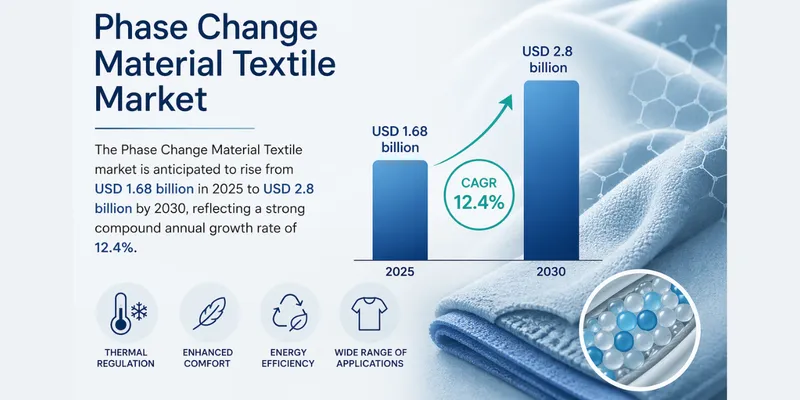
The Phase Change Material Textile market is anticipated to rise from USD 1.68 billion in 2025 to USD 2.8 billion by 2030, reflecting a strong compound annual growth rate of 12.4%. This growth is fueled by a growing use apparel, building materials, and defense modernization initiatives.
In terms of regional contributions, Asia-Pacific is projected to account for the total incremental growth, while Europe is expected to invest about USD 620 million in sustainable textile innovations Meanwhile, is set to maintain its leadership in defense-related applications and cutting-edge2026: USD 1.89 billion
• 2027: USD 2.10 billion
• 2028: USD 2.34 billion
• 2029: USD 2.56 billion
• 2030: USD 2.80 billion
Sustainability, Innovation, and Policy Support
The Phase Change Material Textile industry is increasingly aligned with global sustainability goals and energy efficiency mandates. Governments across Europe and Asia have allocated over USD 780 million between 2022 and 2025 to smart textile innovation programs.
Carbon reduction benefits of PCM fabrics are estimated at up to 22% per garment lifecycle, while building insulation applications deliver 18–26% energy savings. Additionally, recyclable PCM materials adoption has increased by 31% since 2022, reflecting a strong shift toward circular textile production.
Conclusion: Long-Term Structural Growth Toward USD 2.8 Billion Market
The global Phase Change Material Textile market demonstrates strong and sustained expansion, rising from USD 420 million in 2016 to USD 1.68 billion in 2025, and projected to reach USD 2.8 billion by 2030. With a stable 12.4% CAGR, increasing industrial penetration, and strong regional diversification, the Phase Change Material Textile industry is firmly positioned within the next generation of smart materials.
Supported by over USD 3 billion in cumulative investments, expanding applications in sportswear, healthcare, and defense, and continuous technological advancement, the Phase Change Material Textile market is expected to maintain strong double-digit growth through 2030 and beyond, reinforcing its role as a core pillar of advanced textile innovation.
Read A Full Report: https://marketintelo.com/report/phase-change-material-textile-market