Performance Review & Strategic Analysis: Santosh Fine Fab Ltd (2024-2025)

1. Introduction
The Indian textile industry is currently a meat grinder of volatility, where high raw material costs and shifting fashion cycles test even the most seasoned players. In this landscape, legacy micro-caps like Santosh Fine Fab Ltd (SFFL)—now over four decades into the game—face a steep climb. This isn't just about surviving the cycle; it's about whether a small, Mumbai-based firm can still command a premium in the crowded "Suitings" segment.
This report parses the 2025 financial disclosures to see if the business is actually stabilizing or just spinning its wheels. We are moving beyond the top-line numbers to evaluate the recovery trajectory.
Purpose of Analysis:
- Evaluate Stabilization: Determining if the 2025 revenue rebound translates to real operational health.
- Assess Leadership: Analyzing the impact of the Tulsiyan family's "skin-in-the-game" and recent re-appointments.
- Identify Operational Risks: Investigating the friction between reported profits and deteriorating working capital.
2. Company Overview
In a cyclical industry, a company’s roots often dictate its resilience. Santosh Fine Fab isn't a newcomer trying to find its footing; it is an established entity founded in 1981 with a manufacturing heart in Tarapur, Maharashtra. The business model is straightforward—manufacturing and trading fabrics under the "Santosh" brand—but the execution in a post-pandemic economy has been anything but simple.
As a listed entity on the BSE (Scrip: 530035), SFFL has maintained its presence in the Mumbai textile hub for 43 years. While its market cap sits at a modest ₹10.7 Cr, its longevity suggests an operational stubbornness common in family-led industrial firms. But is that stubbornness a virtue or a liability in a modern market?
The steering wheel, however, remains in the same hands that built the company, which brings us to the leadership.
3. Promoter / Founder Introduction
For a micro-cap like SFFL, promoter continuity is often the only thing preventing insolvency during lean years. The leadership remains firmly family-led, with Shri Santosh R. Tulsiyan (Chairman & Managing Director) and Shri Subhash R. Tulsiyan (Executive Director) at the helm. Both are commerce graduates with decades of "on-the-ground" experience in the textile trade.
What’s notable in the 2025 filing is their formal re-appointment for five-year terms effective October 2024. This signals management stability, but it also means the strategy won't be pivoting anytime soon. They are doubling down on their existing model.
This stability is finally starting to show up in the hard numbers, though a closer look at the balance sheet suggests we shouldn't celebrate just yet.
4. Financial Statement Analysis
Interpreting SFFL’s health requires looking past the 28% revenue jump. While the trend line is moving in the right direction, the company is effectively running to stand still.
Three-Year Financial Performance Summary (2023-2025)
Metric | 2025 (Cr) | 2024 (Cr) | 2023 (Cr) |
Revenue / Gross Income | 16.62 | 12.90 | 16.36 |
Net Profit / (Loss) | (0.0138) | (0.95) | (0.01) |
ROCE % | 5.83% | -6.26% | 4.48% |
Total Assets | 15.38 | 12.92 | 14.90 |
Note: Figures converted from Lacs to Crores for consistency.
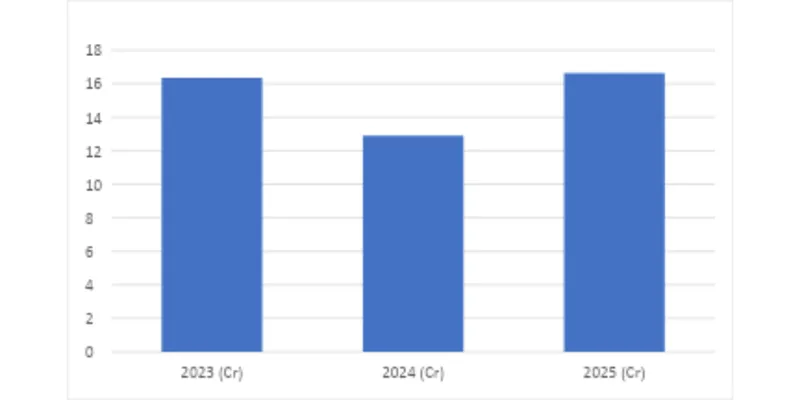
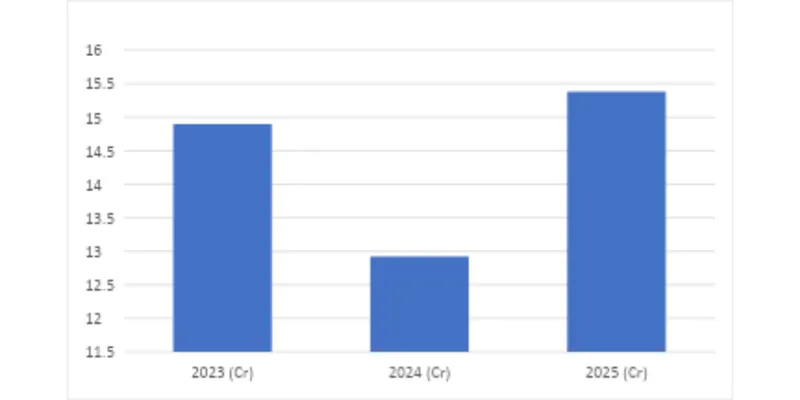
Looking at the Income Statement, revenue recovered to ₹16.62 Cr, nearly matching 2023 levels. But here’s the rub: finance charges of ₹0.60 Cr (₹59.72 Lacs) almost entirely wiped out the ₹0.80 Cr operating profit. The company is essentially working to pay its bankers.
The Balance Sheet reveals a deeper concern. While assets grew to ₹15.38 Cr, the Cash Flow statement shows a negative Cash Flow from Operations (CFO) of ₹1.42 Cr. Why? Because the money is tied up in the warehouse. Inventory days have ballooned to 347, and debtor days sit at 121.
5. Key Insights & Interpretation
The numbers tell a story of a business fighting for air. Revenue from "Job Work" for related parties like Silwester Tex Pvt Ltd (totaling ~₹40 Lacs) acts as a strategic volume filler, but it isn't a long-term growth engine.
Strengths: The "Santosh" brand still has pull, and the 5.83% ROCE is a massive improvement over last year’s disaster. Management is also getting granular with costs—monitoring the "electricity power factor" and utilization—which shows a desperate, necessary focus on efficiency. Interestingly, R&D isn't a separate budget line; it’s treated as "integral to manufacturing," a sign that innovation is purely functional here.
Weaknesses & Risks: The inventory overhang is a massive red flag. The 2025 "recovery" is a paper victory until those 347 days of stock are liquidated. Furthermore, the interest coverage is dangerously low. Post-reporting, the resignation of Company Secretary Niti Jain in March 2026 adds a minor administrative hurdle to an already stretched team.
Future Outlook: Zero dividends. Tight margins. High interest. This is the micro-cap reality. The recovery is fragile. If they can’t turn that unsold fabric into cash, the 2025 rebound will be short-lived.
6. Conclusion
Evaluating Santosh Fine Fab at the 2025 AGM is a study in contrasts. On one hand, the company has successfully clawed back to a near-breakeven point on a significantly higher revenue base. On the other, the warehouse is full of unsold fabric, and the cash is fleeing the building.
From a student-analyst perspective, this isn't a "turnaround story" yet—it's a survival story. The recovery looks good on an Excel sheet, but the liquidity profile remains anemic. SFFL isn't quite a "value trap" because the brand and the promoters are staying the course, but it’s a high-risk hold. Until management can prove they can convert sales into actual cash, this stabilization remains one bad quarter away from a reversal.
Data Source: Santosh Fine Fab Ltd. 43rd Annual Report (2024-2025) and Screener.in Financial Database.