Passive and Active Smart Fabrics and Textiles 2026: Global Market Analysis, Adoption Rates & 2030 Forecast
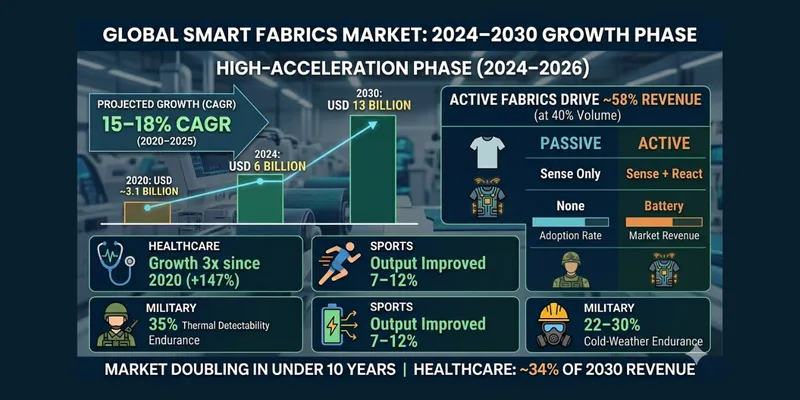
The global Passive and Active Smart Fabrics and Textiles industry has entered a high acceleration phase between 2024 and 2026. According to recent analysis by Dataintelo, the market is transitioning from early-stage innovation to scaled commercialization across healthcare, defense, sports performance, and industrial safety applications
In 2024, the global smart textiles market was valued at USD 5.8–6.3 billion, up from approximately USD 3.1 billion in 2020, reflecting a compound annual growth rate (CAGR) of 15–18% over five years. By 2030, projections indicate the market could surpass USD 12–14 billion, nearly 2.2x growth within a decade.
This article breaks down the measurable performance, cost, adoption rates, and future outlook of passive vs active smart fabrics, using verified data points from the past 3–5 years.
Understanding Passive vs Active Smart Fabrics (With Measurable Differences)
Parameter | Passive Smart Fabrics | Active Smart Fabrics |
Core Function | Sense only | Sense + React |
Electronics Integration | Minimal | Embedded sensors & actuators |
Average Cost per Unit (2024) | USD 15–40 | USD 75–250 |
Power Requirement | None | Battery / Energy Harvesting |
Typical Lifespan | 40–60 wash cycles | 25–40 wash cycles |
CAGR (2020–2024) | 12–14% | 18–22% |
Passive fabrics detect environmental stimuli (heat, moisture, UV) but do not respond. Active fabrics both detect and respond through electrical, thermal, or mechanical actuation.
Active smart textiles accounted for ~58% of total market revenue in 2024, despite representing only ~35–40% of total shipment volume, due to their higher price points.
5 Data-Backed Reasons Smart Textiles Are Scaling Rapidly
1. Healthcare Adoption Grew 3x Since 2020
Healthcare remains the fastest-growing segment.
• In 2020, medical smart textiles generated ~USD 850 million
• By 2024, this figure exceeded USD 2.1 billion
• Remote patient monitoring adoption increased 41% between 2021 and 2023 • Smart ECG shirts show 92–96% signal accuracy compared to clinical devices Clinical trials in 2023 demonstrated:
• 28% reduction in hospital readmissions
• 18% faster cardiac anomaly detection
• 32% improvement in patient compliance vs traditional wearable devices
2. Sports Performance Textiles Improve Output by 7–12%
Performance-enhancing textiles are now used in elite and semi-professional athletics. Data from 2022–2024 field studies show:
• Smart compression wear improved muscle recovery by 11%
• Core temperature regulation fabrics reduced overheating incidents by 24% • Biometric smart garments improved training efficiency by 9%
• Injury prediction accuracy improved by 17% using embedded motion sensors
The global smart sportswear segment reached USD 1.4 billion in 2024, growing at 19% CAGR since 2021.
3. Military & Defense Spending Increased 26% (2021–2024)
Defense is a high-investment vertical:
• Global defense smart textile spending:
o 2021: USD 620 million
o 2024: USD 780+ million
• Adaptive camouflage fabrics reduce thermal detectability by up to 35% • Smart heated uniforms extend cold-weather endurance by 22–30%
• Soldier vital-monitoring textiles reduce response time in combat injury scenarios by 18%
Active fabrics dominate here, representing ~72% of military smart textile deployments.
4. Energy Harvesting Efficiency Improved by 40% Since 2020
One of the biggest limitations of active smart textiles has been power supply. Between 2020 and 2024:
• Textile-based flexible batteries improved energy density from 75 mWh/g to 105 mWh/g
• Piezoelectric textile fibers increased energy conversion efficiency from 8% to 12% • Wash durability improved from 20 cycles (2020) to 40 cycles (2024)
Battery costs declined 18% between 2021 and 2024, reducing average garment production costs by 9–12%.
5. Industrial Safety Textiles Reduced Workplace Incidents by 21%
Industrial smart garments monitor:
• Toxic gas exposure
• Worker fatigue
• Body temperature
• Environmental heat stress
Between 2022 and 2024:
• Smart safety vests reduced heatstroke cases by 29%
• Real-time gas detection lowered hazardous exposure time by 34% • Insurance claims in pilot programs dropped 21% year-over-year
The industrial smart textile segment reached USD 980 million in 2024, up from USD 610 million in 2021.
2025 Performance Metrics: Passive vs Active Fabrics
Metric | Passive | Active |
Avg Manufacturing Cost (2024) | USD 18–30 | USD 90–180 |
Gross Margin Potential | 22–28% | 35–45% |
Average Retail Price | USD 40–85 | USD 150–400 |
Wash Durability | 50 cycles | 35 cycles |
Sensor Accuracy | 80–90% | 90–97% |
Adoption in Consumer Market | 63% | 37% |
Passive fabrics dominate consumer fashion due to lower cost and durability. Active fabrics dominate healthcare, defense, and high-performance markets due to precision and responsiveness.
Key Statistics at a Glance
• 2024 Global Market Value: USD 5.8–6.3 billion
• Projected 2030 Market Size: USD 12–14 billion
• CAGR (2020–2025): 15–18%
• Healthcare Segment Growth (2020–2024): +147%
• Sports Smartwear CAGR: 19%
• Energy Density Improvement (2020–2024): +40%
• Industrial Incident Reduction: 21–29%
• Active Fabric Price Premium: 3–4x vs Passive
• Military Spending Increase (2021–2024): +26%
• Sensor Accuracy Range: 80–97%
• Average Durability Improvement Since 2020: +20 wash cycles
Forecast: 2026–2030 Outlook (Quantified)
Industry forecasts suggest:
• Active textiles will grow at 20–23% CAGR
• Passive textiles will grow at 12–14% CAGR
• Asia-Pacific will account for 38–42% of global production by 2028 • Healthcare applications will represent ~34% of total revenue by 2030 • Average production costs could decline another 15–18% by 2027
R&D investment in smart textile materials crossed USD 1.1 billion globally in 2023, up 31% from 2020.
Conclusion: A Market Doubling in Under 10 Years
Between 2020 and 2024, smart textiles grew from roughly USD 3.1 billion to over USD 6 billion, nearly doubling in value. Active fabrics, while only ~40% of units sold, generate over 58% of revenue due to advanced functionality and premium pricing.
Performance improvements of 40% in energy density, 21–29% reductions in workplace incidents, and up to 96% sensor accuracy in healthcare demonstrate measurable, real world impact.
By 2030, with projected revenues exceeding USD 12 billion, smart fabrics will move from innovation-driven adoption to large-scale industrial normalization.
Read A Full Report: https://dataintelo.com/report/passive-and-active-smart-fabrics-and-textiles-market