Pasari Spinning Mills Limited (FY 2024-2025)

- Introduction
The Indian textile industry exhibits a contrast between robust economic growth and the difficulties faced by conventional manufacturing firms in FY 2024–2025. Even though the GDP of India is expected to increase by about 7%, many older textile companies still face operational and structural problems.
Global supply chain volatility, intensified by the Red Sea crisis, has fundamentally challenged the cost-competitiveness of traditional spinning units. In this climate, firms with high operational leverage and dated manufacturing footprints are being forced into radical business model pivots.
Pasari Spinning Mills Limited, currently convening its 34th Annual General Meeting, represents a definitive case study in distressed asset resolution. Long removed from its origins as a cotton yarn manufacturer, the company is navigating a terminal transition away from industrial production. This analysis evaluates the financial solvency and strategic viability of Pasari as it attempts to finalize its transformation into an asset-light, real-estate-yielding model with a speculative foray into the retail sector. The objective is to determine whether the company’s current "holding pattern" serves as a viable launchpad for new commercial ventures or merely a managed liquidation of legacy assets.
2. Company Overview
A corporation’s historical trajectory is the most reliable lead indicator of its future resilience. For entities facing structural industry decline, the transition from operational intensity to capital preservation is often the only path to avoiding total insolvency. Pasari’s history is characterized by an early recognition of manufacturing unviability.
Incorporated in 1991, the company initially focused on cotton yarn production at its Nanjangud unit. However, the management executed a total cessation of production in 2011, citing unfavorable power costs and labor volatility—a decision formally ratified by the Government of Karnataka in November 2011. Since then, the business model has shifted exclusively to the leasing of factory premises. While this transition effectively halted manufacturing losses, it has resulted in a stagnant revenue ceiling.
The company's corporate structure has also narrowed significantly; notably, its associate entity, T.K.R Textiles Private Limited, has been "struck off" by the Registrar of Companies. Furthermore, the company continues to navigate long-standing "distressed asset" hurdles, including its BIFR status and unresolved Sales Tax relief claims.
3. Promoter & Founder Introduction
"Promoter Skin-in-the-Game" is a crucial stand-in for business survival in the small-cap and micro-cap markets. It indicates a commitment to eventual recovery rather than an exit when management keeps a large personal stake in a stagnant organization.
Mr. Krishna Kumar Gupta, the managing director, and Mrs. Poonam Gupta, the non-executive director, serve as the foundation of the leadership. Their expertise in corporate governance and finance has been crucial to preserving the company's listed status during a ten-year period of no operations.
From an equity research perspective, the leadership’s most significant move is a sustained liquidity preservation tactic: the voluntary waiver of director remuneration. By forgoing salaries during this period of zero manufacturing turnover, the promoters have aligned their interests with minority shareholders, ensuring that the company’s thin operating cash flows are not consumed by executive overhead.
4. Analysing the Financial Statements
A company in a state of suspended animation is reflected in the FY 2024–2025 financials. The figures demonstrate that base-level asset maintenance and legal compliance are prioritised over any significant top-line growth.
Income Statement Analysis
The following table shows the marginal contraction in performance.
Particulars | FY 2024-25 (Rs. in 1000s) | FY 2023-24 (Rs. in 1000s) | % Change |
Total Income | 6,866.48 | 6,887.67 | -0.31% |
Total Expenses | 3,429.68 | 2,799.32 | +22.52% |
Net Profit | 3,604.77 | 4,253.42 | -15.25% |
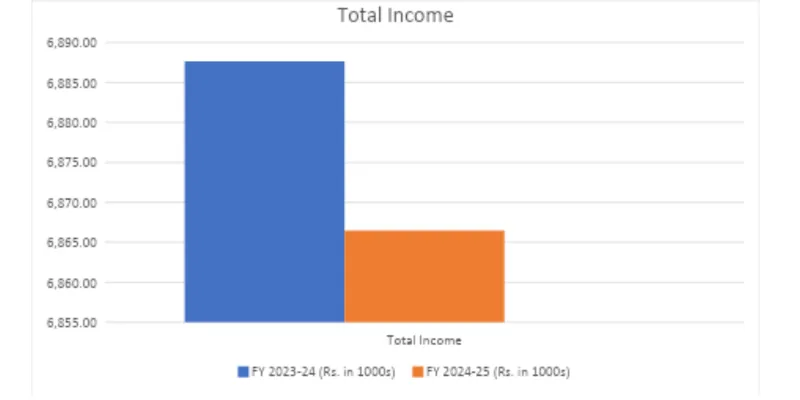
Interpretation: Net Profit decreased by more than 15% while rental yield revenue stayed essentially unchanged. This decline was driven by a 22.5% spike in expenses, specifically triggered by auditor-noted provisions for property tax (Rs. 15.87 lakhs) and increased legal outlays related to ongoing litigation. In a static-revenue model, these non-discretionary costs represent a significant threat to bottom-line stability.
Balance Sheet Analysis
The balance sheet reveals a condition of technical distress and extreme equity erosion.
Particulars | As at March 31, 2025 (Rs. in 1000s) |
Total Assets | 27,856.68 |
Equity Share Capital | 138,000.00 |
Reserves and Surplus (Negative) | (137,458.93) |
Non-Current Liabilities | 24,203.96 |
Interpretation: The company’s equity is almost entirely eroded. With Equity Capital of Rs. 13.8 Crores weighed against Negative Reserves of Rs. 13.74 Crores, the net worth is negligible. Pasari is technically operating on the edge of insolvency, sustained only by its lack of institutional bank debt and reliance on interest-free unsecured loans from related parties (e.g., Pasari Exports Limited).
Cash Flow Analysis
Cash and cash equivalents increased to Rs. 2,103.59 (in 1000s), indicating a positive net cash movement. Although net cash from operations reached Rs. 4,391.97 (in 1000s), its sustainability is in doubt because it was mainly used to pay off small amounts of unsecured debt and service financing costs.
Key Financial Ratios
Ratio | FY 2024-2025 | FY 2023-2024 |
Earnings Per Share (Basic) | 0.26 | 0.31 |
Current Ratio | 1.45 | 0.61 |
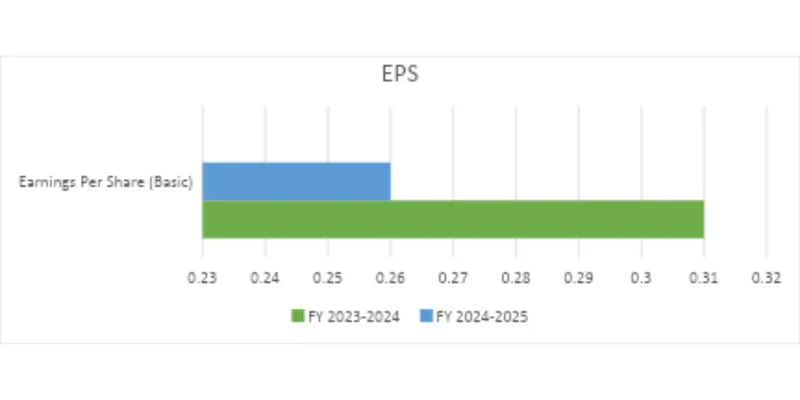
Analytical Interpretation: At first glance, the current ratio of 1.45 seems healthy. However, this does not constitute a "growth-ready capital base" for a non-manufacturing entity; rather, it is a static liquidity buffer intended to satisfy immediate legal and statutory obligations.
5. Crucial Perspectives & Analysis
To identify crucial governance and legal red flags, investors need to look past the condensed financial summaries.
- Corporate Governance Red Flag: Since Mr. Tarun Kumar Gupta, the Chief Financial Officer (CFO), did not sign the financial statements, there is a serious transparency risk. Even though the report mentions "medical conditions," a significant compliance irregularity is when a listed entity's financials lack a CFO's signature.
- Legal "Sword of Damocles": The litigation with the Cotton Corporation of India (CCI) remains the primary threat to the company's survival. The Bangalore District Court dismissed the company’s case in January 2020. Pasari is currently the appellant in the High Court, but the contingent liability stands at Rs. 639.22 lakhs—an amount that far exceeds the company’s current liquid assets.
- Tax Liabilities: The company has not paid property tax since the 2019-2020 fiscal year. While a provision of Rs. 15.87 lakhs has been made, these arrears represent a persistent drain on future cash flows.
- The Skeptical "Retail Pivot": Management has voiced intent to enter the "lucrative" retail industry. However, the Annual Report provides no concrete roadmap, capital expenditure plan, or target segment. Until such operational granularity is provided, this must be seen as purely speculative upside rather than a viable strategic plan.
6. Conclusion
The financial health of Pasari Spinning Mills Limited can be described as stable but stagnant, bordering on technical insolvency. Pasari has successfully avoided default to financial institutions by virtue of its debt-free institutional profile but continues to be weighed down by substantial historical liabilities and an apparent lack of operational traction.
Investment Perspective (2024-2025): Pasari is a "recovery play" only for highly speculative risk-takers.
The company is essentially a listed shell with real estate value and zero institutional debt. However, its future is contingent on two binary outcomes: the favorable resolution of the CCI litigation and the actualization of its retail pivot. Given the lack of a detailed roadmap for the latter and the prior dismissal of the former in district court, the stock remains a high-risk prospect with significant governance "overhangs."
Data Source: Pasari Spinning Mills Limited Annual Report 2024-2025.