OTTAVA Surgical Robot: 8 Key Supply Chain Opportunities for Precision Engineering and Medical Device Manufacturers
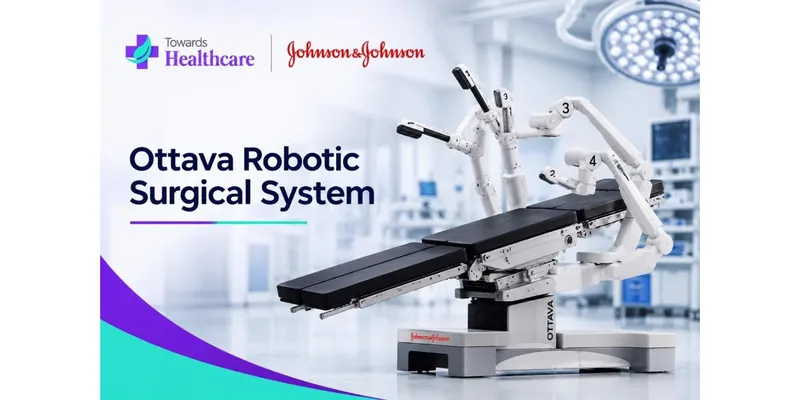
From robotic arms and surgical instruments to medical electronics and digital infrastructure, Johnson & Johnson's OTTAVA platform highlights emerging manufacturing opportunities in the surgical robotics industry, including potential participation by Indian suppliers.
The development of surgical robotics involves an interconnected supply chain spanning precision engineering, motion-control systems, sensors, medical electronics, imaging technologies and specialised surgical instruments. Johnson & Johnson's OTTAVA™ Robotic Surgical System provides an example of this integration, featuring four robotic arms incorporated directly into the operating table. Its design highlights potential opportunities for manufacturers across multiple technology and medical-device segments, including precision components, operating-room equipment and software integration.
OTTAVA: A Different Approach to Surgical Robot Design
Unlike conventional surgical robotic systems that use external robotic booms and carts, Johnson & Johnson's OTTAVA has been developed as a table-integrated soft-tissue surgical robotic platform. Its four robotic arms are built into the operating table, bringing patient positioning and robotic movement into a unified architecture.
According to Johnson & Johnson, the design occupies 30–50% less space than traditional boom- and cart-mounted robotic systems. The company has also highlighted automated arm positioning and synchronised movement between the operating table and robotic arms, a feature known as twin motion.
On July 22, 2026, the system received FDA De Novo marketing authorisation for specified upper-abdominal general surgery procedures. J&J subsequently announced plans for an initial U.S. commercial launch with selected customers.
The platform's architecture requires coordination between mechanical structures, actuators, sensors, electronic hardware, control systems and safety mechanisms. It also incorporates surgical instruments developed around J&J's Ethicon technology and connects with the company's Polyphonic digital ecosystem.
For manufacturers, OTTAVA offers a reference point for understanding the different technologies involved in developing an integrated surgical robotics platform.
8 Major Component Categories Creating Manufacturing Opportunities
Surgical robots combine interconnected mechanical, electronic and software systems. Each subsystem has distinct manufacturing requirements and technical specifications.
Component category | Function | Potential supplier opportunity |
|---|---|---|
Robotic arms and joints | Position and control surgical instruments | Precision engineering and machining |
Motors and actuators | Generate controlled mechanical movement | Motion-control component manufacturing |
Sensors and encoders | Measure position and movement | Sensor and electronics manufacturing |
Surgical instruments | Perform grasping, cutting and suturing | Medical instrument manufacturing |
Imaging components | Support surgical visualisation | Optical and imaging technology |
Electronic control units | Coordinate system functions | Medical electronics and PCB manufacturing |
Operating-table components | Support patient positioning and integrated robotic architecture | Medical furniture and mechanical engineering |
Software and connectivity | Coordinate operations and digital information | Medical software and data technology |
These categories represent broader technologies used across surgical robotic platforms. They should not be interpreted as a confirmed list of OTTAVA's external suppliers or individually disclosed component specifications.
1. Precision Engineering: Manufacturing the Robotic Arms and Joints
Robotic arms are among the most technically demanding components of a surgical robotics system. They must position surgical instruments accurately and maintain controlled movement during complex procedures.
OTTAVA's table-integrated configuration introduces additional engineering requirements. Its robotic mechanisms must function within the operating-table structure while maintaining patient positioning, clinical access and compatibility with operating-room workflows.
Potential manufacturing requirements include:
- Precision-machined metal components
- Structural supports and robotic arm housings
- Mechanical joints and linkages
- Custom brackets and mounting assemblies
- High-tolerance gears and transmission components
- Specialised fasteners and mechanical interfaces
Companies involved in precision machining for medical devices, aerospace and industrial automation may possess relevant manufacturing capabilities.
However, surgical robotics requires particular attention to dimensional accuracy, material selection, surface finishing, repeatability and production documentation.
For component manufacturers, maintaining consistent performance and quality across repeated production batches is an important requirement.
2. Motors and Actuators: Supporting Controlled Robotic Movement
Motors and actuators convert electronic commands into mechanical movement, making them essential to robotic surgical systems.
In platforms with multiple robotic arms, different joints and instruments must move in coordination. The system must respond consistently to control inputs while maintaining the required positioning accuracy.
This creates potential opportunities for manufacturers of:
- Electric motors: Compact motors designed for controlled movement in restricted mechanical spaces.
- Actuators: Components that convert electrical energy into linear or rotational movement.
- Gear systems: Precision gearboxes and transmission assemblies that support controlled motion.
- Motion-control assemblies: Integrated systems combining motors, drive electronics and mechanical transmission.
- Thermal management components: Parts designed to manage heat generated by electronic and mechanical systems.
For OTTAVA specifically, the exact motor and actuator suppliers and technical specifications have not been publicly disclosed in the cited company materials.
Nevertheless, these components represent important manufacturing categories across the surgical robotics industry. Companies with established motion-control expertise can explore this segment through engineering partnerships and component qualification programmes.
3. Sensors and Encoders: Supporting Movement Accuracy
Sensors provide information about the position, movement and operating conditions of robotic mechanisms. In surgical robotics, this information supports system control, movement coordination and safety monitoring.
Relevant component categories include:
- Position sensors
- Rotary and linear encoders
- Force and torque sensors
- Motion and orientation sensors
- Temperature sensors
- Electrical monitoring components
Encoders, for example, measure rotational or linear movement and provide feedback to motion-control systems.
Force and torque sensing can also be relevant to robotic instrument development. However, the specific sensing architecture used in OTTAVA should not be assumed without technical disclosure.
Electronics manufacturers can explore opportunities beyond individual sensor components by developing integrated sensor assemblies, signal-conditioning electronics and compact circuit boards for medical equipment.
Key manufacturing requirements include measurement reliability, electrical safety, environmental compatibility and consistent performance.
4. Surgical Instruments: A Specialised Medical Manufacturing Segment
Surgical instruments are critical to robotic-assisted procedures because they directly interact with tissue. These tools must support precise movements and functions such as grasping, cutting, dissection, suturing and tissue manipulation.
OTTAVA uses a portfolio of robotic surgical instruments based on J&J's Ethicon technology. The company has highlighted instruments including a two-in-one needle driver and monopolar curved scissors.
This demonstrates how established surgical instrument technology can be extended into robotic-assisted procedures.
Potential manufacturing areas include:
- Precision surgical jaws and tips
- Needle drivers and graspers
- Cutting and dissection instruments
- Instrument shafts and articulated mechanisms
- Electrosurgical instrument components
- Instrument handles and mechanical interfaces
- Sterile packaging and instrument accessories
Manufacturers entering this segment must address mechanical strength, surface quality, corrosion resistance, cleaning and sterilisation compatibility.
Robotic instruments must also be compatible with the mechanical and electronic interfaces of the relevant platform. Therefore, conventional surgical instrument manufacturing experience may provide a foundation, but robotic-specific design and qualification capabilities are also necessary.
5. Medical Electronics and Control Systems
Electronic hardware coordinates the mechanical components of a surgical robot and supports its overall operation.
The electronics supply chain includes printed circuit boards, embedded controllers, power-management components, communication interfaces and electrical connections.
Potential manufacturing opportunities include:
- Printed circuit boards (PCBs): Used in control units, sensor interfaces and other electronic subsystems.
- Embedded electronics: Hardware supporting real-time system functions and communication between components.
- Power management: Components that regulate and distribute electrical power across the system.
- Cable assemblies and connectors: Electrical connections designed for reliable operation and organised equipment integration.
- Electronic testing: Functional testing and inspection of circuit assemblies and electronic subsystems.
Medical electronics suppliers may also contribute to system-level integration, where multiple components must communicate and function within defined performance limits.
For companies entering this segment, reliability, traceability, electrical safety and documented manufacturing processes are important supplier qualification considerations.
6. Operating Tables and Integrated Mechanical Structures
OTTAVA's integration of four robotic arms into the operating table makes table engineering an important part of its overall architecture.
Traditional medical furniture manufacturers may not possess all the capabilities required for robotic integration. However, their experience in patient positioning, structural engineering and operating-room equipment can provide relevant expertise.
Potential manufacturing opportunities include:
- Precision table structures
- Motorised positioning mechanisms
- Structural metal fabrication
- Patient-support surfaces
- Mechanical locking systems
- Integrated mounting assemblies
- Cable management and equipment interfaces
Manufacturers must consider load-bearing performance, movement stability, cleaning requirements and compatibility with operating-room environments.
The integration of robotic arms with table movement also increases the importance of coordination between mechanical and software systems.
This creates a manufacturing intersection between medical furniture, precision engineering and advanced robotics.
7. Imaging and Visualisation Technologies
Imaging and visualisation systems play an important role in robotic-assisted surgery. Surgeons depend on visual information to observe the surgical field and guide instrument movements.
The broader imaging supply chain for surgical robotics includes:
- Surgical endoscopes
- High-resolution camera systems
- Optical components
- Image sensors
- Light sources
- Video processing hardware
- Display and monitor systems
Manufacturers with experience in medical imaging and optical engineering can explore opportunities in these areas.
Developing compact imaging components, reliable connections and technologies compatible with surgical platforms is particularly relevant.
However, imaging technologies must be evaluated within the complete surgical system. The availability of an advanced camera or image sensor does not automatically establish compatibility with a specific robotic platform.
8. Software, Connectivity and Digital Infrastructure
Surgical robotics increasingly combines physical equipment with software, connectivity and data-management technologies.
OTTAVA is connected to Johnson & Johnson's Polyphonic digital ecosystem. J&J describes this platform as bringing together surgical data, video, devices, learning resources and data-driven insights.
This extends the potential supplier landscape beyond physical component manufacturing.
Relevant technology segments include:
- Embedded software developers: Develop software supporting equipment functions and communication between hardware components.
- Medical software companies: Support clinical workflows, device integration and digital applications.
- Cybersecurity providers: Address access control, data protection and secure connectivity.
- Cloud and data infrastructure providers: Support the storage, processing and management of digital information where required.
- Video and imaging technology companies: Develop systems for surgical media capture and integration.
Medical software suppliers must also consider cybersecurity, software lifecycle controls, system validation and applicable medical-device regulatory requirements.
For technology companies, surgical robotics provides potential opportunities in the digital infrastructure supporting physical robotic systems.
Where Can Indian Manufacturers Participate?
India has an established manufacturing base across engineering, automotive components, electronics, medical devices and precision manufacturing.
Some of these capabilities may be transferable to surgical robotics, although entering the segment requires medical-device-specific quality systems, engineering validation and customer qualification.
The following areas offer potential points of participation:
Indian manufacturing capability | Potential surgical robotics application |
|---|---|
CNC machining | Robotic joints, housings and precision mechanical parts |
Automotive component manufacturing | Precision gears, shafts and mechanical assemblies |
Electronics manufacturing | Circuit boards, cable assemblies and control electronics |
Medical instrument manufacturing | Surgical tools and instrument components |
Medical furniture manufacturing | Operating-table structures and positioning components |
Software engineering | Embedded systems, connectivity and cybersecurity |
India's participation in surgical robotics need not be limited to manufacturing complete robotic systems. Component suppliers can contribute through specialised products and engineering services.
However, automotive or industrial certifications do not automatically qualify a manufacturer for medical-device supply contracts. Medical robotics customers require additional quality controls, documentation and product-specific validation.
What Do Surgical Robotics Companies Expect From Component Suppliers?
Surgical robotics platforms operate through closely integrated systems. A component failure can affect equipment performance, operating-room workflows and patient safety.
Consequently, supplier evaluation involves more than production capacity and pricing. Manufacturers must demonstrate technical capabilities, quality consistency and the ability to meet product-specific requirements.
Six important evaluation areas include:
1. Precision and repeatability
Mechanical and electronic components must meet defined specifications consistently across production batches.
2. Quality management
Suppliers should maintain documented manufacturing processes, inspection systems and corrective-action procedures. ISO 13485 may be relevant where the supplier's activities fall within its scope and the customer requires it.
3. Material and component traceability
Manufacturers need reliable records covering raw materials, components, production batches and relevant changes.
4. Product validation
Components must undergo testing appropriate to their intended functions, including mechanical, electrical, environmental and functional assessments.
5. Supply continuity
Robotic system manufacturers require suppliers capable of maintaining consistent production and managing potential supply disruptions.
6. Engineering collaboration
Suppliers may need to work closely with the original equipment manufacturer (OEM) during design development, prototyping, testing and production scale-up.
Companies offering engineering support alongside manufacturing may have additional opportunities to participate in product development and supply chain activities.
Challenges in Entering the Surgical Robotics Supply Chain
Despite the range of potential manufacturing opportunities, entering the surgical robotics industry involves significant technical and commercial requirements.
High precision requirements: Robotic components often require tight manufacturing tolerances and consistent performance. Manufacturers may need advanced machining equipment, metrology systems and specialised production processes.
Long qualification cycles: New component suppliers may have to complete engineering reviews, prototype testing, quality audits and product validation before receiving commercial orders.
High development investment: Precision machinery, specialised testing equipment, skilled engineers and quality infrastructure require capital investment.
Regulatory and quality expectations: Medical-device manufacturers must manage risks associated with product design, manufacturing and use. Their suppliers may therefore need to meet specific quality, documentation and traceability requirements.
Dependence on OEM specifications: Surgical robotic platforms use proprietary designs and interfaces. Components developed for one platform cannot automatically be assumed suitable for another.
Supply chain reliability: Shortages of specialised components can affect equipment production and servicing. Suppliers must demonstrate production stability and effective inventory and sourcing strategies.
What Should Investors and Manufacturers Monitor?
The commercial prospects surrounding OTTAVA will depend on its adoption, manufacturing scale and future product development. Several developments could help suppliers and investors assess the direction of the market.
- Commercial deployment: The number and pace of initial U.S. system installations.
- Procedure expansion: Additional clinical evidence and regulatory authorisations for new surgical indications.
- Instrument portfolio development: Introduction of additional robotic instruments and related accessories.
- Manufacturing scale-up: Changes in production capacity and supply chain requirements.
- Digital ecosystem development: New integrations and capabilities within the Polyphonic platform.
- Hospital adoption: Surgeon training, operating-room integration and hospital purchasing decisions.
These developments can help manufacturers assess where demand for specialised components may emerge. However, they should not be considered confirmation of specific supplier contracts or guaranteed procurement opportunities.
About Towards Healthcare Research & Consulting
Towards Healthcare Research & Consulting is a global strategy consulting firm with a presence in both Canada and India. The company provides customised solutions for the healthcare sector, helping business leaders address challenges and accelerate growth. Its areas of specialisation include advanced technological solutions, clinical research services and data analytics, with a focus on building partnerships that support innovation and deliver actionable insights.
References:
- https://www.linkedin.com/posts/ottava-roboticsurgery-surgicalrobotics-share-7506291740199411713-fSzb/
- https://www.towardshealthcare.com/insights/robotic-surgery-market-sizing