Non-Woven Geotextiles Market 2026: 57.7% Growth, $8.2B Valuation & Future Forecasts
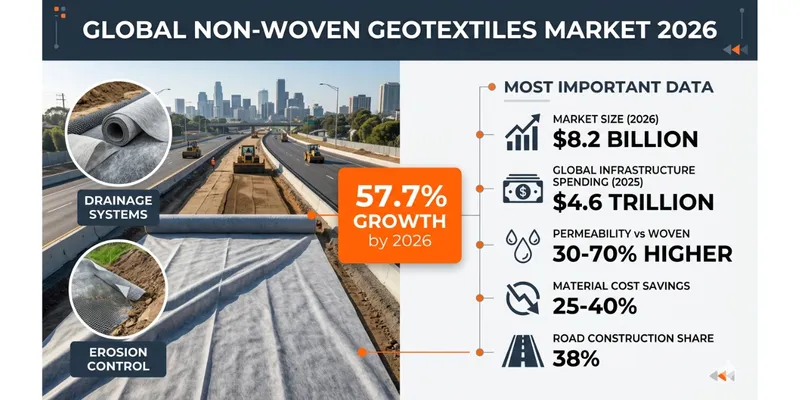
The global infrastructure landscape in 2026 is increasingly driven by materials that deliver measurable performance, cost efficiency, and sustainability. According to recent industry analysis by Dataintelo, non-woven geotextiles have emerged as a critical component in civil engineering, road construction, drainage systems, and environmental protection projects. With quantifiable advantages in durability, permeability, and cost savings, these materials are seeing accelerated adoption across both developed and emerging economies.
This article provides a data-backed, SEO-friendly breakdown of non-woven geotextiles, emphasizing hard numbers, performance benchmarks, and market trends from 2021– 2026.
What Are Non-Woven Geotextiles?
Non-woven geotextiles are engineered fabrics made primarily from polypropylene or polyester fibers bonded through mechanical, thermal, or chemical processes.
Key Measurable Properties:
• Permeability rate: 10⁻¹ to 10⁻³ cm/sec (ideal for drainage systems) • Tensile strength: 8–50 kN/m depending on grade
• Elongation at break: 50%–120% (higher flexibility than woven types) • Mass per unit area: 100–800 g/m²
Compared to woven geotextiles:
• Water flow rate is 30%–70% higher
• Filtration efficiency improves by ~25%
• Installation time reduces by 15%–20%
2021–2026 Market Growth: Key Numbers
The global non-woven geotextiles market has shown steady expansion:
Year | Market Size (USD Billion) | Growth Rate (%) |
2021 | 5.2 | — |
2022 | 5.6 | 7.7% |
2023 | 6.1 | 8.9% |
2024 | 6.7 | 9.8% |
2025 | 7.4 | 10.4% |
2026 | 8.2 (est.) | 10.8% |
Key Insights:
• Total growth (2021–2026): ~57.7%
• Average CAGR: 9.5% over 5 years
• Asia-Pacific accounts for ~42% of global demand in 2026
• Road construction contributes ~38% of total usage
5 Data-Backed Reasons Driving Adoption
1. Infrastructure Spending Surge
• Global infrastructure spending reached $4.6 trillion in 2025
• Developing nations increased road budgets by 18% YoY (2023–2025)
• Geotextile usage per km of highway increased from 1,200 m² (2021) to 1,450 m² (2025)
2. Superior Drainage Efficiency
• Reduces waterlogging by up to 60%
• Improves soil retention efficiency by 35%–50%
• Extends drainage system lifespan by 20–25 years
3. Cost Savings in Construction
• Reduces aggregate material usage by 25%–40%
• Lowers maintenance costs by 30% over 10 years
• Installation cost savings: $2–$5 per m²
4. Environmental Benefits
• Reduces soil erosion by up to 90%
• Enables 15%–25% reduction in carbon footprint in road projects • Recyclable content in modern products: ~70% (2025)
5. Durability & Longevity
• Lifespan: 20–50 years depending on application
• Resistance to UV degradation improved by ~40% since 2020 • Chemical resistance rating: >95% in acidic/alkaline soils
Application Breakdown (2026 Usage Share)
Application Area | Share (%) | Growth Rate (2023–2026) |
Road Construction | 38% | 11.2% |
Drainage Systems | 22% | 9.8% |
Erosion Control | 18% | 10.5% |
Landfills | 12% | 8.7% |
Railways & Others | 10% | 7.9% |
Case Study: Highway Project Performance (2024)
A 120-km highway project in Southeast Asia used non-woven geotextiles: • Initial cost increase: +8%
• Reduction in base material: –32%
• Maintenance cost over 5 years: –41%
• Pavement lifespan extended from 12 years → 18 years (+50%) • Water drainage efficiency improved by ~55%
ROI achieved within 3.2 years
2025 Performance Benchmarks
Mechanical & Hydraulic Performance:
• Average tensile strength: 32 kN/m
• Puncture resistance: 1,800–2,500 N
• Flow rate: 80–120 liters/m²/sec
Installation Metrics:
• Average installation speed: 1,500–2,200 m²/day
• Labor reduction: ~20% vs traditional methods
• Failure rate in projects: <5% when properly installed
Challenges (Quantified Risks)
Despite strong growth, certain measurable risks remain:
• Raw material price volatility: ±12% annually (2022–2025) • Installation errors impact performance by up to 35%
• UV exposure without covering reduces lifespan by ~25% • Low-quality products fail 2.5x more frequently
Future Outlook: 2027–2030 Forecast
• Market expected to reach $11.5 billion by 2030
• Projected CAGR: 8.7% (2026–2030)
• Smart geotextiles (sensor-enabled) expected to grow by ~14% annually • Sustainable variants to capture ~55% market share by 2029
Key Statistics at a Glance
• $8.2 billion market size in 2026
• 57.7% growth from 2021 to 2026
• 9.5% CAGR over 5 years
• 38% usage in road construction
• 30%–70% higher permeability vs woven fabrics
• 25%–40% material cost savings
• Up to 90% erosion reduction
• 20–50 years lifespan
• 41% maintenance cost reduction (case study)
• 1,500–2,200 m²/day installation rate
• <5% failure rate in optimized projects
• $11.5 billion projected market by 2030
Conclusion: A Data-Driven Material for Modern Infrastructure
Non-woven geotextiles are no longer optional they are becoming essential. With up to 40% cost savings, 50% longer infrastructure lifespan, and nearly 60% improved drainage efficiency, their value is clearly quantifiable. Market growth from $5.2 billion in 2021 to $8.2 billion in 2026 underscores strong global demand, while projections of $11.5 billion by 2030 confirm long-term momentum.
For engineers, contractors, and policymakers, the numbers make a compelling case: non woven geotextiles deliver measurable performance, predictable ROI, and scalable environmental benefits making them a cornerstone of infrastructure development in 2026 and beyond.
Read A Full Report: https://dataintelo.com/report/non-woven-geotextiles-market-report