Non-Food Bank Credit Growth Reaches 14.4% Year-on-Year in January 2026
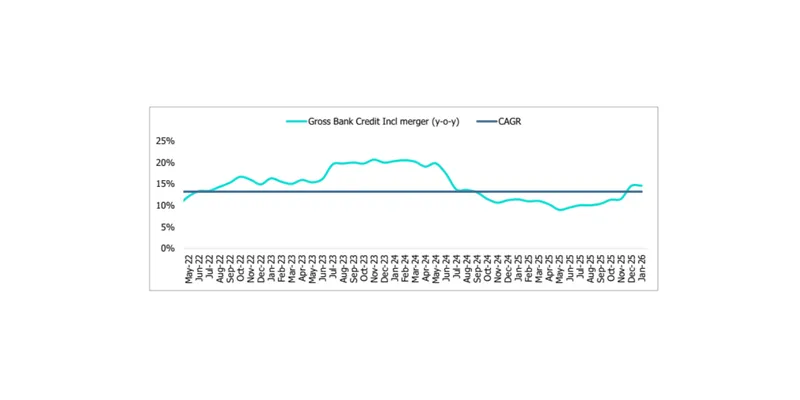
Bank credit growth strengthened in January 2026, with non-food credit expanding at a faster pace compared with the previous year. Lending growth was broad-based across several sectors, supported by increases in personal loans, services, and industrial credit. Data also reflects adjustments linked to the revised reporting framework under the Banking Laws (Amendment) Act, 2025.
Bank credit expansion accelerated in January 2026, with non-food bank credit rising by 14.4% year-on-year (y-o-y) compared with 11.3% in January 2025, while remaining similar to the level recorded in December 2025. The increase was observed across multiple sectors, led by personal loans, particularly vehicle loans, and supported by continued lending to services and industry.
Gold loans recorded strong growth, rising 128.8% y-o-y, reflecting increased demand for collateral-backed borrowing. Part of the increase in credit growth also reflects the revised fortnightly reporting framework introduced under the Banking Laws (Amendment) Act, 2025, which changed the definition of a fortnight from alternate Fridays to the 15th and the last calendar day of a month, effective December 15, 2025.
Industrial Credit
Credit to industry increased by 12.1% y-o-y in January 2026, compared with 7.1% a year earlier. The growth was supported by higher credit offtake across several sectors including mining and quarrying, beverages and tobacco, textiles, leather and leather products, wood and wood products, petroleum and coal products, engineering goods, chemicals, automotive components and transport equipment, cement, construction, infrastructure, gems and jewellery, and glass and glassware.
However, lending momentum was uneven across industries. Credit growth moderated in sectors such as food processing, paper and paper products, rubber and plastics, and basic metals, indicating mixed sectoral performance.
Micro, small and medium enterprises (MSMEs) continued to contribute significantly to industrial credit growth. The share of large industries in total industrial credit declined to 66.8% in January 2026 from 71.0% a year earlier, while the share of micro and small enterprises increased from 20.1% to 26.3% over the same period.
Policy measures also supported MSME lending. The Union Budget 2025–26 raised MSME investment and turnover limits and increased the guaranteed coverage ceiling from Rs 5 crore to Rs 10 crore, effective April 1, 2025.
Infrastructure Credit
Infrastructure lending, which accounts for over one-third of total industrial credit, expanded by 6.4% y-o-y in January 2026. Growth was largely driven by the power sector, which holds a 55.3% share within infrastructure credit, with growth increasing to 17.5% from 4.6% a year earlier.
Credit to ports grew by 49.3%, while lending to the road sector moderated to 0.2% from 2.3% last year. Credit to railways, airports, and telecommunications declined, partly offsetting gains in other infrastructure segments.
Services Sector
Credit to the services sector increased by 15.5% y-o-y in January 2026, compared with 12.3% a year earlier. Growth was driven by increased lending to trade, tourism, hotels and restaurants, shipping, aviation, and non-banking financial companies (NBFCs).
Outstanding bank credit to NBFCs rose to Rs 19.0 lakh crore, accounting for 9.3% of total bank credit, with growth accelerating to 17.8% y-o-y, compared with 8.2% a year earlier.
Credit to the trade sector also expanded, reaching Rs 13.1 lakh crore, with growth of 16.1% y-o-y, compared with 14.5% in January 2025.
Personal Loans
Personal loans, which account for nearly one-third of total bank credit, grew 14.9% y-o-y in January 2026, up from 11.9% a year earlier. The increase was primarily driven by the expansion in gold-backed loans.
Across key retail loan categories:
- Mortgage loan growth remained steady at 11.1% y-o-y.
- Vehicle loan growth increased to 17.1% y-o-y, compared with 9.7% a year earlier.
- Credit card outstanding grew 1.5% y-o-y, significantly lower than 13.0% in January 2025.
- Other unsecured personal loans stood at Rs 17.1 lakh crore, with growth of 11.3% y-o-y.
Agricultural Credit
After adjusting for the reclassification of agri-gold loans, credit to agriculture and allied sectors is estimated to have grown around 12.7% y-o-y in January 2026, compared with 12.2% in January 2025. This adjusted growth is approximately 140 basis points higher than the initially reported 11.4%.
External Factors
The report notes that heightened tensions in the Middle East remain a potential external risk. Given India’s reliance on crude oil imports, sustained increases in oil prices could affect liquidity and funding conditions. Energy-dependent sectors such as transport, aviation, logistics, chemicals, cement, and manufacturing may require higher working capital, potentially increasing credit utilisation.
At the same time, higher fuel costs could affect household spending and demand across certain retail segments. If oil prices stabilise, the impact on banks may remain limited, while prolonged disruptions could moderate overall credit growth.