Nitrile Gloves in Medical Textiles: Materials, Manufacturing and Performance
Overview
Nitrile gloves have become an important part of modern medical and protective textiles. They are widely used in hospitals, laboratories, dental clinics, pharmaceutical facilities and other environments where hand protection and contamination control are essential.
Unlike natural rubber latex, nitrile is a synthetic material that combines flexibility, chemical resistance and puncture resistance. These properties make nitrile gloves suitable for applications where both protection and comfortable handling are required.
What Are Nitrile Gloves Made Of?
Nitrile gloves are produced from nitrile butadiene rubber (NBR), a synthetic elastomer made from butadiene and acrylonitrile.
The acrylonitrile content influences properties such as chemical resistance, while the butadiene component contributes to flexibility and elasticity. Manufacturers can adjust the formulation depending on the intended application.
Unlike latex gloves, nitrile gloves do not rely on natural rubber proteins, making them an alternative for users who need to avoid latex exposure.
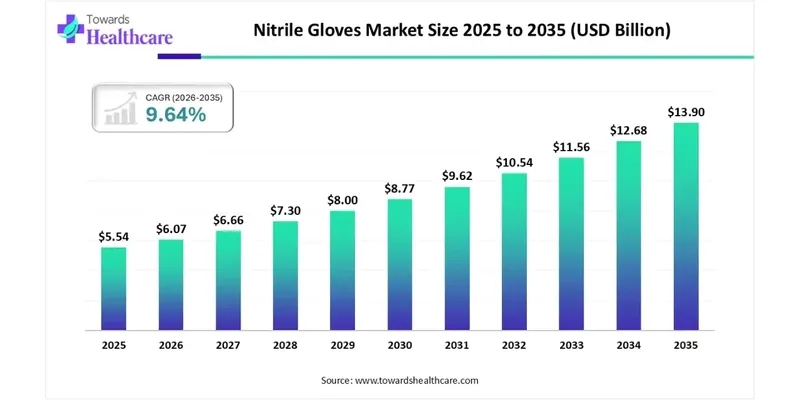
According to Towards Healthcare Research and Consulting, the global nitrile gloves market size is calculated at USD 5.54 billion in 2025, grew to USD 6.07 billion in 2026, and is projected to reach around USD 13.9 billion by 2035. The market is expanding at a CAGR of 9.64% between 2026 and 2035.
How Are Nitrile Gloves Manufactured?
The manufacturing process generally begins with preparing and mixing the NBR latex with additives that provide the required strength, elasticity, curing and stability.
Glove-shaped formers are then dipped into the prepared compound. Multiple dipping and treatment stages can be used to achieve the desired thickness and performance.
After dipping, the gloves undergo leaching, curing and drying. Leaching helps remove residual chemicals and soluble materials, while curing develops the final mechanical properties of the rubber.
The finished gloves may then receive surface treatments such as chlorination or polymer coating. These treatments can improve donning, reduce tackiness and provide a smoother surface.
Key Performance Characteristics
The performance of nitrile gloves depends on material formulation, thickness and manufacturing quality.
Chemical Resistance: Nitrile can provide resistance to many oils, solvents and chemicals, although performance varies by chemical and exposure conditions.
Puncture Resistance: Nitrile gloves generally provide good resistance to punctures and tears, which is important during clinical and laboratory work.
Flexibility and Fit: Proper formulation and manufacturing can provide sufficient elasticity for tasks requiring fine hand movements.
Barrier Protection: Glove integrity is important for reducing contact between the user's skin and potentially hazardous substances or contaminants.
Role in Medical Textiles
Medical textiles include materials designed for healthcare, hygiene, protection and clinical applications. Nitrile gloves fit into this category as protective medical products where material performance directly affects safety and usability.
Their applications extend beyond hospitals. Dental procedures, pharmaceutical manufacturing, laboratory research, food handling and industrial environments can also require disposable nitrile gloves.
For medical textile manufacturers, factors such as material consistency, thickness uniformity, tensile strength, elongation, barrier performance and defect control are important during production.
Advantages and Limitations
Nitrile gloves offer several advantages, including latex-free composition, good puncture resistance, chemical resistance and a comfortable fit when properly designed.
However, they are not suitable for every chemical or application. Their performance can vary depending on formulation, thickness, exposure time and environmental conditions. Manufacturing also requires careful control of raw materials, curing conditions and quality inspection. Pinholes, tears and inconsistent thickness can affect barrier performance.
Manufacturing Challenges and Opportunities
Nitrile glove production faces challenges related to raw material quality, energy consumption, wastewater management, production consistency and waste generation.
Automation and process monitoring can help manufacturers improve consistency and identify defects during production. Advances in material formulation can also support thinner gloves without unnecessarily compromising performance.
Another area of development is sustainable manufacturing. Manufacturers are exploring ways to reduce material waste, improve production efficiency and manage the environmental impact associated with disposable protective products.
The Road Ahead
Nitrile gloves demonstrate how material science and textile manufacturing come together to create products designed for protection, comfort and performance.
As healthcare and laboratory applications continue to demand reliable protective products, developments in NBR formulations, manufacturing automation, quality control and sustainable production will remain important.
The future of nitrile gloves is therefore not only about producing more gloves, but about developing materials and manufacturing processes that deliver consistent performance while improving efficiency and environmental responsibility.
About Author

Payal Rabde is a Healthcare Market Research Analyst at Towards Healthcare Research & Consulting with over 4+ years of experience in pharmaceutical, biotechnology, medical device, and healthcare market research. She holds an MBA in Pharmaceutical- Biotechnology Management and a B.Pharm, specializing in market analysis, forecasting, competitive intelligence, and strategic healthcare insights.
About Towards Healthcare Research and Consulting
Towards Healthcare Research & Consulting is a global strategy consulting firm with a
presence in both Canada and India. We provide innovative solutions customized to the
healthcare sector, helping business leaders overcome challenges and accelerate
growth. We specialize in delivering advanced technological solutions, clinical research
services, and powerful data analytics. Our focus is on building meaningful partnerships
that foster innovation and deliver actionable insights to drive success in healthcare.
References:
https://pmc.ncbi.nlm.nih.gov/articles/PMC11527158/
https://www.towardshealthcare.com/insights/nitrile-gloves-market-sizing
https://www.towardshealthcare.com/insights/medical-waste-management-market-sizing