Nikhil Kamath Examines Battery Technologies Shaping India’s Next Manufacturing Wave
Sodium-Ion and Alternative Battery Chemistries Emerge as India Weighs Energy Security and Domestic Manufacturing
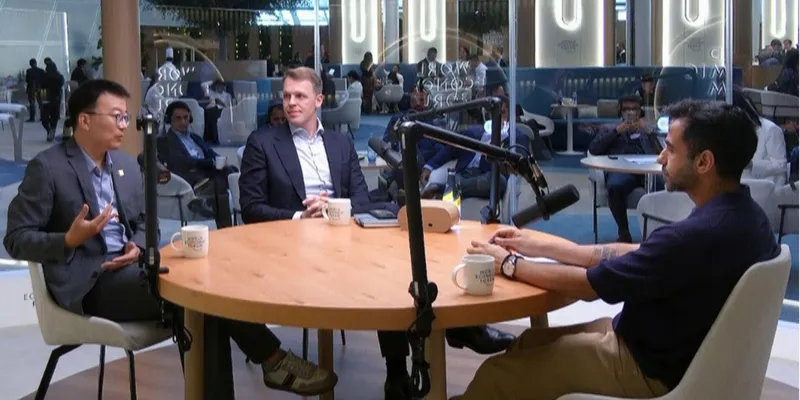
In the latest episode of People by WTF, Nikhil Kamath, who has been investing in energy-transition companies through his private-equity fund, speaks with Henning Rath, CEO of EnerVenue, and Kun Tang, Executive Chairman of HiNa Battery. The discussion examines battery technologies, manufacturing, industrial policy, AI infrastructure and the economics of establishing a battery company in India.
The conversation begins with concerns around lithium-ion battery safety and the question of whether alternative technologies could offer different advantages.
Battery Safety and LFP Chemistry
Lithium-iron-phosphate (LFP) batteries are currently used widely in electric vehicles, including many Tesla and BYD vehicles. During the discussion, Rath explains the phenomenon of “thermal runaway”, in which a battery reaching a certain temperature triggers an internal reaction that becomes self-accelerating and cannot be stopped.
Tang says that more than 14,000 LFP battery fires were recorded globally in 2025. He also points to differences in manufacturing quality, noting that safety incidents are concentrated heavily among smaller, tier-two Chinese manufacturers.
“The higher the energy, the more safety issues,” Tang says. “The energy is like water in a pump, but the tube is thin. That's easy to break.”
The discussion also highlights the production quality associated with leading manufacturers such as CATL and BYD, which charge a premium in part because of tighter production quality.
Sodium-Ion Batteries as an Alternative
The conversation then turns to battery technologies beyond lithium. Tang’s company has supplied what it describes as the world’s first 100-megawatt-hour sodium-ion storage project.
According to Tang, sodium costs roughly a tenth of lithium and, at current energy densities, resists thermal runaway. Sodium-ion batteries can also use materials such as sodium, iron and phosphate that can be sourced domestically in many countries.
The main trade-off is energy density. Current sodium-ion technology is therefore more suited to grid storage and short-range vehicles such as scooters and three-wheelers rather than long-range cars.
EnerVenue’s Nickel-Based Technology
Rath outlines another approach through EnerVenue, which uses a nickel-based, water-electrolyte battery adapted from technology once used by NASA.
The technology is designed to reduce fire risk by removing higher-risk components associated with thermal runaway. It is rated for 30,000 charge cycles and is currently intended for stationary storage rather than vehicles.
Both Rath and Tang remain cautious about the commercial readiness of solid-state batteries, which are often described as a successor to lithium-ion technology. Referring to an industry readiness scale of one to nine, Tang places solid-state technology at around level four, describing it as strong in research papers but still distant from commercial production.
Electrification, Manufacturing and AI
Looking ahead, Rath identifies three converging “super cycles”: electrification, manufacturing and AI. He argues that these areas are developing faster than supply capacity and that countries seeking to compete will require greater energy independence.
The discussion also addresses dependence on imported lithium and rare earths, with Rath expecting competition around these resources to increase as globalisation gives way to regional blocs.
Rath points to 2023 as the year when renewable power combined with batteries became cheaper than fossil fuels across much of the world. He expects AI data centres to further accelerate this transition as they move away from diesel backup power towards battery storage.
Should India Build a Battery or Electric Car Company?
The discussion takes a direct turn towards India as Kamath considers entering the energy-transition sector.
“After my trip in China, I want to go back to India and start a business,” Kamath says, asking whether he should build an electric car company or a battery company.
Rath advises against entering the car business and instead recommends building a battery company that is decoupled from lithium and rare earths. He identifies India’s scooter and three-wheeler market as a potential first customer base for sodium-ion technology.
The two also discuss BYD’s development from a phone-battery manufacturer into a vertically integrated electric vehicle and battery company within roughly a decade. Rath describes China’s approach as a “government venture capital” model, in which funding is provided to numerous companies in a sector, with only some ultimately surviving and becoming dominant players such as BYD and CATL.
China, AI and Changing Attitudes Towards Technology
The episode also explores China’s relationship with artificial intelligence. Both guests describe an environment driven more by curiosity than anxiety.
Tang illustrates this through three generations of his own family, from his 90-year-old grandfather ordering food through drone delivery to his six-year-old daughter.
“The excitement is outpacing the anxiety,” Rath says, contrasting this with the mood he encounters in the United States.
Different Chemistries for Different Applications
The discussion concludes with the idea that battery development is unlikely to be driven by a single chemistry or technology.
“No single technology will solve our problem,” Tang says. “We need more different chemistry to meet different demands.”
The episode examines battery development through safety, charge cycles, energy density, manufacturing requirements and cost, while considering how different technologies could serve different applications.
The episode is available now on YouTube.