New PBS Bioplastics for Industrial Use at K 2025
Bioplastics have been a key focus in the search for sustainable alternatives to conventional plastics for years. They help cut dependence on fossil resources, save raw materials, and lower CO₂ emissions. For industrial adoption, however, these bioplastics must be not only eco-friendly but also easily processable. This is the challenge the Fraunhofer Institute for Applied Polymer Research IAP, located at Potsdam Science Park, is addressing. The institute will showcase its advancements in bio-based and biodegradable plastics at K 2025, the leading international trade fair for plastics and rubber.
Under the RUBIO project (Regional Entrepreneurial Alliance for the Development of Value Chains for Technical Bioplastics in Central Germany), researchers have successfully developed, produced, and pilot-scale processed about 20 new types of polybutylene succinate (PBS). Derived from plant-based residues, these PBS variants are versatile and suitable for multiple processing methods, including injection molding, deep drawing, extrusion, and spinning. They can be used across a wide range of sectors, such as packaging, consumer goods, and textiles.
Scaling Up from Lab to Production
Fraunhofer IAP researchers have scaled PBS synthesis from laboratory scale to 100-kg production scale, producing approximately three tons of PBS to date. By adjusting synthesis parameters, they created various PBS grades tailored for specific applications. Three PBS variants with distinct flow properties were developed for injection molding. Other grades are suitable for blow molding, thermoforming, blown and flat film extrusion, melt-blown processes, and spunbonded nonwovens.
The polymer structure is crucial for processing performance — the molecular chains must be arranged according to the chosen manufacturing method. The team successfully created both fully linear and selectively branched PBS structures, each optimized for its processing route. Furthermore, the melt stability of the material was enhanced to withstand temperatures exceeding 200°C, making it well-suited for industrial use.
Proven Industrial Performance
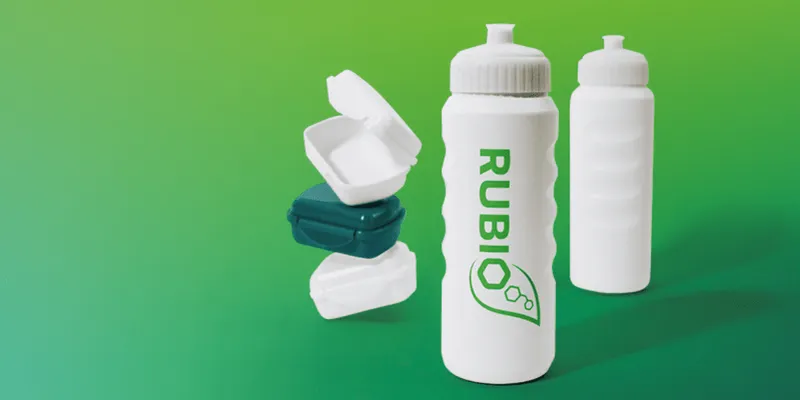
In collaboration with partners such as Sauer GmbH & Co. KG and Gramß GmbH Kunststoffverarbeitung, Fraunhofer IAP developed the first market-ready PBS products — a sports water bottle and its cap — using blow molding and injection molding techniques. These PBS types were tested on standard industrial equipment, confirming they can be processed efficiently, consistently, and with excellent mechanical properties.
Looking Ahead
Dr. Jens Balko, Head of the Processing Pilot Plant for Biopolymers Schwarzheide, said:
“As a bio-based and recyclable material, PBS will be a real game changer on the bioplastics market in the near future and will play a decisive role in the circular economy of plastics. Thanks to its appealing feel and soft to medium hardness, PBS is a genuine alternative for products that still use polyethylene today.”
PBS production uses plant-based residuals, though the process for extracting succinic acid — a key precursor — still needs further refinement and collaboration with partners.
Meet Fraunhofer IAP at K 2025
From October 8–15, 2025, Fraunhofer IAP will display PBS-based exhibits that demonstrate various industrial processing techniques at the joint Fraunhofer booth in Hall 7, Stand SC05.